

Appendix
299
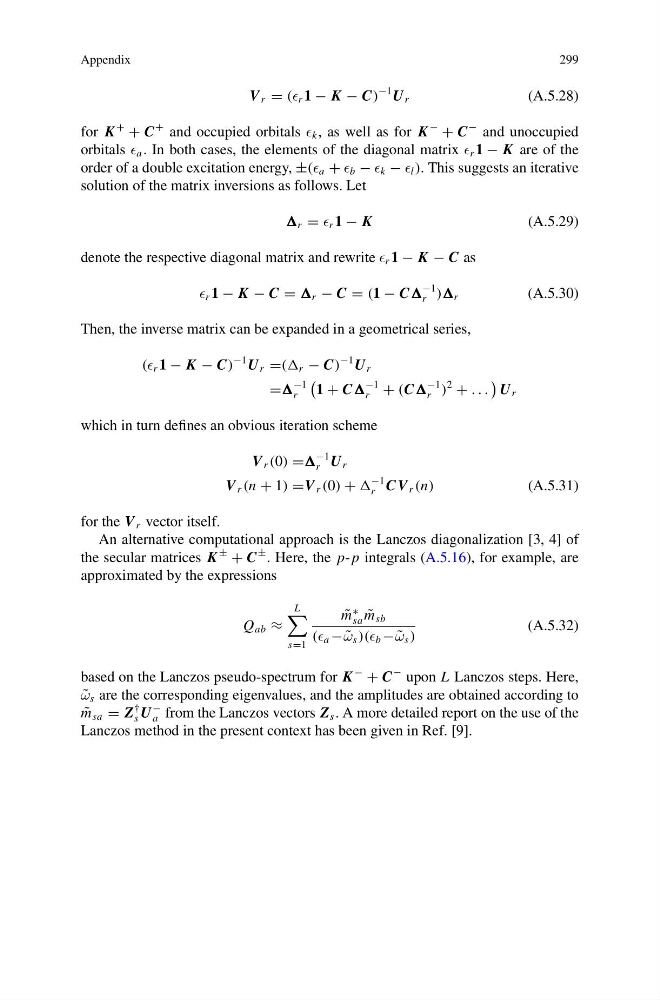
V r = ( r 1 − K − C)
−1 U r
(A.5.28)
for K
+
+ C
+ and occupied orbitals k , as well as for K
−
+ C
− and unoccupied
orbitals a . In both cases, the elements of the diagonal matrix r 1 − K are of the
order of a double excitation energy, ±( a + b − k − l ). This suggests an iterative
solution of the matrix inversions as follows. Let
r = r 1 − K
(A.5.29)
denote the respective diagonal matrix and rewrite r 1 − K − C as
r 1 − K − C = r − C = (1 − C
−1
r ) r
(A.5.30)
Then, the inverse matrix can be expanded in a geometrical series,
( r 1 − K − C)
−1 U r =(( r − C)
−1 U r
=
−1
r
1 + C
−1
r + (C
−1
r )
2
+ . . .
U r
which in turn defines an obvious iteration scheme
V r (0) =
−1
r U r
V r (n + 1) =V r (0) +
−1
r C V r (n)
(A.5.31)
for the V r vector itself.
An alternative computational approach is the Lanczos diagonalization [3, 4] of
the secular matrices K
±
+ C
± . Here, the p- p integrals (A.5.16), for example, are
approximated by the expressions
Q ab ≈
L
s=1
˜
m
∗
sa ˜
m sb
( a − ˜
ω s )( b − ˜
ω s )
(A.5.32)
based on the Lanczos pseudo-spectrum for K
−
+ C
− upon L Lanczos steps. Here,
˜
ω s are the corresponding eigenvalues, and the amplitudes are obtained according to
˜
m sa = Z
†
s U
−
a from the Lanczos vectors Z s . A more detailed report on the use of the
Lanczos method in the present context has been given in Ref. [9].
299
V r = ( r 1 − K − C)
−1 U r
(A.5.28)
for K
+
+ C
+ and occupied orbitals k , as well as for K
−
+ C
− and unoccupied
orbitals a . In both cases, the elements of the diagonal matrix r 1 − K are of the
order of a double excitation energy, ±( a + b − k − l ). This suggests an iterative
solution of the matrix inversions as follows. Let
r = r 1 − K
(A.5.29)
denote the respective diagonal matrix and rewrite r 1 − K − C as
r 1 − K − C = r − C = (1 − C
−1
r ) r
(A.5.30)
Then, the inverse matrix can be expanded in a geometrical series,
( r 1 − K − C)
−1 U r =(( r − C)
−1 U r
=
−1
r
1 + C
−1
r + (C
−1
r )
2
+ . . .
U r
which in turn defines an obvious iteration scheme
V r (0) =
−1
r U r
V r (n + 1) =V r (0) +
−1
r C V r (n)
(A.5.31)
for the V r vector itself.
An alternative computational approach is the Lanczos diagonalization [3, 4] of
the secular matrices K
±
+ C
± . Here, the p- p integrals (A.5.16), for example, are
approximated by the expressions
Q ab ≈
L
s=1
˜
m
∗
sa ˜
m sb
( a − ˜
ω s )( b − ˜
ω s )
(A.5.32)
based on the Lanczos pseudo-spectrum for K
−
+ C
− upon L Lanczos steps. Here,
˜
ω s are the corresponding eigenvalues, and the amplitudes are obtained according to
˜
m sa = Z
†
s U
−
a from the Lanczos vectors Z s . A more detailed report on the use of the
Lanczos method in the present context has been given in Ref. [9].