

290
Appendix
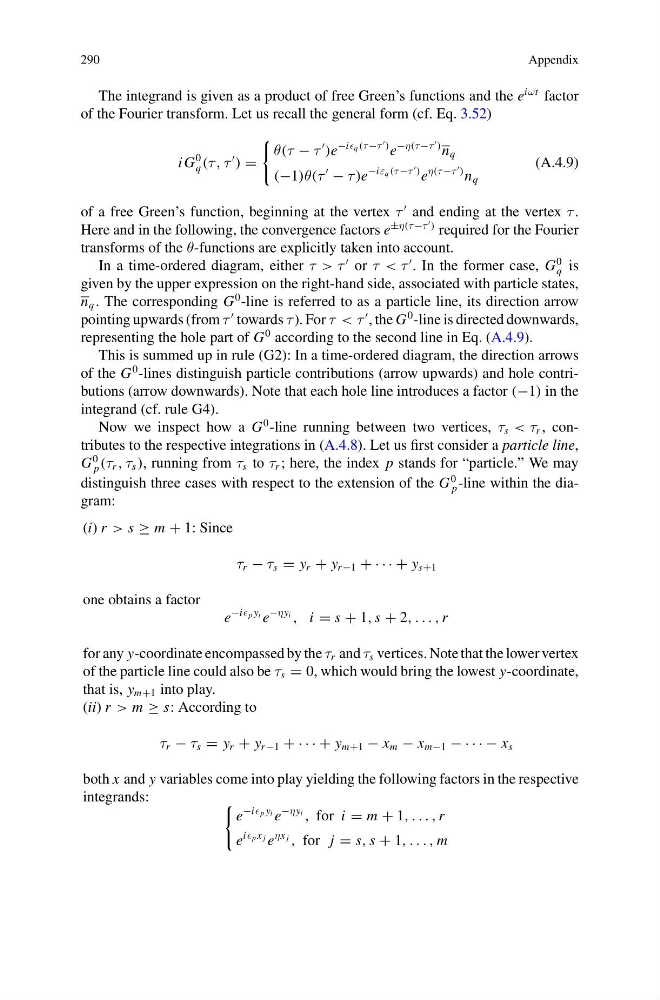
The integrand is given as a product of free Green’s functions and the e
iωt factor
of the Fourier transform. Let us recall the general form (cf. Eq. 3.52)
i G
0
q (τ , τ
) =
θ(τ − τ
)e
−i q (τ −τ
) e
−η(τ −τ
) n q
(−1)θ(τ
− τ )e
−iε q (τ −τ
) e
η(τ −τ
) n q
(A.4.9)
of a free Green’s function, beginning at the vertex τ
and ending at the vertex τ .
Here and in the following, the convergence factors e
±η(τ −τ
) required for the Fourier
transforms of the θ-functions are explicitly taken into account.
In a time-ordered diagram, either τ > τ
or τ < τ
. In the former case, G
0
q is
given by the upper expression on the right-hand side, associated with particle states,
n q . The corresponding G
0 -line is referred to as a particle line, its direction arrow
pointing upwards (from τ
towards τ ). For τ < τ
, the G
0 -line is directed downwards,
representing the hole part of G
0 according to the second line in Eq. (A.4.9).
This is summed up in rule (G2): In a time-ordered diagram, the direction arrows
of the G
0 -lines distinguish particle contributions (arrow upwards) and hole contributions (arrow downwards). Note that each hole line introduces a factor (−1) in the
integrand (cf. rule G4).
Now we inspect how a G
0 -line running between two vertices, τ s < τ r , contributes to the respective integrations in (A.4.8). Let us first consider a particle line,
G
0
p (τ r , τ s ), running from τ s to τ r ; here, the index p stands for “particle.” We may
distinguish three cases with respect to the extension of the G
0
p -line within the diagram:
(i) r > s ≥ m + 1: Since
τ r − τ s = y r + y r −1 + · · · + y s+1
one obtains a factor
e
−i p y i e
−η y i , i = s + 1, s + 2, . . . , r
for any y-coordinate encompassed by the τ r and τ s vertices. Note that the lower vertex
of the particle line could also be τ s = 0, which would bring the lowest y-coordinate,
that is, y m+1 into play.
(ii) r > m ≥ s: According to
τ r − τ s = y r + y r −1 + · · · + y m+1 − x m − x m−1 − · · · − x s
both x and y variables come into play yielding the following factors in the respective
integrands:
e
−i p y i e
−η y i , for i = m + 1, . . . , r
e
i p x j e
ηx j , for j = s, s + 1, . . . , m
Appendix
The integrand is given as a product of free Green’s functions and the e
iωt factor
of the Fourier transform. Let us recall the general form (cf. Eq. 3.52)
i G
0
q (τ , τ
) =
θ(τ − τ
)e
−i q (τ −τ
) e
−η(τ −τ
) n q
(−1)θ(τ
− τ )e
−iε q (τ −τ
) e
η(τ −τ
) n q
(A.4.9)
of a free Green’s function, beginning at the vertex τ
and ending at the vertex τ .
Here and in the following, the convergence factors e
±η(τ −τ
) required for the Fourier
transforms of the θ-functions are explicitly taken into account.
In a time-ordered diagram, either τ > τ
or τ < τ
. In the former case, G
0
q is
given by the upper expression on the right-hand side, associated with particle states,
n q . The corresponding G
0 -line is referred to as a particle line, its direction arrow
pointing upwards (from τ
towards τ ). For τ < τ
, the G
0 -line is directed downwards,
representing the hole part of G
0 according to the second line in Eq. (A.4.9).
This is summed up in rule (G2): In a time-ordered diagram, the direction arrows
of the G
0 -lines distinguish particle contributions (arrow upwards) and hole contributions (arrow downwards). Note that each hole line introduces a factor (−1) in the
integrand (cf. rule G4).
Now we inspect how a G
0 -line running between two vertices, τ s < τ r , contributes to the respective integrations in (A.4.8). Let us first consider a particle line,
G
0
p (τ r , τ s ), running from τ s to τ r ; here, the index p stands for “particle.” We may
distinguish three cases with respect to the extension of the G
0
p -line within the diagram:
(i) r > s ≥ m + 1: Since
τ r − τ s = y r + y r −1 + · · · + y s+1
one obtains a factor
e
−i p y i e
−η y i , i = s + 1, s + 2, . . . , r
for any y-coordinate encompassed by the τ r and τ s vertices. Note that the lower vertex
of the particle line could also be τ s = 0, which would bring the lowest y-coordinate,
that is, y m+1 into play.
(ii) r > m ≥ s: According to
τ r − τ s = y r + y r −1 + · · · + y m+1 − x m − x m−1 − · · · − x s
both x and y variables come into play yielding the following factors in the respective
integrands:
e
−i p y i e
−η y i , for i = m + 1, . . . , r
e
i p x j e
ηx j , for j = s, s + 1, . . . , m