

Appendix
271
| 0 = | 0 +
ˆ
Q 0
E
(0)
0 − ˆ
H 0
ˆ
H I | 0 +
ˆ
Q 0
E
(0)
0 − ˆ
H 0
( ˆ
H I − E
(1)
0 )
ˆ
Q 0
E
(0)
0 − ˆ
H 0
ˆ
H I | 0 + O(3)
(A.1.12)
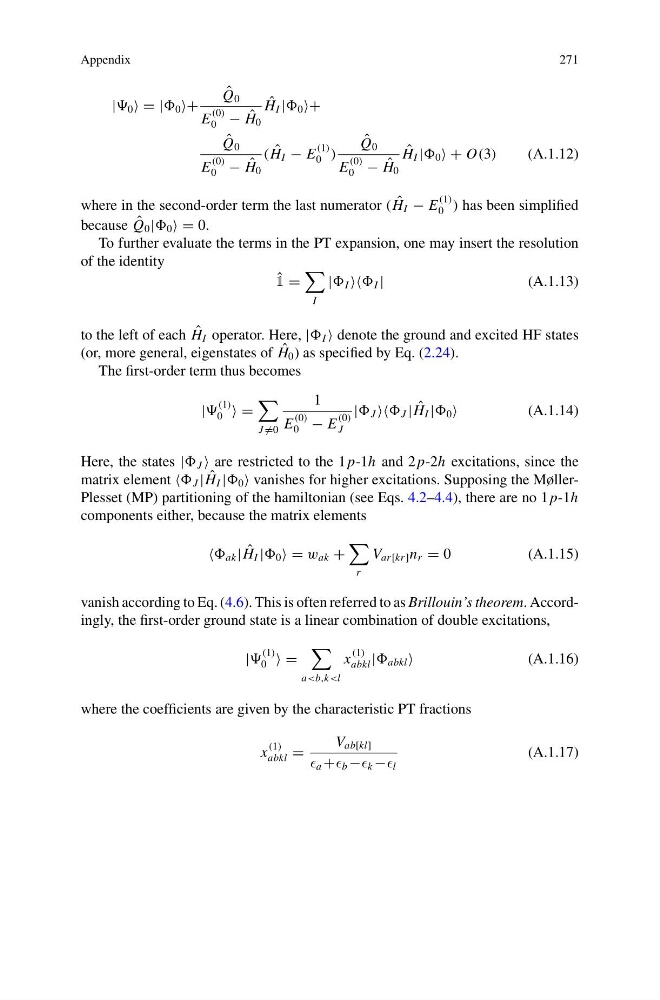
where in the second-order term the last numerator ( ˆ
H I − E
(1)
0 ) has been simplified
because ˆ
Q 0 | 0 = 0.
To further evaluate the terms in the PT expansion, one may insert the resolution
of the identity
ˆ
1 =
I
| I I |
(A.1.13)
to the left of each ˆ
H I operator. Here, | I denote the ground and excited HF states
(or, more general, eigenstates of ˆ
H 0 ) as specified by Eq. (2.24).
The first-order term thus becomes
|
(1)
0 =
J =0
1
E
(0)
0 − E
(0)
J
| J J | ˆ
H I | 0
(A.1.14)
Here, the states | J are restricted to the 1 p-1h and 2 p-2h excitations, since the
matrix element J | ˆ
H I | 0 vanishes for higher excitations. Supposing the MøllerPlesset (MP) partitioning of the hamiltonian (see Eqs. 4.2–4.4), there are no 1 p-1h
components either, because the matrix elements
ak | ˆ
H I | 0 = w ak +
r
V ar[kr] n r = 0
(A.1.15)
vanish according to Eq. (4.6). This is often referred to as Brillouin’s theorem. Accordingly, the first-order ground state is a linear combination of double excitations,
|
(1)
0 =
a
(1)
abkl | abkl
(A.1.16)
where the coefficients are given by the characteristic PT fractions
x
(1)
abkl =
V ab[kl]
a + b − k − l
(A.1.17)
271
| 0 = | 0 +
ˆ
Q 0
E
(0)
0 − ˆ
H 0
ˆ
H I | 0 +
ˆ
Q 0
E
(0)
0 − ˆ
H 0
( ˆ
H I − E
(1)
0 )
ˆ
Q 0
E
(0)
0 − ˆ
H 0
ˆ
H I | 0 + O(3)
(A.1.12)
where in the second-order term the last numerator ( ˆ
H I − E
(1)
0 ) has been simplified
because ˆ
Q 0 | 0 = 0.
To further evaluate the terms in the PT expansion, one may insert the resolution
of the identity
ˆ
1 =
I
| I I |
(A.1.13)
to the left of each ˆ
H I operator. Here, | I denote the ground and excited HF states
(or, more general, eigenstates of ˆ
H 0 ) as specified by Eq. (2.24).
The first-order term thus becomes
|
(1)
0 =
J =0
1
E
(0)
0 − E
(0)
J
| J J | ˆ
H I | 0
(A.1.14)
Here, the states | J are restricted to the 1 p-1h and 2 p-2h excitations, since the
matrix element J | ˆ
H I | 0 vanishes for higher excitations. Supposing the MøllerPlesset (MP) partitioning of the hamiltonian (see Eqs. 4.2–4.4), there are no 1 p-1h
components either, because the matrix elements
ak | ˆ
H I | 0 = w ak +
r
V ar[kr] n r = 0
(A.1.15)
vanish according to Eq. (4.6). This is often referred to as Brillouin’s theorem. Accordingly, the first-order ground state is a linear combination of double excitations,
|
(1)
0 =
a
(1)
abkl | abkl
(A.1.16)
where the coefficients are given by the characteristic PT fractions
x
(1)
abkl =
V ab[kl]
a + b − k − l
(A.1.17)