

Appendix
A.1 Basic Tools
A.1.1 Perturbation Theory for the Ground State
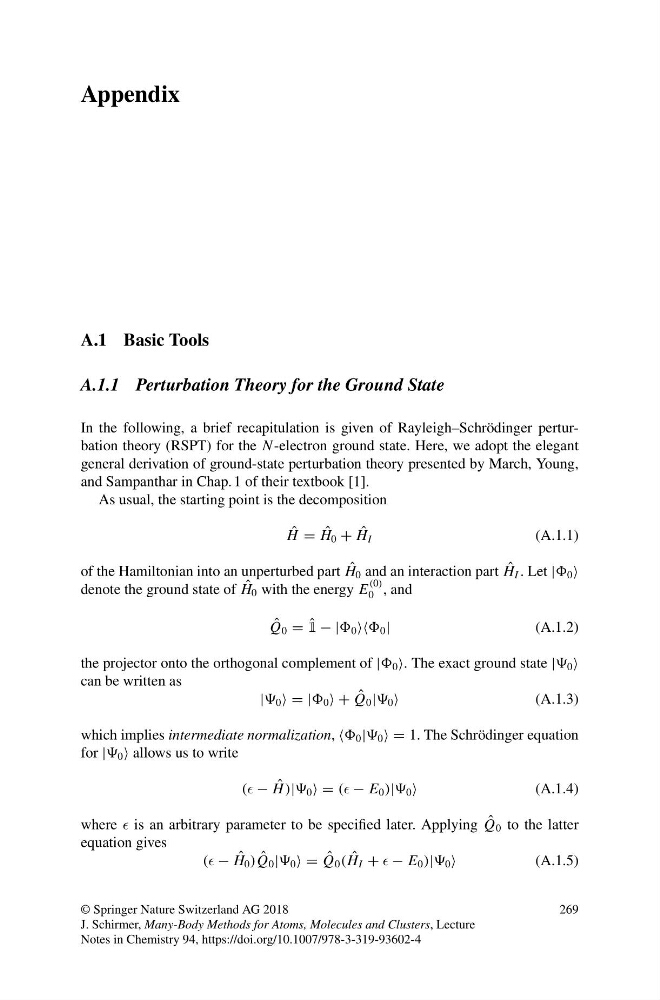
In the following, a brief recapitulation is given of Rayleigh–Schrödinger perturbation theory (RSPT) for the N -electron ground state. Here, we adopt the elegant
general derivation of ground-state perturbation theory presented by March, Young,
and Sampanthar in Chap. 1 of their textbook [1].
As usual, the starting point is the decomposition
ˆ
H = ˆ
H 0 + ˆ
H I
(A.1.1)
of the Hamiltonian into an unperturbed part ˆ
H 0 and an interaction part ˆ
H I . Let | 0
denote the ground state of ˆ
H 0 with the energy E
(0)
0 , and
ˆ
Q 0 = ˆ
1 − | 0 0 |
(A.1.2)
the projector onto the orthogonal complement of | 0 . The exact ground state | 0
can be written as
| 0 = | 0 + ˆ
Q 0 | 0
(A.1.3)
which implies intermediate normalization, 0 | 0 = 1. The Schrödinger equation
for | 0 allows us to write
( − ˆ
H )| 0 = ( − E 0 )| 0
(A.1.4)
where is an arbitrary parameter to be specified later. Applying ˆ
Q 0 to the latter
equation gives
( − ˆ
H 0 ) ˆ
Q 0 | 0 = ˆ
Q 0 ( ˆ
H I + − E 0 )| 0
(A.1.5)
© Springer Nature Switzerland AG 2018
J. Schirmer, Many-Body Methods for Atoms, Molecules and Clusters, Lecture
Notes in Chemistry 94, https://doi.org/10.1007/978-3-319-93602-4
269
A.1 Basic Tools
A.1.1 Perturbation Theory for the Ground State
In the following, a brief recapitulation is given of Rayleigh–Schrödinger perturbation theory (RSPT) for the N -electron ground state. Here, we adopt the elegant
general derivation of ground-state perturbation theory presented by March, Young,
and Sampanthar in Chap. 1 of their textbook [1].
As usual, the starting point is the decomposition
ˆ
H = ˆ
H 0 + ˆ
H I
(A.1.1)
of the Hamiltonian into an unperturbed part ˆ
H 0 and an interaction part ˆ
H I . Let | 0
denote the ground state of ˆ
H 0 with the energy E
(0)
0 , and
ˆ
Q 0 = ˆ
1 − | 0 0 |
(A.1.2)
the projector onto the orthogonal complement of | 0 . The exact ground state | 0
can be written as
| 0 = | 0 + ˆ
Q 0 | 0
(A.1.3)
which implies intermediate normalization, 0 | 0 = 1. The Schrödinger equation
for | 0 allows us to write
( − ˆ
H )| 0 = ( − E 0 )| 0
(A.1.4)
where is an arbitrary parameter to be specified later. Applying ˆ
Q 0 to the latter
equation gives
( − ˆ
H 0 ) ˆ
Q 0 | 0 = ˆ
Q 0 ( ˆ
H I + − E 0 )| 0
(A.1.5)
© Springer Nature Switzerland AG 2018
J. Schirmer, Many-Body Methods for Atoms, Molecules and Clusters, Lecture
Notes in Chemistry 94, https://doi.org/10.1007/978-3-319-93602-4
269