

264
17 Coupled-Cluster Methods for Generalized Excitations
Table 17.1 Truncation errors (PT order) for excitation energies and transition moments of singly
excited states: comparison of CI, BCC, and ADC approaches for the lowest six truncation levels
Truncation
level
Excitation energies
Transition moments
CI
BCC
ADC
CI
BCC
ADC
1
2
2
2
1
1
2
2
2
3
4
2
3
4
3
4
5
6
3
4
6
4
4
6
8
4
6
8
5
6
8
10
5
7
10
6
6
9
12
6
9
12
Separability
An analysis of the separability properties of the BCC secular equations and the sizeconsistency of the resulting excitation energies and transition moments can easily be
performed along the lines of Sect. 12.2. We confine ourselves to a brief sketch of the
essential features.
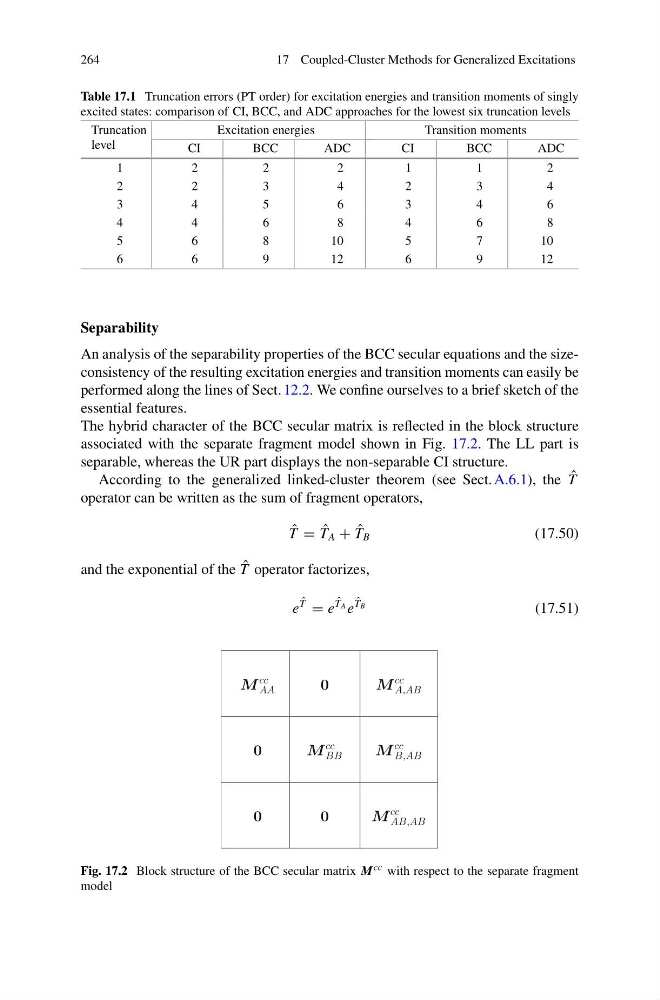
The hybrid character of the BCC secular matrix is reflected in the block structure
associated with the separate fragment model shown in Fig. 17.2. The LL part is
separable, whereas the UR part displays the non-separable CI structure.
According to the generalized linked-cluster theorem (see Sect. A.6.1), the ˆ
T
operator can be written as the sum of fragment operators,
ˆ
T = ˆ
T A + ˆ
T B
(17.50)
and the exponential of the ˆ
T operator factorizes,
e
ˆ
T
= e
ˆ
T A e
ˆ
T B
(17.51)
M
cc
AA
0
M
cc
A,AB
0
M
cc
BB
M
cc
B,AB
0
0
M
cc
AB,AB
Fig. 17.2 Block structure of the BCC secular matrix M cc with respect to the separate fragment
model
17 Coupled-Cluster Methods for Generalized Excitations
Table 17.1 Truncation errors (PT order) for excitation energies and transition moments of singly
excited states: comparison of CI, BCC, and ADC approaches for the lowest six truncation levels
Truncation
level
Excitation energies
Transition moments
CI
BCC
ADC
CI
BCC
ADC
1
2
2
2
1
1
2
2
2
3
4
2
3
4
3
4
5
6
3
4
6
4
4
6
8
4
6
8
5
6
8
10
5
7
10
6
6
9
12
6
9
12
Separability
An analysis of the separability properties of the BCC secular equations and the sizeconsistency of the resulting excitation energies and transition moments can easily be
performed along the lines of Sect. 12.2. We confine ourselves to a brief sketch of the
essential features.
The hybrid character of the BCC secular matrix is reflected in the block structure
associated with the separate fragment model shown in Fig. 17.2. The LL part is
separable, whereas the UR part displays the non-separable CI structure.
According to the generalized linked-cluster theorem (see Sect. A.6.1), the ˆ
T
operator can be written as the sum of fragment operators,
ˆ
T = ˆ
T A + ˆ
T B
(17.50)
and the exponential of the ˆ
T operator factorizes,
e
ˆ
T
= e
ˆ
T A e
ˆ
T B
(17.51)
M
cc
AA
0
M
cc
A,AB
0
M
cc
BB
M
cc
B,AB
0
0
M
cc
AB,AB
Fig. 17.2 Block structure of the BCC secular matrix M cc with respect to the separate fragment
model