

17.3 Order Relations and Separability Properties
263
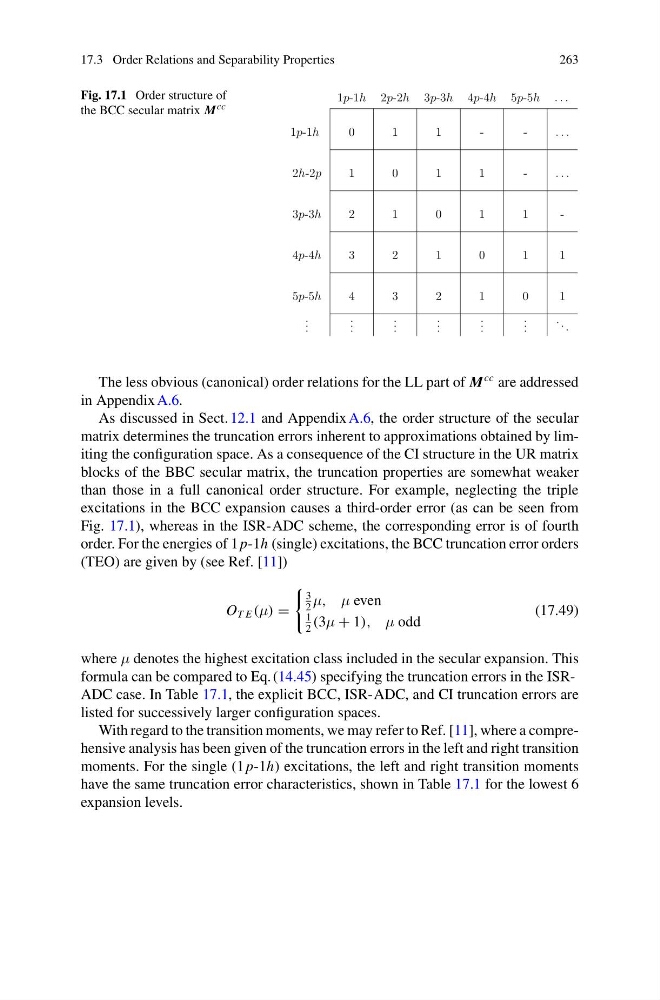
Fig. 17.1 Order structure of
the BCC secular matrix M cc
1p-1h 2p-2h 3p-3h 4p-4h 5p-5h . . .
1p-1h
0
1
1
-
-
. . .
2h-2p
1
0
1
1
-
. . .
3p-3h
2
1
0
1
1
-
4p-4h
3
2
1
0
1
1
5p-5h
4
3
2
1
0
1
. . .
. . .
. . .
. . .
. . .
. . .
. . .
The less obvious (canonical) order relations for the LL part of M
cc are addressed
in Appendix A.6.
As discussed in Sect. 12.1 and Appendix A.6, the order structure of the secular
matrix determines the truncation errors inherent to approximations obtained by limiting the configuration space. As a consequence of the CI structure in the UR matrix
blocks of the BBC secular matrix, the truncation properties are somewhat weaker
than those in a full canonical order structure. For example, neglecting the triple
excitations in the BCC expansion causes a third-order error (as can be seen from
Fig. 17.1), whereas in the ISR-ADC scheme, the corresponding error is of fourth
order. For the energies of 1 p-1h (single) excitations, the BCC truncation error orders
(TEO) are given by (see Ref. [11])
O T E (μ) =
3
2
μ, μ even
1
2
(3μ + 1), μ odd
(17.49)
where μ denotes the highest excitation class included in the secular expansion. This
formula can be compared to Eq. (14.45) specifying the truncation errors in the ISRADC case. In Table 17.1, the explicit BCC, ISR-ADC, and CI truncation errors are
listed for successively larger configuration spaces.
With regard to the transition moments, we may refer to Ref. [11], where a comprehensive analysis has been given of the truncation errors in the left and right transition
moments. For the single (1 p-1h) excitations, the left and right transition moments
have the same truncation error characteristics, shown in Table 17.1 for the lowest 6
expansion levels.
263
Fig. 17.1 Order structure of
the BCC secular matrix M cc
1p-1h 2p-2h 3p-3h 4p-4h 5p-5h . . .
1p-1h
0
1
1
-
-
. . .
2h-2p
1
0
1
1
-
. . .
3p-3h
2
1
0
1
1
-
4p-4h
3
2
1
0
1
1
5p-5h
4
3
2
1
0
1
. . .
. . .
. . .
. . .
. . .
. . .
. . .
The less obvious (canonical) order relations for the LL part of M
cc are addressed
in Appendix A.6.
As discussed in Sect. 12.1 and Appendix A.6, the order structure of the secular
matrix determines the truncation errors inherent to approximations obtained by limiting the configuration space. As a consequence of the CI structure in the UR matrix
blocks of the BBC secular matrix, the truncation properties are somewhat weaker
than those in a full canonical order structure. For example, neglecting the triple
excitations in the BCC expansion causes a third-order error (as can be seen from
Fig. 17.1), whereas in the ISR-ADC scheme, the corresponding error is of fourth
order. For the energies of 1 p-1h (single) excitations, the BCC truncation error orders
(TEO) are given by (see Ref. [11])
O T E (μ) =
3
2
μ, μ even
1
2
(3μ + 1), μ odd
(17.49)
where μ denotes the highest excitation class included in the secular expansion. This
formula can be compared to Eq. (14.45) specifying the truncation errors in the ISRADC case. In Table 17.1, the explicit BCC, ISR-ADC, and CI truncation errors are
listed for successively larger configuration spaces.
With regard to the transition moments, we may refer to Ref. [11], where a comprehensive analysis has been given of the truncation errors in the left and right transition
moments. For the single (1 p-1h) excitations, the left and right transition moments
have the same truncation error characteristics, shown in Table 17.1 for the lowest 6
expansion levels.