

210
14 ADC and ISR Approaches to the Polarization Propagator
affords only zeroth-order consistency. The full first-order contribution (to a final state
deriving from the HF excitation | ak ) given by
T
(1)
ak =
a k
X
(1)∗
a k ,ak d a k +
a k
f
(1)
ak,k a d k a
(14.32)
comprises a second term deriving from the first-order contribution to the ground
state, |
(1)
0 . By construction, the ADC(1) result for the transition moment is correct
through first order. A more detailed PT analysis of the physics encountered in single
electron excitations is given in Sect. 15.1.
Second- and Third-Order ADC Approximations
At second order, the ADC procedure for the polarization propagator is more involved
than in the case of the electron propagator treated in Sect. 10.2. Now we have to deal
with five second-order diagrams (rather than one for G
(2) ), and, moreover, there
are more terms in the ADC form as a consequence of non-vanishing first-order
contributions to C 11 and f 1 . Nevertheless, the procedure is rather straightforward,
and we may confine ourselves to a brief outline.
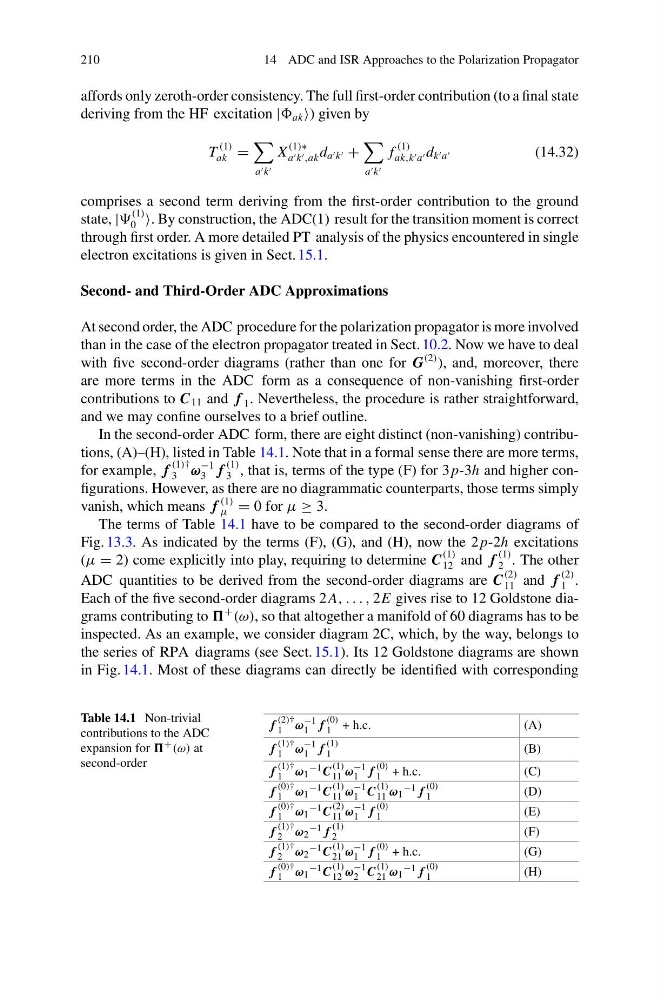
In the second-order ADC form, there are eight distinct (non-vanishing) contributions, (A)–(H), listed in Table 14.1. Note that in a formal sense there are more terms,
for example, f
(1)†
3 ω
−1
3 f
(1)
3 , that is, terms of the type (F) for 3 p-3h and higher configurations. However, as there are no diagrammatic counterparts, those terms simply
vanish, which means f
(1)
μ = 0 for μ ≥ 3.
The terms of Table 14.1 have to be compared to the second-order diagrams of
Fig. 13.3. As indicated by the terms (F), (G), and (H), now the 2 p-2h excitations
(μ = 2) come explicitly into play, requiring to determine C
(1)
12 and f
(1)
2 . The other
ADC quantities to be derived from the second-order diagrams are C
(2)
11 and f
(2)
1 .
Each of the five second-order diagrams 2 A, . . . , 2E gives rise to 12 Goldstone diagrams contributing to
+
(ω), so that altogether a manifold of 60 diagrams has to be
inspected. As an example, we consider diagram 2C, which, by the way, belongs to
the series of RPA diagrams (see Sect. 15.1). Its 12 Goldstone diagrams are shown
in Fig. 14.1. Most of these diagrams can directly be identified with corresponding
Table 14.1 Non-trivial
contributions to the ADC
expansion for + (ω) at
second-order
f
(2)†
1 ω
−1
1 f
(0)
1 + h.c.
(A)
f
(1)†
1 ω
−1
1 f
(1)
1
(B)
f
(1)†
1 ω 1
−1 C
(1)
11 ω
−1
1 f
(0)
1 + h.c.
(C)
f
(0)†
1 ω 1
−1 C
(1)
11 ω
−1
1 C
(1)
11 ω 1
−1 f
(0)
1
(D)
f
(0)†
1 ω 1
−1 C
(2)
11 ω
−1
1 f
(0)
1
(E)
f
(1)†
2 ω 2
−1 f
(1)
2
(F)
f
(1)†
2 ω 2
−1 C
(1)
21 ω
−1
1 f
(0)
1 + h.c.
(G)
f
(0)†
1 ω 1
−1 C
(1)
12 ω
−1
2 C
(1)
21 ω 1
−1 f
(0)
1
(H)
14 ADC and ISR Approaches to the Polarization Propagator
affords only zeroth-order consistency. The full first-order contribution (to a final state
deriving from the HF excitation | ak ) given by
T
(1)
ak =
a k
X
(1)∗
a k ,ak d a k +
a k
f
(1)
ak,k a d k a
(14.32)
comprises a second term deriving from the first-order contribution to the ground
state, |
(1)
0 . By construction, the ADC(1) result for the transition moment is correct
through first order. A more detailed PT analysis of the physics encountered in single
electron excitations is given in Sect. 15.1.
Second- and Third-Order ADC Approximations
At second order, the ADC procedure for the polarization propagator is more involved
than in the case of the electron propagator treated in Sect. 10.2. Now we have to deal
with five second-order diagrams (rather than one for G
(2) ), and, moreover, there
are more terms in the ADC form as a consequence of non-vanishing first-order
contributions to C 11 and f 1 . Nevertheless, the procedure is rather straightforward,
and we may confine ourselves to a brief outline.
In the second-order ADC form, there are eight distinct (non-vanishing) contributions, (A)–(H), listed in Table 14.1. Note that in a formal sense there are more terms,
for example, f
(1)†
3 ω
−1
3 f
(1)
3 , that is, terms of the type (F) for 3 p-3h and higher configurations. However, as there are no diagrammatic counterparts, those terms simply
vanish, which means f
(1)
μ = 0 for μ ≥ 3.
The terms of Table 14.1 have to be compared to the second-order diagrams of
Fig. 13.3. As indicated by the terms (F), (G), and (H), now the 2 p-2h excitations
(μ = 2) come explicitly into play, requiring to determine C
(1)
12 and f
(1)
2 . The other
ADC quantities to be derived from the second-order diagrams are C
(2)
11 and f
(2)
1 .
Each of the five second-order diagrams 2 A, . . . , 2E gives rise to 12 Goldstone diagrams contributing to
+
(ω), so that altogether a manifold of 60 diagrams has to be
inspected. As an example, we consider diagram 2C, which, by the way, belongs to
the series of RPA diagrams (see Sect. 15.1). Its 12 Goldstone diagrams are shown
in Fig. 14.1. Most of these diagrams can directly be identified with corresponding
Table 14.1 Non-trivial
contributions to the ADC
expansion for + (ω) at
second-order
f
(2)†
1 ω
−1
1 f
(0)
1 + h.c.
(A)
f
(1)†
1 ω
−1
1 f
(1)
1
(B)
f
(1)†
1 ω 1
−1 C
(1)
11 ω
−1
1 f
(0)
1 + h.c.
(C)
f
(0)†
1 ω 1
−1 C
(1)
11 ω
−1
1 C
(1)
11 ω 1
−1 f
(0)
1
(D)
f
(0)†
1 ω 1
−1 C
(2)
11 ω
−1
1 f
(0)
1
(E)
f
(1)†
2 ω 2
−1 f
(1)
2
(F)
f
(1)†
2 ω 2
−1 C
(1)
21 ω
−1
1 f
(0)
1 + h.c.
(G)
f
(0)†
1 ω 1
−1 C
(1)
12 ω
−1
2 C
(1)
21 ω 1
−1 f
(0)
1
(H)