

12.3 A Look at the CI Method
189
| 0
= |
A
0
|
B
0
| I A
= |
A
I A
|
B
0
| I AB
= |
A
I A
|
B
I B
(12.51)
Unlike in the ECO-ISR case, there is no equivalent to Eq. (12.37) here. While the A
and B states are strictly decoupled, H AB = 0, there can be a non-vanishing coupling
between a local and a mixed excitation, e.g.,
H I A ,J AB = δ I A J A
B
0 | ˆ
H B |
B
J B
(12.52)
where
B
0 | ˆ
H B |
B
J B
is a righteous matrix element in the CI treatment of the ground
state of fragment B.
Non-local coupling may arise explicitly in the CI matrix elements H I J , where
the configurations I, J differ by two excitation classes, such as in the 1h/3h-2 p
matrix elements (12.3). Let l denote a 1h excitation on fragment A (I A ≡ l) and
a
b
j
k
l ≡ J AB a non-local 3h-2 p excitations where the primed indices refer to
one-particle states associated with fragment B; the coupling matrix element becomes
H l,a b j k l = V a b [ j k ]
(12.53)
which obviously does not depend on the distance between the two fragments.
According to Eq. (12.10), the potentially non-local coupling between 1h and
3h-2 p configurations arises also in the ISR version (11.5) based on symmetrically
orthonormalized (SO) CE states. This shows that the SO procedure for the CE states
does not result in a separable secular matrix either.
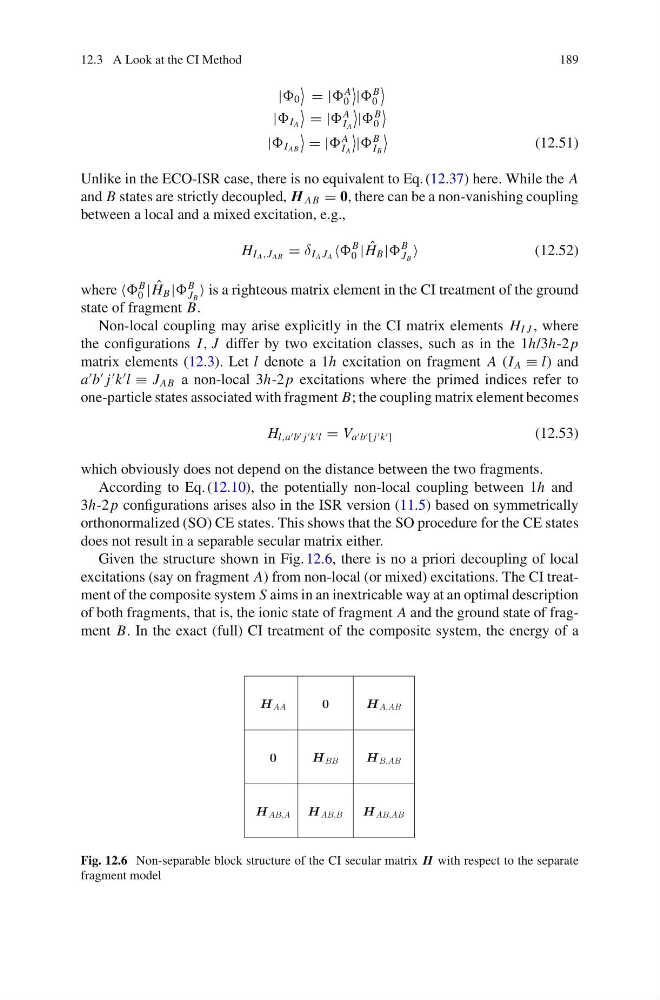
Given the structure shown in Fig. 12.6, there is no a priori decoupling of local
excitations (say on fragment A) from non-local (or mixed) excitations. The CI treatment of the composite system S aims in an inextricable way at an optimal description
of both fragments, that is, the ionic state of fragment A and the ground state of fragment B. In the exact (full) CI treatment of the composite system, the energy of a
H AA
0
H A,AB
0
H BB
H B,AB
H AB,A H AB,B
H AB,AB
Fig. 12.6 Non-separable block structure of the CI secular matrix H with respect to the separate
fragment model
189
| 0
= |
A
0
|
B
0
| I A
= |
A
I A
|
B
0
| I AB
= |
A
I A
|
B
I B
(12.51)
Unlike in the ECO-ISR case, there is no equivalent to Eq. (12.37) here. While the A
and B states are strictly decoupled, H AB = 0, there can be a non-vanishing coupling
between a local and a mixed excitation, e.g.,
H I A ,J AB = δ I A J A
B
0 | ˆ
H B |
B
J B
(12.52)
where
B
0 | ˆ
H B |
B
J B
is a righteous matrix element in the CI treatment of the ground
state of fragment B.
Non-local coupling may arise explicitly in the CI matrix elements H I J , where
the configurations I, J differ by two excitation classes, such as in the 1h/3h-2 p
matrix elements (12.3). Let l denote a 1h excitation on fragment A (I A ≡ l) and
a
b
j
k
l ≡ J AB a non-local 3h-2 p excitations where the primed indices refer to
one-particle states associated with fragment B; the coupling matrix element becomes
H l,a b j k l = V a b [ j k ]
(12.53)
which obviously does not depend on the distance between the two fragments.
According to Eq. (12.10), the potentially non-local coupling between 1h and
3h-2 p configurations arises also in the ISR version (11.5) based on symmetrically
orthonormalized (SO) CE states. This shows that the SO procedure for the CE states
does not result in a separable secular matrix either.
Given the structure shown in Fig. 12.6, there is no a priori decoupling of local
excitations (say on fragment A) from non-local (or mixed) excitations. The CI treatment of the composite system S aims in an inextricable way at an optimal description
of both fragments, that is, the ionic state of fragment A and the ground state of fragment B. In the exact (full) CI treatment of the composite system, the energy of a
H AA
0
H A,AB
0
H BB
H B,AB
H AB,A H AB,B
H AB,AB
Fig. 12.6 Non-separable block structure of the CI secular matrix H with respect to the separate
fragment model