

188
12 Order Relations and Separability
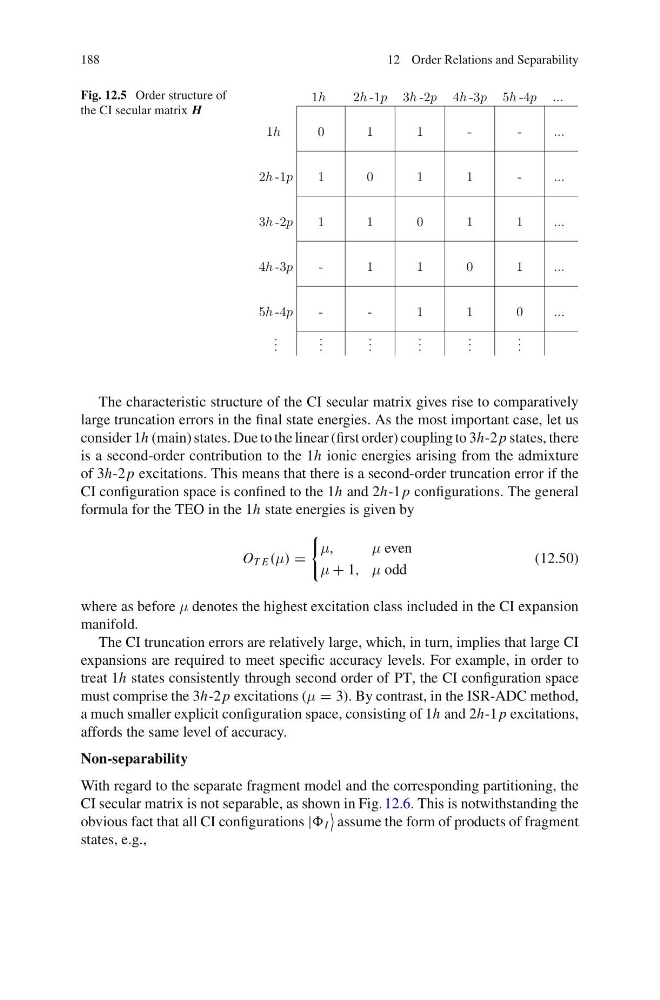
Fig. 12.5 Order structure of
the CI secular matrix H
1h
2h -1p 3h -2p 4h -3p 5h -4p ...
1h
0
1
1
-
-
...
2h -1p
1
0
1
1
-
...
3h -2p
1
1
0
1
1
...
4h -3p
-
1
1
0
1
...
5h -4p
-
-
1
1
0
...
. . .
. . .
. . .
. . .
. . .
. . .
The characteristic structure of the CI secular matrix gives rise to comparatively
large truncation errors in the final state energies. As the most important case, let us
consider 1h (main) states. Due to the linear (first order) coupling to 3h-2 p states, there
is a second-order contribution to the 1h ionic energies arising from the admixture
of 3h-2 p excitations. This means that there is a second-order truncation error if the
CI configuration space is confined to the 1h and 2h-1 p configurations. The general
formula for the TEO in the 1h state energies is given by
O T E (μ) =
μ,
μ even
μ + 1, μ odd
(12.50)
where as before μ denotes the highest excitation class included in the CI expansion
manifold.
The CI truncation errors are relatively large, which, in turn, implies that large CI
expansions are required to meet specific accuracy levels. For example, in order to
treat 1h states consistently through second order of PT, the CI configuration space
must comprise the 3h-2 p excitations (μ = 3). By contrast, in the ISR-ADC method,
a much smaller explicit configuration space, consisting of 1h and 2h-1 p excitations,
affords the same level of accuracy.
Non-separability
With regard to the separate fragment model and the corresponding partitioning, the
CI secular matrix is not separable, as shown in Fig. 12.6. This is notwithstanding the
obvious fact that all CI configurations | I
assume the form of products of fragment
states, e.g.,
12 Order Relations and Separability
Fig. 12.5 Order structure of
the CI secular matrix H
1h
2h -1p 3h -2p 4h -3p 5h -4p ...
1h
0
1
1
-
-
...
2h -1p
1
0
1
1
-
...
3h -2p
1
1
0
1
1
...
4h -3p
-
1
1
0
1
...
5h -4p
-
-
1
1
0
...
. . .
. . .
. . .
. . .
. . .
. . .
The characteristic structure of the CI secular matrix gives rise to comparatively
large truncation errors in the final state energies. As the most important case, let us
consider 1h (main) states. Due to the linear (first order) coupling to 3h-2 p states, there
is a second-order contribution to the 1h ionic energies arising from the admixture
of 3h-2 p excitations. This means that there is a second-order truncation error if the
CI configuration space is confined to the 1h and 2h-1 p configurations. The general
formula for the TEO in the 1h state energies is given by
O T E (μ) =
μ,
μ even
μ + 1, μ odd
(12.50)
where as before μ denotes the highest excitation class included in the CI expansion
manifold.
The CI truncation errors are relatively large, which, in turn, implies that large CI
expansions are required to meet specific accuracy levels. For example, in order to
treat 1h states consistently through second order of PT, the CI configuration space
must comprise the 3h-2 p excitations (μ = 3). By contrast, in the ISR-ADC method,
a much smaller explicit configuration space, consisting of 1h and 2h-1 p excitations,
affords the same level of accuracy.
Non-separability
With regard to the separate fragment model and the corresponding partitioning, the
CI secular matrix is not separable, as shown in Fig. 12.6. This is notwithstanding the
obvious fact that all CI configurations | I
assume the form of products of fragment
states, e.g.,