

184
12 Order Relations and Separability
c k |
A
0
=
l
| ˜
A
l
˜
A
l |c k |
A
0
(12.31)
that is, the decomposition of the CE state c k |
A
0
of fragment A with respect to the
fragment A intermediate states of class 1. The term in brackets in the second line of
Eq. (12.30) can be identified as the precursor state
|
B#
a j
= c
†
a c j |
B
0
− |
B
0
B
0 |c
†
a c j |
B
0
(12.32)
of the 1 p-1h excitation on fragment B which, being a neutral excitation, involves
orthogonalization to the ground state of fragment B (see Sect. 14.1). This means that
the 2h-1 p precursor state (12.30) is the product
|
#
a j k
= |
A#
k
|
B#
a j
(12.33)
of the respective fragment precursor states. Obviously, the ensuing symmetric
orthonormalization of the (non-local) 2h-1 p precursor states is obtained by independent orthonormalization of the fragment precursor states, establishing the product
form
| ˜
a j k
= | ˜
A
k
| ˜
B
a j
(12.34)
for the final intermediate states.
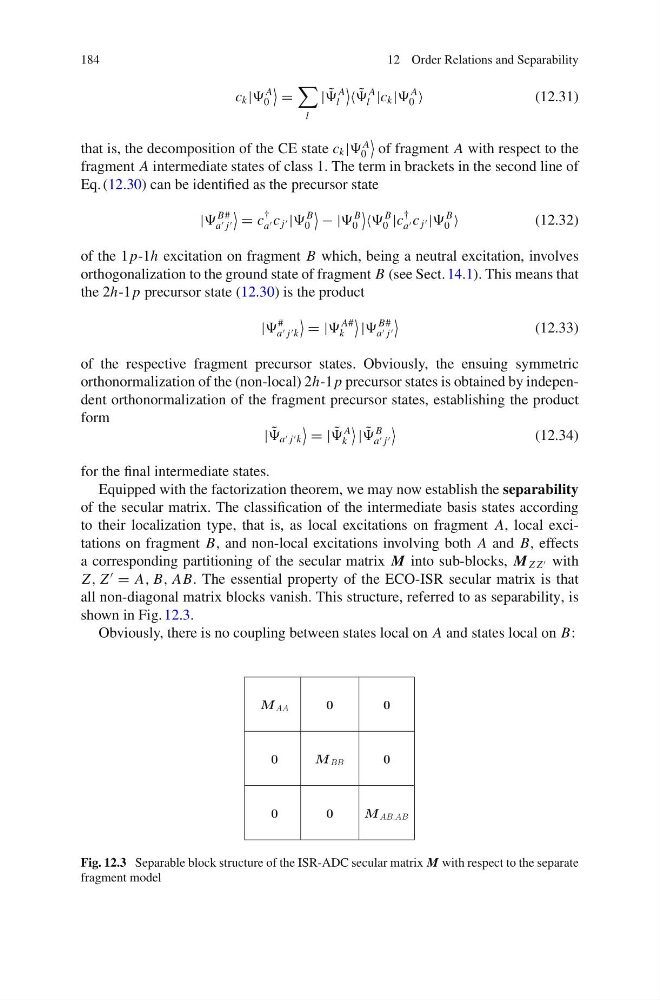
Equipped with the factorization theorem, we may now establish the separability
of the secular matrix. The classification of the intermediate basis states according
to their localization type, that is, as local excitations on fragment A, local excitations on fragment B, and non-local excitations involving both A and B, effects
a corresponding partitioning of the secular matrix M into sub-blocks, M Z Z with
Z , Z
= A, B, AB. The essential property of the ECO-ISR secular matrix is that
all non-diagonal matrix blocks vanish. This structure, referred to as separability, is
shown in Fig. 12.3.
Obviously, there is no coupling between states local on A and states local on B:
M AA
0
0
0
M BB
0
0
0
M AB,AB
Fig. 12.3 Separable block structure of the ISR-ADC secular matrix M with respect to the separate
fragment model
12 Order Relations and Separability
c k |
A
0
=
l
| ˜
A
l
˜
A
l |c k |
A
0
(12.31)
that is, the decomposition of the CE state c k |
A
0
of fragment A with respect to the
fragment A intermediate states of class 1. The term in brackets in the second line of
Eq. (12.30) can be identified as the precursor state
|
B#
a j
= c
†
a c j |
B
0
− |
B
0
B
0 |c
†
a c j |
B
0
(12.32)
of the 1 p-1h excitation on fragment B which, being a neutral excitation, involves
orthogonalization to the ground state of fragment B (see Sect. 14.1). This means that
the 2h-1 p precursor state (12.30) is the product
|
#
a j k
= |
A#
k
|
B#
a j
(12.33)
of the respective fragment precursor states. Obviously, the ensuing symmetric
orthonormalization of the (non-local) 2h-1 p precursor states is obtained by independent orthonormalization of the fragment precursor states, establishing the product
form
| ˜
a j k
= | ˜
A
k
| ˜
B
a j
(12.34)
for the final intermediate states.
Equipped with the factorization theorem, we may now establish the separability
of the secular matrix. The classification of the intermediate basis states according
to their localization type, that is, as local excitations on fragment A, local excitations on fragment B, and non-local excitations involving both A and B, effects
a corresponding partitioning of the secular matrix M into sub-blocks, M Z Z with
Z , Z
= A, B, AB. The essential property of the ECO-ISR secular matrix is that
all non-diagonal matrix blocks vanish. This structure, referred to as separability, is
shown in Fig. 12.3.
Obviously, there is no coupling between states local on A and states local on B:
M AA
0
0
0
M BB
0
0
0
M AB,AB
Fig. 12.3 Separable block structure of the ISR-ADC secular matrix M with respect to the separate
fragment model