

154
10 Direct ADC Procedure for the Electron Propagator
n p
ω − p
⎧
⎨
⎩
−
1
2
a,b, j
V ab[ pj] V q j[ab]
a + b − j −
1
2
( p + q )
( a + b − p − j )( a + b − q − j )
⎫
⎬
⎭
n q
ω − q
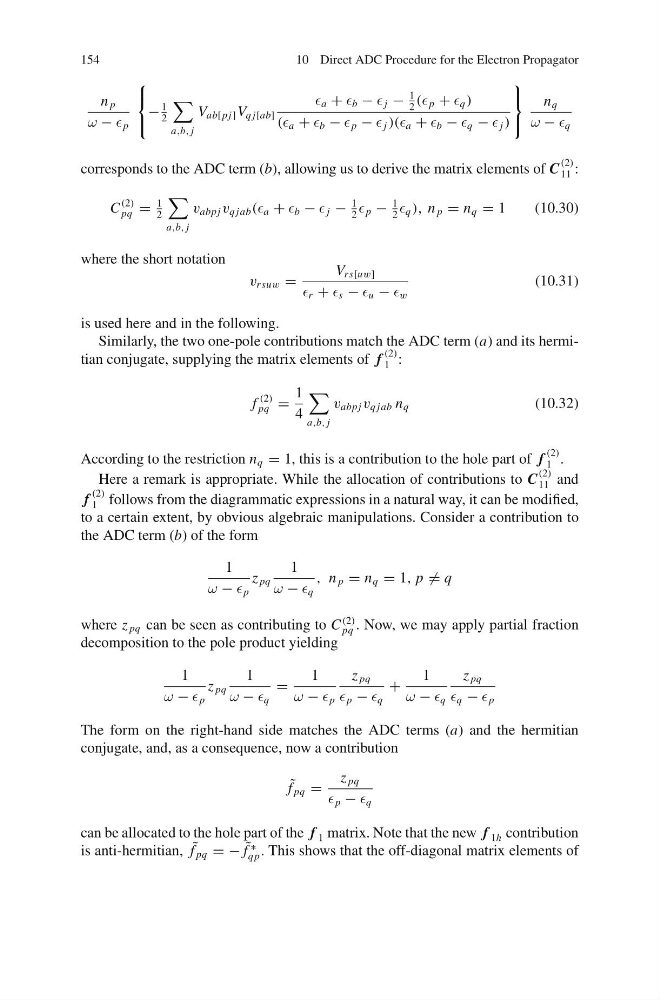
corresponds to the ADC term (b), allowing us to derive the matrix elements of C
(2)
11 :
C
(2)
pq =
1
2
a,b, j
v abpj v q jab ( a + b − j −
1
2
p −
1
2
q ), n p = n q = 1
(10.30)
where the short notation
v rsuw =
V rs[uw]
r + s − u − w
(10.31)
is used here and in the following.
Similarly, the two one-pole contributions match the ADC term (a) and its hermitian conjugate, supplying the matrix elements of f
(2)
1 :
f
(2)
pq =
1
4
a,b, j
v abpj v q jab n q
(10.32)
According to the restriction n q = 1, this is a contribution to the hole part of f
(2)
1 .
Here a remark is appropriate. While the allocation of contributions to C
(2)
11 and
f
(2)
1 follows from the diagrammatic expressions in a natural way, it can be modified,
to a certain extent, by obvious algebraic manipulations. Consider a contribution to
the ADC term (b) of the form
1
ω − p
z pq
1
ω − q
, n p = n q = 1, p = q
where z pq can be seen as contributing to C
(2)
pq . Now, we may apply partial fraction
decomposition to the pole product yielding
1
ω − p
z pq
1
ω − q
=
1
ω − p
z pq
p − q
+
1
ω − q
z pq
q − p
The form on the right-hand side matches the ADC terms (a) and the hermitian
conjugate, and, as a consequence, now a contribution
˜
f pq =
z pq
p − q
can be allocated to the hole part of the f 1 matrix. Note that the new f 1h contribution
is anti-hermitian, ˜
f pq = − ˜
f
∗
qp . This shows that the off-diagonal matrix elements of
10 Direct ADC Procedure for the Electron Propagator
n p
ω − p
⎧
⎨
⎩
−
1
2
a,b, j
V ab[ pj] V q j[ab]
a + b − j −
1
2
( p + q )
( a + b − p − j )( a + b − q − j )
⎫
⎬
⎭
n q
ω − q
corresponds to the ADC term (b), allowing us to derive the matrix elements of C
(2)
11 :
C
(2)
pq =
1
2
a,b, j
v abpj v q jab ( a + b − j −
1
2
p −
1
2
q ), n p = n q = 1
(10.30)
where the short notation
v rsuw =
V rs[uw]
r + s − u − w
(10.31)
is used here and in the following.
Similarly, the two one-pole contributions match the ADC term (a) and its hermitian conjugate, supplying the matrix elements of f
(2)
1 :
f
(2)
pq =
1
4
a,b, j
v abpj v q jab n q
(10.32)
According to the restriction n q = 1, this is a contribution to the hole part of f
(2)
1 .
Here a remark is appropriate. While the allocation of contributions to C
(2)
11 and
f
(2)
1 follows from the diagrammatic expressions in a natural way, it can be modified,
to a certain extent, by obvious algebraic manipulations. Consider a contribution to
the ADC term (b) of the form
1
ω − p
z pq
1
ω − q
, n p = n q = 1, p = q
where z pq can be seen as contributing to C
(2)
pq . Now, we may apply partial fraction
decomposition to the pole product yielding
1
ω − p
z pq
1
ω − q
=
1
ω − p
z pq
p − q
+
1
ω − q
z pq
q − p
The form on the right-hand side matches the ADC terms (a) and the hermitian
conjugate, and, as a consequence, now a contribution
˜
f pq =
z pq
p − q
can be allocated to the hole part of the f 1 matrix. Note that the new f 1h contribution
is anti-hermitian, ˜
f pq = − ˜
f
∗
qp . This shows that the off-diagonal matrix elements of