

10.2 Explicit ADC Procedure Through Second Order
153
cancel, and the resulting expressions can be assigned to the ADC terms (a) and (b),
as will be shown in the following.
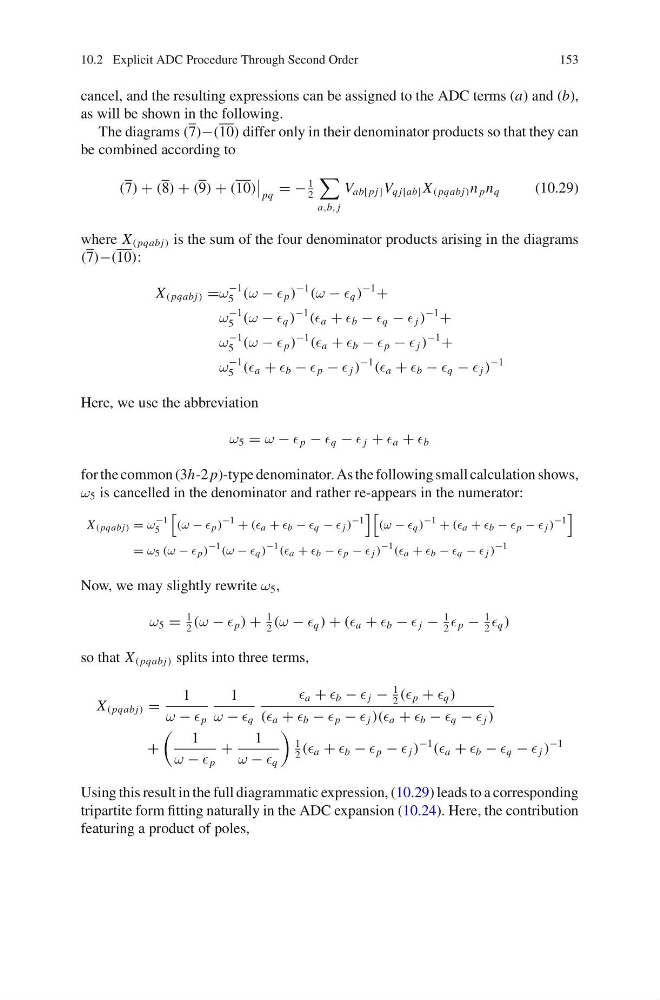
The diagrams (7)−(10) differ only in their denominator products so that they can
be combined according to
(7) + (8) + (9) + (10)
pq
= −
1
2
a,b, j
V ab[ pj] V q j[ab] X ( pqabj) n p n q
(10.29)
where X ( pqabj) is the sum of the four denominator products arising in the diagrams
(7)−(10):
X ( pqabj) =ω
−1
5 (ω − p )
−1
(ω − q )
−1
+
ω
−1
5 (ω − q )
−1
( a + b − q − j )
−1
+
ω
−1
5 (ω − p )
−1
( a + b − p − j )
−1
+
ω
−1
5 ( a + b − p − j )
−1
( a + b − q − j )
−1
Here, we use the abbreviation
ω 5 = ω − p − q − j + a + b
for the common (3h-2 p)-type denominator. As the following small calculation shows,
ω 5 is cancelled in the denominator and rather re-appears in the numerator:
X ( pqabj) = ω
−1
5
(ω − p )
−1 + ( a + b − q − j )
−1
(ω − q )
−1 + ( a + b − p − j )
−1
= ω 5 (ω − p )
−1 (ω − q )
−1 ( a + b − p − j )
−1 ( a + b − q − j )
−1
Now, we may slightly rewrite ω 5 ,
ω 5 =
1
2
(ω − p ) +
1
2
(ω − q ) + ( a + b − j −
1
2
p −
1
2
q )
so that X ( pqabj) splits into three terms,
X ( pqabj) =
1
ω − p
1
ω − q
a + b − j −
1
2
( p + q )
( a + b − p − j )( a + b − q − j )
+
1
ω − p
+
1
ω − q
1
2
( a + b − p − j )
−1
( a + b − q − j )
−1
Using this result in the full diagrammatic expression, (10.29) leads to a corresponding
tripartite form fitting naturally in the ADC expansion (10.24). Here, the contribution
featuring a product of poles,
153
cancel, and the resulting expressions can be assigned to the ADC terms (a) and (b),
as will be shown in the following.
The diagrams (7)−(10) differ only in their denominator products so that they can
be combined according to
(7) + (8) + (9) + (10)
pq
= −
1
2
a,b, j
V ab[ pj] V q j[ab] X ( pqabj) n p n q
(10.29)
where X ( pqabj) is the sum of the four denominator products arising in the diagrams
(7)−(10):
X ( pqabj) =ω
−1
5 (ω − p )
−1
(ω − q )
−1
+
ω
−1
5 (ω − q )
−1
( a + b − q − j )
−1
+
ω
−1
5 (ω − p )
−1
( a + b − p − j )
−1
+
ω
−1
5 ( a + b − p − j )
−1
( a + b − q − j )
−1
Here, we use the abbreviation
ω 5 = ω − p − q − j + a + b
for the common (3h-2 p)-type denominator. As the following small calculation shows,
ω 5 is cancelled in the denominator and rather re-appears in the numerator:
X ( pqabj) = ω
−1
5
(ω − p )
−1 + ( a + b − q − j )
−1
(ω − q )
−1 + ( a + b − p − j )
−1
= ω 5 (ω − p )
−1 (ω − q )
−1 ( a + b − p − j )
−1 ( a + b − q − j )
−1
Now, we may slightly rewrite ω 5 ,
ω 5 =
1
2
(ω − p ) +
1
2
(ω − q ) + ( a + b − j −
1
2
p −
1
2
q )
so that X ( pqabj) splits into three terms,
X ( pqabj) =
1
ω − p
1
ω − q
a + b − j −
1
2
( p + q )
( a + b − p − j )( a + b − q − j )
+
1
ω − p
+
1
ω − q
1
2
( a + b − p − j )
−1
( a + b − q − j )
−1
Using this result in the full diagrammatic expression, (10.29) leads to a corresponding
tripartite form fitting naturally in the ADC expansion (10.24). Here, the contribution
featuring a product of poles,