

142
9 Algebraic–Diagrammatic Construction (ADC)
in terms of the eigenvalue and eigenvector matrices of B:
B X = X E,
X
† X = 1
(9.35)
Here, E and X denote the diagonal matrix of eigenvalues and the eigenvector matrix,
respectively. The obvious advantage of the Dyson-ADC secular matrix B is that one
can directly compute selected ionization energies, I n = −E n , or electron affinities,
A m = −E m , using iterative matrix diagonalization routines such as the Davidson [4]
or Lanczos [5, 6] methods. It should be noted, however, that the desired roots, e.g.,
for the energetically lowest ionization energies, lie in the middle of the eigenvalue
spectrum of B, which complicates the use of iterative diagonalization techniques.
As we have argued in Sect. 8.2, the static part (∞) of the self-energy entering
the Dyson-ADC secular matrix in the 1 p/1h block should be chosen to be consistent
with the respective approximation scheme employed for the dynamical self-energy
part M(ω). A practical method to determine (∞) for an ADC representation of
M(ω) is presented in Appendix A.5.
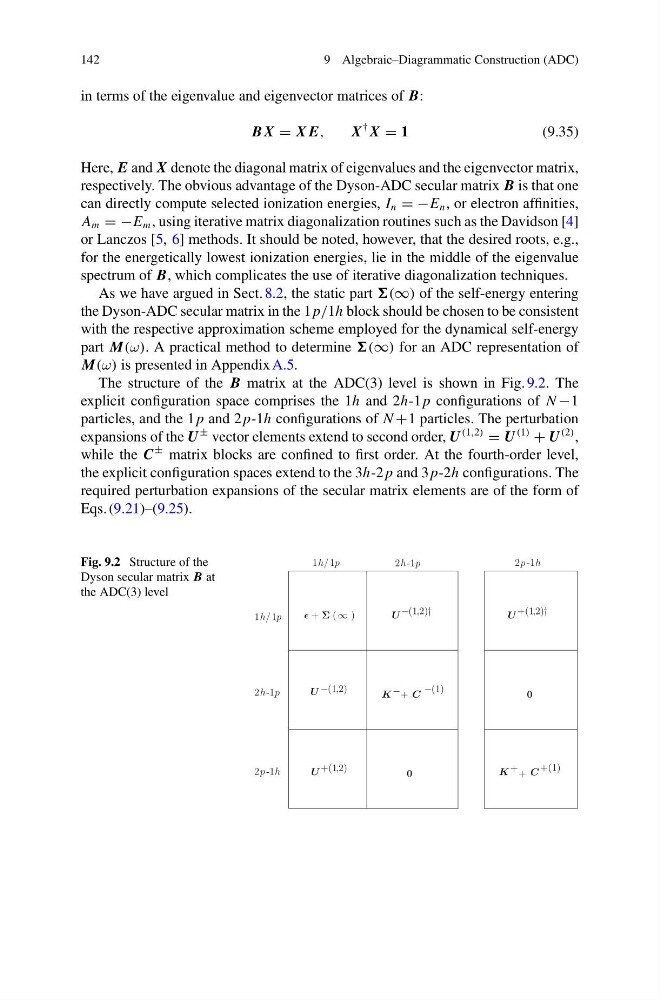
The structure of the B matrix at the ADC(3) level is shown in Fig. 9.2. The
explicit configuration space comprises the 1h and 2h-1 p configurations of N −1
particles, and the 1 p and 2 p-1h configurations of N +1 particles. The perturbation
expansions of the U
± vector elements extend to second order, U
(1,2)
= U
(1)
+ U
(2) ,
while the C
± matrix blocks are confined to first order. At the fourth-order level,
the explicit configuration spaces extend to the 3h-2 p and 3 p-2h configurations. The
required perturbation expansions of the secular matrix elements are of the form of
Eqs. (9.21)–(9.25).
Fig. 9.2 Structure of the
Dyson secular matrix B at
the ADC(3) level
1h/ 1
+ Σ ( ∞ )
U −(1,2)†
U +(1,2)†
U −(1,2)
K − + C
−(1)
0
U +(1,2)
0
K + + C +(1)
2h-1p
2h-1p
p
1h/ 1p
2p -1h
2p -1h
9 Algebraic–Diagrammatic Construction (ADC)
in terms of the eigenvalue and eigenvector matrices of B:
B X = X E,
X
† X = 1
(9.35)
Here, E and X denote the diagonal matrix of eigenvalues and the eigenvector matrix,
respectively. The obvious advantage of the Dyson-ADC secular matrix B is that one
can directly compute selected ionization energies, I n = −E n , or electron affinities,
A m = −E m , using iterative matrix diagonalization routines such as the Davidson [4]
or Lanczos [5, 6] methods. It should be noted, however, that the desired roots, e.g.,
for the energetically lowest ionization energies, lie in the middle of the eigenvalue
spectrum of B, which complicates the use of iterative diagonalization techniques.
As we have argued in Sect. 8.2, the static part (∞) of the self-energy entering
the Dyson-ADC secular matrix in the 1 p/1h block should be chosen to be consistent
with the respective approximation scheme employed for the dynamical self-energy
part M(ω). A practical method to determine (∞) for an ADC representation of
M(ω) is presented in Appendix A.5.
The structure of the B matrix at the ADC(3) level is shown in Fig. 9.2. The
explicit configuration space comprises the 1h and 2h-1 p configurations of N −1
particles, and the 1 p and 2 p-1h configurations of N +1 particles. The perturbation
expansions of the U
± vector elements extend to second order, U
(1,2)
= U
(1)
+ U
(2) ,
while the C
± matrix blocks are confined to first order. At the fourth-order level,
the explicit configuration spaces extend to the 3h-2 p and 3 p-2h configurations. The
required perturbation expansions of the secular matrix elements are of the form of
Eqs. (9.21)–(9.25).
Fig. 9.2 Structure of the
Dyson secular matrix B at
the ADC(3) level
1h/ 1
+ Σ ( ∞ )
U −(1,2)†
U +(1,2)†
U −(1,2)
K − + C
−(1)
0
U +(1,2)
0
K + + C +(1)
2h-1p
2h-1p
p
1h/ 1p
2p -1h
2p -1h