

136
9 Algebraic–Diagrammatic Construction (ADC)
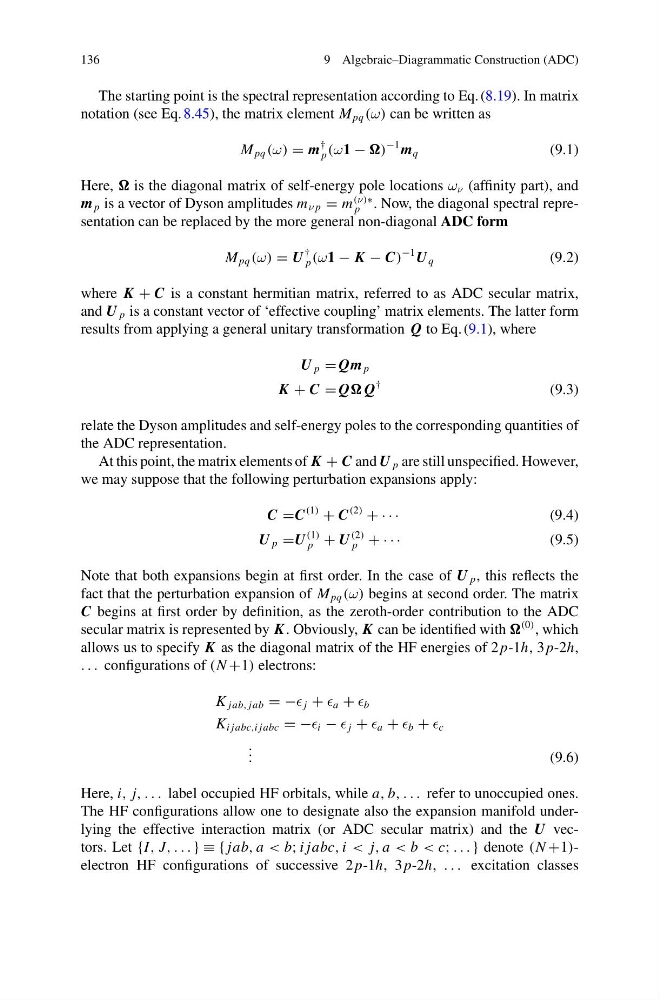
The starting point is the spectral representation according to Eq. (8.19). In matrix
notation (see Eq. 8.45), the matrix element M pq (ω) can be written as
M pq (ω) = m
†
p (ω1 − )
−1 m q
(9.1)
Here, is the diagonal matrix of self-energy pole locations ω ν (affinity part), and
m p is a vector of Dyson amplitudes m ν p = m
(ν)∗
p . Now, the diagonal spectral representation can be replaced by the more general non-diagonal ADC form
M pq (ω) = U
†
p (ω1 − K − C)
−1 U q
(9.2)
where K + C is a constant hermitian matrix, referred to as ADC secular matrix,
and U p is a constant vector of ‘effective coupling’ matrix elements. The latter form
results from applying a general unitary transformation Q to Eq. (9.1), where
U p = Qm p
K + C = Q Q
†
(9.3)
relate the Dyson amplitudes and self-energy poles to the corresponding quantities of
the ADC representation.
At this point, the matrix elements of K + C and U p are still unspecified. However,
we may suppose that the following perturbation expansions apply:
C =C
(1)
+ C
(2)
+ · · ·
(9.4)
U p =U
(1)
p + U
(2)
p + · · ·
(9.5)
Note that both expansions begin at first order. In the case of U p , this reflects the
fact that the perturbation expansion of M pq (ω) begins at second order. The matrix
C begins at first order by definition, as the zeroth-order contribution to the ADC
secular matrix is represented by K . Obviously, K can be identified with
(0) , which
allows us to specify K as the diagonal matrix of the HF energies of 2 p-1h, 3p-2h,
. . . configurations of (N +1) electrons:
K jab, jab = − j + a + b
K i jabc,i jabc = − i − j + a + b + c
. . .
(9.6)
Here, i, j, . . . label occupied HF orbitals, while a, b, . . . refer to unoccupied ones.
The HF configurations allow one to designate also the expansion manifold underlying the effective interaction matrix (or ADC secular matrix) and the U vectors. Let {I, J, . . . } ≡ { jab, a < b; i jabc, i < j, a < b < c; . . . } denote (N +1)electron HF configurations of successive 2 p-1h, 3p-2h, . . . excitation classes
9 Algebraic–Diagrammatic Construction (ADC)
The starting point is the spectral representation according to Eq. (8.19). In matrix
notation (see Eq. 8.45), the matrix element M pq (ω) can be written as
M pq (ω) = m
†
p (ω1 − )
−1 m q
(9.1)
Here, is the diagonal matrix of self-energy pole locations ω ν (affinity part), and
m p is a vector of Dyson amplitudes m ν p = m
(ν)∗
p . Now, the diagonal spectral representation can be replaced by the more general non-diagonal ADC form
M pq (ω) = U
†
p (ω1 − K − C)
−1 U q
(9.2)
where K + C is a constant hermitian matrix, referred to as ADC secular matrix,
and U p is a constant vector of ‘effective coupling’ matrix elements. The latter form
results from applying a general unitary transformation Q to Eq. (9.1), where
U p = Qm p
K + C = Q Q
†
(9.3)
relate the Dyson amplitudes and self-energy poles to the corresponding quantities of
the ADC representation.
At this point, the matrix elements of K + C and U p are still unspecified. However,
we may suppose that the following perturbation expansions apply:
C =C
(1)
+ C
(2)
+ · · ·
(9.4)
U p =U
(1)
p + U
(2)
p + · · ·
(9.5)
Note that both expansions begin at first order. In the case of U p , this reflects the
fact that the perturbation expansion of M pq (ω) begins at second order. The matrix
C begins at first order by definition, as the zeroth-order contribution to the ADC
secular matrix is represented by K . Obviously, K can be identified with
(0) , which
allows us to specify K as the diagonal matrix of the HF energies of 2 p-1h, 3p-2h,
. . . configurations of (N +1) electrons:
K jab, jab = − j + a + b
K i jabc,i jabc = − i − j + a + b + c
. . .
(9.6)
Here, i, j, . . . label occupied HF orbitals, while a, b, . . . refer to unoccupied ones.
The HF configurations allow one to designate also the expansion manifold underlying the effective interaction matrix (or ADC secular matrix) and the U vectors. Let {I, J, . . . } ≡ { jab, a < b; i jabc, i < j, a < b < c; . . . } denote (N +1)electron HF configurations of successive 2 p-1h, 3p-2h, . . . excitation classes