

120
8 Self-Energy and the Dyson Equation
G pq (ω) =
n
x
(n)
p x
(n)∗
q
ω − e n
(8.23)
where the index n runs over both (N +1)- and (N −1)-particle states; the imaginary
infinitesimals ±iη are not essential for the ensuing analysis and have been dropped.
Using a compact matrix notation, the spectral representation can be written as
G(ω) = x(ω1 − E)
−1 x
†
(8.24)
Here, E is a diagonal matrix of energies e n , that is, negative electron affinities and
ionization potentials:
e n =
−A n , n ∈ {N + 1}
−I n , n ∈ {N − 1}
(8.25)
The matrix x is a rectangular matrix of amplitudes x pn :
x pn = x
(n)
p =
0 |c p |
N +1
n
, n ∈ {N + 1}
N −1
n
|c p | 0 , n ∈ {N − 1}
(8.26)
Note that
xx
†
= 1
(8.27)
which is the matrix form of Eq. (3.22).
Using Eq. (8.24) in (8.13) and G
0
(ω)
−1
= ω1 − , where denotes the diagonal
matrix of HF orbital energies, the self-energy takes on the form
(ω) = ω1 − −
x(ω1 − E)
−1 x
†
−1
(8.28)
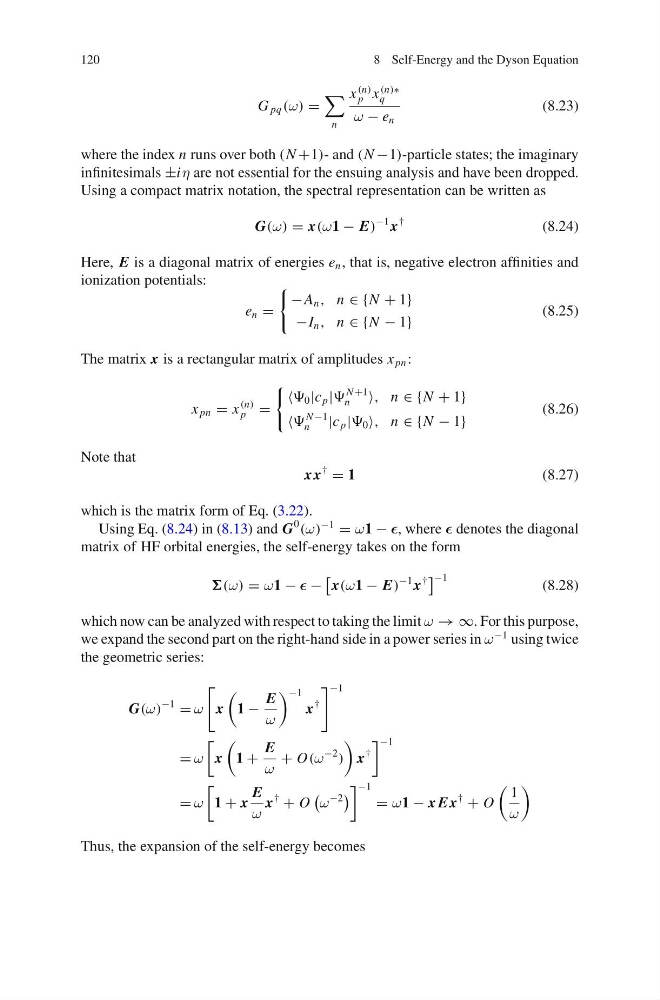
which now can be analyzed with respect to taking the limit ω → ∞. For this purpose,
we expand the second part on the right-hand side in a power series in ω
−1 using twice
the geometric series:
G(ω)
−1
= ω
x
1 −
E
ω
−1
x
†
−1
= ω
x
1 +
E
ω
+ O(ω
−2
)
x
†
−1
= ω
1 + x
E
ω
x
†
+ O
ω
−2
−1
= ω1 − x Ex
†
+ O
1
ω
Thus, the expansion of the self-energy becomes
8 Self-Energy and the Dyson Equation
G pq (ω) =
n
x
(n)
p x
(n)∗
q
ω − e n
(8.23)
where the index n runs over both (N +1)- and (N −1)-particle states; the imaginary
infinitesimals ±iη are not essential for the ensuing analysis and have been dropped.
Using a compact matrix notation, the spectral representation can be written as
G(ω) = x(ω1 − E)
−1 x
†
(8.24)
Here, E is a diagonal matrix of energies e n , that is, negative electron affinities and
ionization potentials:
e n =
−A n , n ∈ {N + 1}
−I n , n ∈ {N − 1}
(8.25)
The matrix x is a rectangular matrix of amplitudes x pn :
x pn = x
(n)
p =
0 |c p |
N +1
n
, n ∈ {N + 1}
N −1
n
|c p | 0 , n ∈ {N − 1}
(8.26)
Note that
xx
†
= 1
(8.27)
which is the matrix form of Eq. (3.22).
Using Eq. (8.24) in (8.13) and G
0
(ω)
−1
= ω1 − , where denotes the diagonal
matrix of HF orbital energies, the self-energy takes on the form
(ω) = ω1 − −
x(ω1 − E)
−1 x
†
−1
(8.28)
which now can be analyzed with respect to taking the limit ω → ∞. For this purpose,
we expand the second part on the right-hand side in a power series in ω
−1 using twice
the geometric series:
G(ω)
−1
= ω
x
1 −
E
ω
−1
x
†
−1
= ω
x
1 +
E
ω
+ O(ω
−2
)
x
†
−1
= ω
1 + x
E
ω
x
†
+ O
ω
−2
−1
= ω1 − x Ex
†
+ O
1
ω
Thus, the expansion of the self-energy becomes