

118
8 Self-Energy and the Dyson Equation
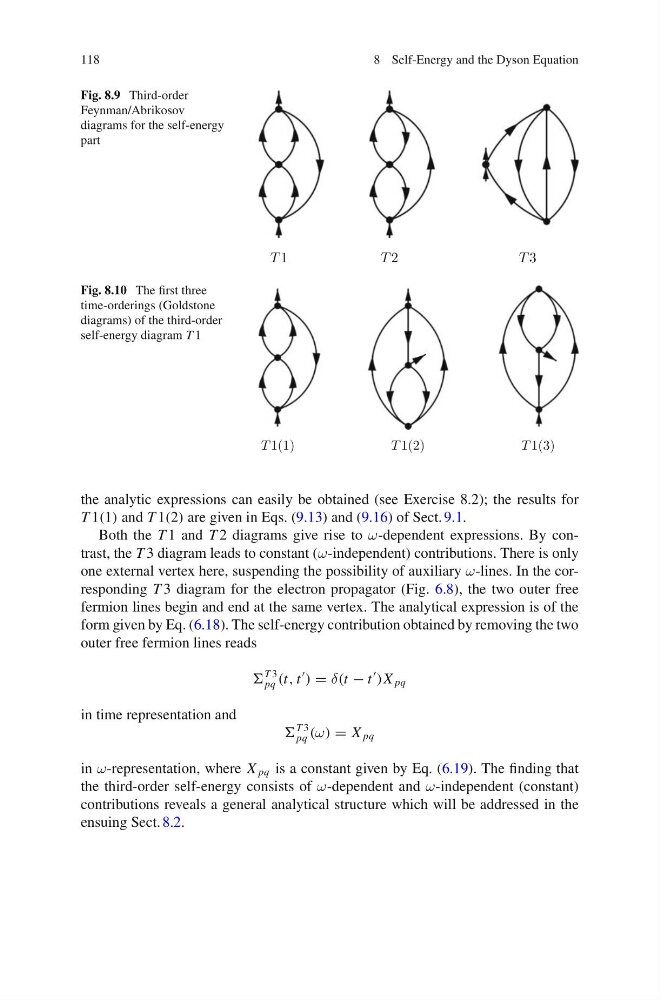
Fig. 8.9 Third-order
Feynman/Abrikosov
diagrams for the self-energy
part
Fig. 8.10 The first three
time-orderings (Goldstone
diagrams) of the third-order
self-energy diagram T 1
the analytic expressions can easily be obtained (see Exercise 8.2); the results for
T 1(1) and T 1(2) are given in Eqs. (9.13) and (9.16) of Sect. 9.1.
Both the T 1 and T 2 diagrams give rise to ω-dependent expressions. By contrast, the T 3 diagram leads to constant (ω-independent) contributions. There is only
one external vertex here, suspending the possibility of auxiliary ω-lines. In the corresponding T 3 diagram for the electron propagator (Fig. 6.8), the two outer free
fermion lines begin and end at the same vertex. The analytical expression is of the
form given by Eq. (6.18). The self-energy contribution obtained by removing the two
outer free fermion lines reads
T 3
pq (t, t
) = δ(t − t
)X pq
in time representation and
T 3
pq (ω) = X pq
in ω-representation, where X pq is a constant given by Eq. (6.19). The finding that
the third-order self-energy consists of ω-dependent and ω-independent (constant)
contributions reveals a general analytical structure which will be addressed in the
ensuing Sect. 8.2.
8 Self-Energy and the Dyson Equation
Fig. 8.9 Third-order
Feynman/Abrikosov
diagrams for the self-energy
part
Fig. 8.10 The first three
time-orderings (Goldstone
diagrams) of the third-order
self-energy diagram T 1
the analytic expressions can easily be obtained (see Exercise 8.2); the results for
T 1(1) and T 1(2) are given in Eqs. (9.13) and (9.16) of Sect. 9.1.
Both the T 1 and T 2 diagrams give rise to ω-dependent expressions. By contrast, the T 3 diagram leads to constant (ω-independent) contributions. There is only
one external vertex here, suspending the possibility of auxiliary ω-lines. In the corresponding T 3 diagram for the electron propagator (Fig. 6.8), the two outer free
fermion lines begin and end at the same vertex. The analytical expression is of the
form given by Eq. (6.18). The self-energy contribution obtained by removing the two
outer free fermion lines reads
T 3
pq (t, t
) = δ(t − t
)X pq
in time representation and
T 3
pq (ω) = X pq
in ω-representation, where X pq is a constant given by Eq. (6.19). The finding that
the third-order self-energy consists of ω-dependent and ω-independent (constant)
contributions reveals a general analytical structure which will be addressed in the
ensuing Sect. 8.2.