

between Cu(I) and triazolyl and hydrogen bond. The gelator with the shortest
carbon chain self-assembles in a completely amorphous pattern in comparison to
those having longer carbon chains due to the carbon spacer length with different
hydrogen-donor and hydrogen-acceptor atoms.
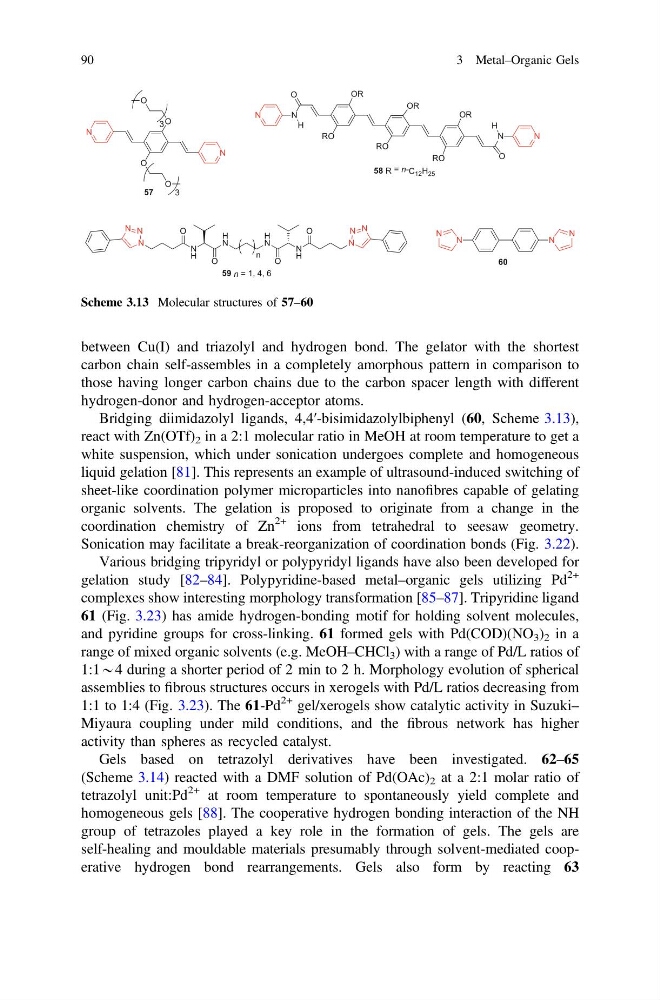
Bridging diimidazolyl ligands, 4,4′-bisimidazolylbiphenyl (60, Scheme 3.13),
react with Zn(OTf) 2 in a 2:1 molecular ratio in MeOH at room temperature to get a
white suspension, which under sonication undergoes complete and homogeneous
liquid gelation [81]. This represents an example of ultrasound-induced switching of
sheet-like coordination polymer microparticles into nanofibres capable of gelating
organic solvents. The gelation is proposed to originate from a change in the
coordination chemistry of Zn
2+ ions from tetrahedral to seesaw geometry.
Sonication may facilitate a break-reorganization of coordination bonds (Fig. 3.22).
Various bridging tripyridyl or polypyridyl ligands have also been developed for
gelation study [82–84]. Polypyridine-based metal–organic gels utilizing Pd
2+
complexes show interesting morphology transformation [85–87]. Tripyridine ligand
61 (Fig. 3.23) has amide hydrogen-bonding motif for holding solvent molecules,
and pyridine groups for cross-linking. 61 formed gels with Pd(COD)(NO 3 ) 2 in a
range of mixed organic solvents (e.g. MeOH–CHCl 3 ) with a range of Pd/L ratios of
1:1*4 during a shorter period of 2 min to 2 h. Morphology evolution of spherical
assemblies to fibrous structures occurs in xerogels with Pd/L ratios decreasing from
1:1 to 1:4 (Fig. 3.23). The 61-Pd
2+ gel/xerogels show catalytic activity in Suzuki–
Miyaura coupling under mild conditions, and the fibrous network has higher
activity than spheres as recycled catalyst.
Gels based on tetrazolyl derivatives have been investigated. 62–65
(Scheme 3.14) reacted with a DMF solution of Pd(OAc) 2 at a 2:1 molar ratio of
tetrazolyl unit:Pd
2+ at room temperature to spontaneously yield complete and
homogeneous gels [88]. The cooperative hydrogen bonding interaction of the NH
group of tetrazoles played a key role in the formation of gels. The gels are
self-healing and mouldable materials presumably through solvent-mediated cooperative hydrogen bond rearrangements. Gels also form by reacting 63
N
N
H
OR
RO
O
RO
OR
N
H
N
O
RO
OR
58 R = n- C 12 H 25
57
N
N
O
O
O
O
3
3
H
N
H
N
O
N
H
O
O
N
N
N
N
H
O
N
N
N
n
59 n = 1, 4, 6
N
N
N
N
60
Scheme 3.13 Molecular structures of 57–60
90
3 Metal–Organic Gels
carbon chain self-assembles in a completely amorphous pattern in comparison to
those having longer carbon chains due to the carbon spacer length with different
hydrogen-donor and hydrogen-acceptor atoms.
Bridging diimidazolyl ligands, 4,4′-bisimidazolylbiphenyl (60, Scheme 3.13),
react with Zn(OTf) 2 in a 2:1 molecular ratio in MeOH at room temperature to get a
white suspension, which under sonication undergoes complete and homogeneous
liquid gelation [81]. This represents an example of ultrasound-induced switching of
sheet-like coordination polymer microparticles into nanofibres capable of gelating
organic solvents. The gelation is proposed to originate from a change in the
coordination chemistry of Zn
2+ ions from tetrahedral to seesaw geometry.
Sonication may facilitate a break-reorganization of coordination bonds (Fig. 3.22).
Various bridging tripyridyl or polypyridyl ligands have also been developed for
gelation study [82–84]. Polypyridine-based metal–organic gels utilizing Pd
2+
complexes show interesting morphology transformation [85–87]. Tripyridine ligand
61 (Fig. 3.23) has amide hydrogen-bonding motif for holding solvent molecules,
and pyridine groups for cross-linking. 61 formed gels with Pd(COD)(NO 3 ) 2 in a
range of mixed organic solvents (e.g. MeOH–CHCl 3 ) with a range of Pd/L ratios of
1:1*4 during a shorter period of 2 min to 2 h. Morphology evolution of spherical
assemblies to fibrous structures occurs in xerogels with Pd/L ratios decreasing from
1:1 to 1:4 (Fig. 3.23). The 61-Pd
2+ gel/xerogels show catalytic activity in Suzuki–
Miyaura coupling under mild conditions, and the fibrous network has higher
activity than spheres as recycled catalyst.
Gels based on tetrazolyl derivatives have been investigated. 62–65
(Scheme 3.14) reacted with a DMF solution of Pd(OAc) 2 at a 2:1 molar ratio of
tetrazolyl unit:Pd
2+ at room temperature to spontaneously yield complete and
homogeneous gels [88]. The cooperative hydrogen bonding interaction of the NH
group of tetrazoles played a key role in the formation of gels. The gels are
self-healing and mouldable materials presumably through solvent-mediated cooperative hydrogen bond rearrangements. Gels also form by reacting 63
N
N
H
OR
RO
O
RO
OR
N
H
N
O
RO
OR
58 R = n- C 12 H 25
57
N
N
O
O
O
O
3
3
H
N
H
N
O
N
H
O
O
N
N
N
N
H
O
N
N
N
n
59 n = 1, 4, 6
N
N
N
N
60
Scheme 3.13 Molecular structures of 57–60
90
3 Metal–Organic Gels