

example, metal–organic gels are obtained from Zr
4+ and 2-aminoterephthalic acid.
The gels are based on UiO-66-NH 2 MOF nanoparticles [52]. Cu
2+ gel materials are
prepared from Cu(NO 3 ) 2 Á3H 2 O and H 3 BTC in the present of triethylamine [53].
Cu
2+ gel materials are also obtained via deprotonation of H 3 BTC by KOH.
A continuous morphology evolution from granular particles to fibres exists is
adjusted and controlled with a gradual decrease of the Cu/BTC molar ratio [54].
Cu
2+ gels are also readily obtained by simple mixing of stock solutions of Cu
2+ and
oxalic acid at room temperature. The gel shows proton conduction of 10
−3
–
10
−4 S cm
−1 under anhydrous conditions [55]. What’s more, the Cu
2+ -oxalate gel
shows self-healing and mouldable properties. The system displays an ability to
impart self-healing properties to other gel networks lacking this capacity [56].
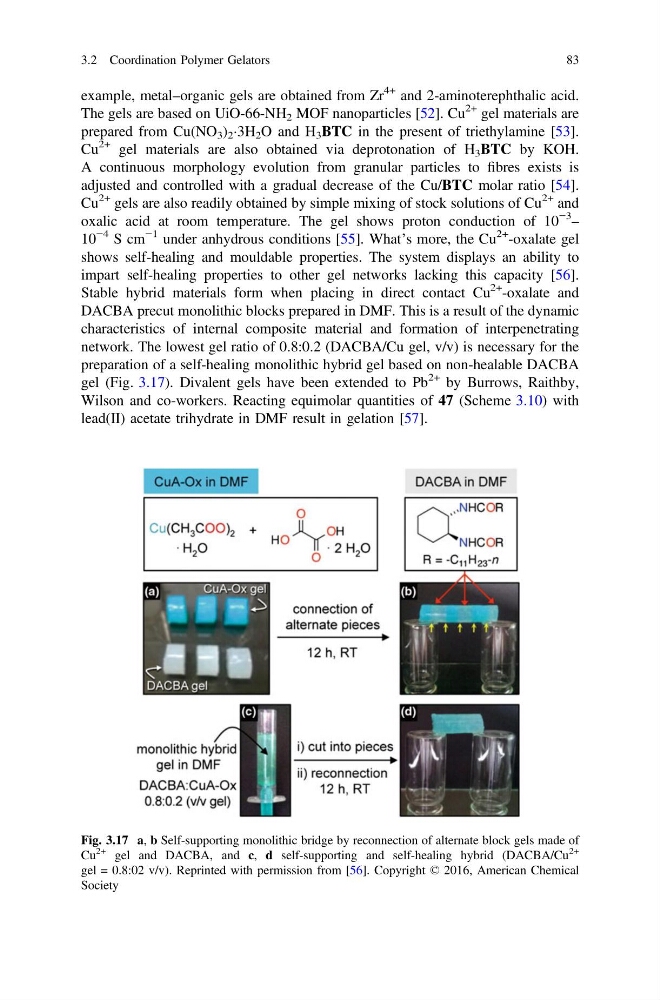
Stable hybrid materials form when placing in direct contact Cu
2+ -oxalate and
DACBA precut monolithic blocks prepared in DMF. This is a result of the dynamic
characteristics of internal composite material and formation of interpenetrating
network. The lowest gel ratio of 0.8:0.2 (DACBA/Cu gel, v/v) is necessary for the
preparation of a self-healing monolithic hybrid gel based on non-healable DACBA
gel (Fig. 3.17). Divalent gels have been extended to Pb
2+ by Burrows, Raithby,
Wilson and co-workers. Reacting equimolar quantities of 47 (Scheme 3.10) with
lead(II) acetate trihydrate in DMF result in gelation [57].
Fig. 3.17 a, b Self-supporting monolithic bridge by reconnection of alternate block gels made of
Cu
2+ gel and DACBA, and c, d self-supporting and self-healing hybrid (DACBA/Cu
2+
gel = 0.8:02 v/v). Reprinted with permission from [56]. Copyright © 2016, American Chemical
Society
3.2 Coordination Polymer Gelators
83
4+ and 2-aminoterephthalic acid.
The gels are based on UiO-66-NH 2 MOF nanoparticles [52]. Cu
2+ gel materials are
prepared from Cu(NO 3 ) 2 Á3H 2 O and H 3 BTC in the present of triethylamine [53].
Cu
2+ gel materials are also obtained via deprotonation of H 3 BTC by KOH.
A continuous morphology evolution from granular particles to fibres exists is
adjusted and controlled with a gradual decrease of the Cu/BTC molar ratio [54].
Cu
2+ gels are also readily obtained by simple mixing of stock solutions of Cu
2+ and
oxalic acid at room temperature. The gel shows proton conduction of 10
−3
–
10
−4 S cm
−1 under anhydrous conditions [55]. What’s more, the Cu
2+ -oxalate gel
shows self-healing and mouldable properties. The system displays an ability to
impart self-healing properties to other gel networks lacking this capacity [56].
Stable hybrid materials form when placing in direct contact Cu
2+ -oxalate and
DACBA precut monolithic blocks prepared in DMF. This is a result of the dynamic
characteristics of internal composite material and formation of interpenetrating
network. The lowest gel ratio of 0.8:0.2 (DACBA/Cu gel, v/v) is necessary for the
preparation of a self-healing monolithic hybrid gel based on non-healable DACBA
gel (Fig. 3.17). Divalent gels have been extended to Pb
2+ by Burrows, Raithby,
Wilson and co-workers. Reacting equimolar quantities of 47 (Scheme 3.10) with
lead(II) acetate trihydrate in DMF result in gelation [57].
Fig. 3.17 a, b Self-supporting monolithic bridge by reconnection of alternate block gels made of
Cu
2+ gel and DACBA, and c, d self-supporting and self-healing hybrid (DACBA/Cu
2+
gel = 0.8:02 v/v). Reprinted with permission from [56]. Copyright © 2016, American Chemical
Society
3.2 Coordination Polymer Gelators
83