

3.2 Coordination Polymer Gelators
3.2.1 Metal-Carboxylate Gels
Various bridging carboxylate derivatives have been used to produce this class of
metal-carboxylate gels in the past decade. Fe
3+ and benzene-1,3,5-tricarboxylic acid
(H 3 BTC) can be easily to form gels in alcohols in a few minutes [47]. The Fe-BTC
gel can be readily extended to a series of gels based on trivalent metal ions (e.g.
Al
3+ , Cr
3+ ) and carboxylates with a bridging dicarboxylate motif [48, 49].
Metal-carboxylate gels of Fe
3+ are easy to form at room temperature, but those of
Al
3+ , Cr
3+ need heating during the gelation process. Metal-rigid bridging carboxylate gels are easy to design and adjust in their structure and function, due to
metal ion variability and a variety of organic ligands. This kind of materials can be
used in adsorption, separation and catalysis applications and as templates.
The metal-carboxylate gels are made up of coordination polymer nanoparticles,
which is different from usual fibrous networks of supramolecular gels [48, 50, 51].
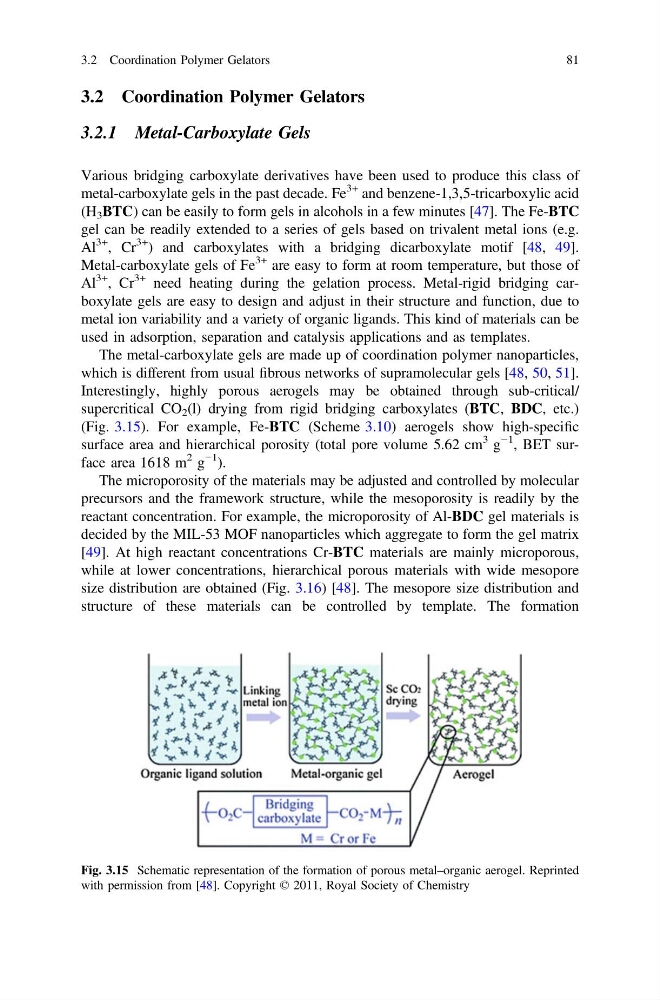
Interestingly, highly porous aerogels may be obtained through sub-critical/
supercritical CO 2 (l) drying from rigid bridging carboxylates (BTC, BDC, etc.)
(Fig. 3.15). For example, Fe-BTC (Scheme 3.10) aerogels show high-specific
surface area and hierarchical porosity (total pore volume 5.62 cm
3 g
−1 , BET surface area 1618 m
2 g
−1 ).
The microporosity of the materials may be adjusted and controlled by molecular
precursors and the framework structure, while the mesoporosity is readily by the
reactant concentration. For example, the microporosity of Al-BDC gel materials is
decided by the MIL-53 MOF nanoparticles which aggregate to form the gel matrix
[49]. At high reactant concentrations Cr-BTC materials are mainly microporous,
while at lower concentrations, hierarchical porous materials with wide mesopore
size distribution are obtained (Fig. 3.16) [48]. The mesopore size distribution and
structure of these materials can be controlled by template. The formation
Fig. 3.15 Schematic representation of the formation of porous metal–organic aerogel. Reprinted
with permission from [48]. Copyright © 2011, Royal Society of Chemistry
3.2 Coordination Polymer Gelators
81
3.2.1 Metal-Carboxylate Gels
Various bridging carboxylate derivatives have been used to produce this class of
metal-carboxylate gels in the past decade. Fe
3+ and benzene-1,3,5-tricarboxylic acid
(H 3 BTC) can be easily to form gels in alcohols in a few minutes [47]. The Fe-BTC
gel can be readily extended to a series of gels based on trivalent metal ions (e.g.
Al
3+ , Cr
3+ ) and carboxylates with a bridging dicarboxylate motif [48, 49].
Metal-carboxylate gels of Fe
3+ are easy to form at room temperature, but those of
Al
3+ , Cr
3+ need heating during the gelation process. Metal-rigid bridging carboxylate gels are easy to design and adjust in their structure and function, due to
metal ion variability and a variety of organic ligands. This kind of materials can be
used in adsorption, separation and catalysis applications and as templates.
The metal-carboxylate gels are made up of coordination polymer nanoparticles,
which is different from usual fibrous networks of supramolecular gels [48, 50, 51].
Interestingly, highly porous aerogels may be obtained through sub-critical/
supercritical CO 2 (l) drying from rigid bridging carboxylates (BTC, BDC, etc.)
(Fig. 3.15). For example, Fe-BTC (Scheme 3.10) aerogels show high-specific
surface area and hierarchical porosity (total pore volume 5.62 cm
3 g
−1 , BET surface area 1618 m
2 g
−1 ).
The microporosity of the materials may be adjusted and controlled by molecular
precursors and the framework structure, while the mesoporosity is readily by the
reactant concentration. For example, the microporosity of Al-BDC gel materials is
decided by the MIL-53 MOF nanoparticles which aggregate to form the gel matrix
[49]. At high reactant concentrations Cr-BTC materials are mainly microporous,
while at lower concentrations, hierarchical porous materials with wide mesopore
size distribution are obtained (Fig. 3.16) [48]. The mesopore size distribution and
structure of these materials can be controlled by template. The formation
Fig. 3.15 Schematic representation of the formation of porous metal–organic aerogel. Reprinted
with permission from [48]. Copyright © 2011, Royal Society of Chemistry
3.2 Coordination Polymer Gelators
81