

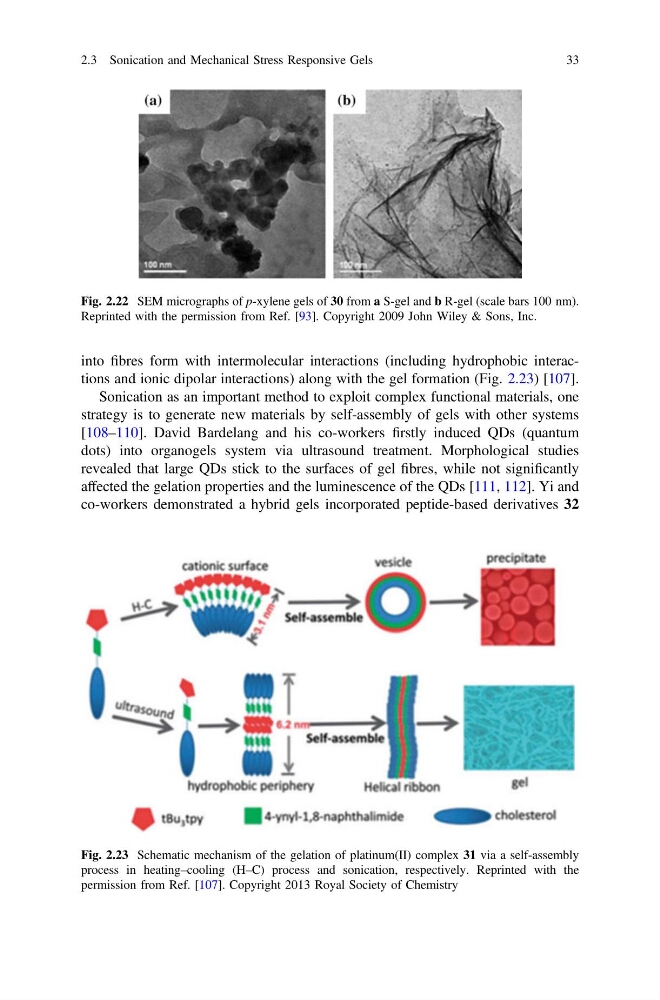
into fibres form with intermolecular interactions (including hydrophobic interactions and ionic dipolar interactions) along with the gel formation (Fig. 2.23) [107].
Sonication as an important method to exploit complex functional materials, one
strategy is to generate new materials by self-assembly of gels with other systems
[108–110]. David Bardelang and his co-workers firstly induced QDs (quantum
dots) into organogels system via ultrasound treatment. Morphological studies
revealed that large QDs stick to the surfaces of gel fibres, while not significantly
affected the gelation properties and the luminescence of the QDs [111, 112]. Yi and
co-workers demonstrated a hybrid gels incorporated peptide-based derivatives 32
Fig. 2.22 SEM micrographs of p-xylene gels of 30 from a S-gel and b R-gel (scale bars 100 nm).
Reprinted with the permission from Ref. [93]. Copyright 2009 John Wiley & Sons, Inc.
Fig. 2.23 Schematic mechanism of the gelation of platinum(II) complex 31 via a self-assembly
process in heating–cooling (H–C) process and sonication, respectively. Reprinted with the
permission from Ref. [107]. Copyright 2013 Royal Society of Chemistry
2.3 Sonication and Mechanical Stress Responsive Gels
33
Sonication as an important method to exploit complex functional materials, one
strategy is to generate new materials by self-assembly of gels with other systems
[108–110]. David Bardelang and his co-workers firstly induced QDs (quantum
dots) into organogels system via ultrasound treatment. Morphological studies
revealed that large QDs stick to the surfaces of gel fibres, while not significantly
affected the gelation properties and the luminescence of the QDs [111, 112]. Yi and
co-workers demonstrated a hybrid gels incorporated peptide-based derivatives 32
Fig. 2.22 SEM micrographs of p-xylene gels of 30 from a S-gel and b R-gel (scale bars 100 nm).
Reprinted with the permission from Ref. [93]. Copyright 2009 John Wiley & Sons, Inc.
Fig. 2.23 Schematic mechanism of the gelation of platinum(II) complex 31 via a self-assembly
process in heating–cooling (H–C) process and sonication, respectively. Reprinted with the
permission from Ref. [107]. Copyright 2013 Royal Society of Chemistry
2.3 Sonication and Mechanical Stress Responsive Gels
33