

2.2 Light Responsive Gels
Supramolecular gels based on photoresponsive chromophores have attracted much
attention since the modulation of their properties can be realized by using light as an
external trigger. Generally, the trans–cis isomerization, 2+2 dimerization, photoscission, photopolymerizations of the chromophore derived gelators can be realized.
The common patterns of reactivity based on LMWGs are listed in Table 2.1. Upon
photoirradiation, the changes at microlevel based on the supramolecular interactions
such as p–p stacking and hydrogen bonding and so on can result in the transformation of self-assembly manners of gelators. Further, the properties of gels produce
changes, such as the change of viscosity and polarity, the modulation of the size and
shape of the xerogel morphology, electronic properties. Such processes can be
sorted as conformational changes, coupling reactions, intramolecular proton
transfer and electrocyclic reactions of the photoresponsive chromophores. And the
most commonly used photoresponsive chromophores include azobenzene, stilbene,
diarylethene and spiropyran.
2.2.1 Conformational Changes
In supramolecular gels, the changes of molecular conformation are quite common,
generally, in which, the bond angels vary while the connectivity of the atoms
remains fixed. In this process, gelators with flexibility can get access to different
packing modes with comparable energies. And cis–trans isomerization is particularly popular, because they have a reversible conversion between the two fixed
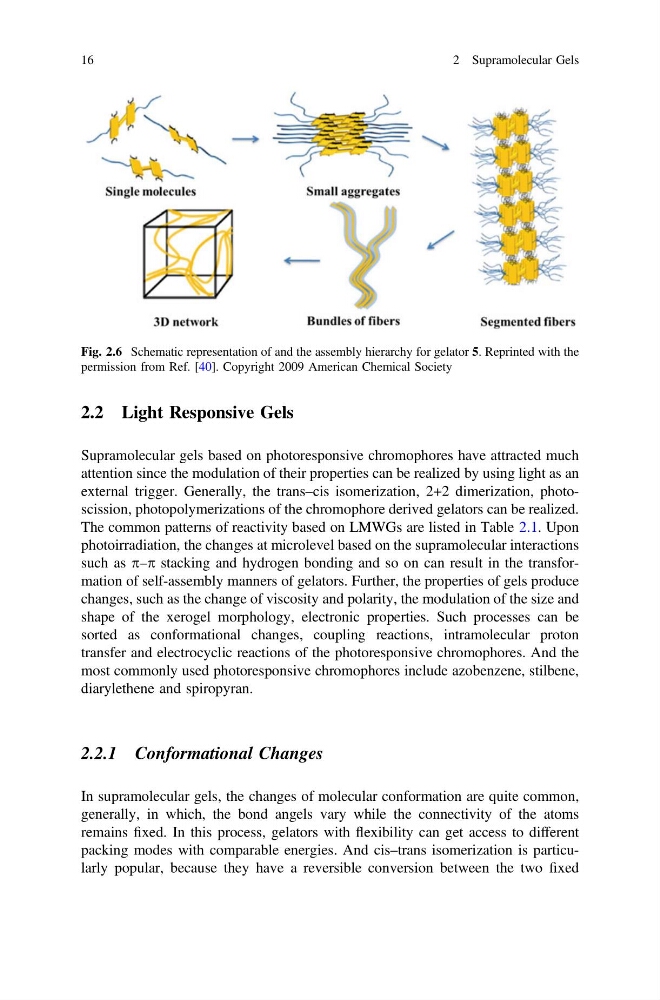
Fig. 2.6 Schematic representation of and the assembly hierarchy for gelator 5. Reprinted with the
permission from Ref. [40]. Copyright 2009 American Chemical Society
16
2 Supramolecular Gels
Supramolecular gels based on photoresponsive chromophores have attracted much
attention since the modulation of their properties can be realized by using light as an
external trigger. Generally, the trans–cis isomerization, 2+2 dimerization, photoscission, photopolymerizations of the chromophore derived gelators can be realized.
The common patterns of reactivity based on LMWGs are listed in Table 2.1. Upon
photoirradiation, the changes at microlevel based on the supramolecular interactions
such as p–p stacking and hydrogen bonding and so on can result in the transformation of self-assembly manners of gelators. Further, the properties of gels produce
changes, such as the change of viscosity and polarity, the modulation of the size and
shape of the xerogel morphology, electronic properties. Such processes can be
sorted as conformational changes, coupling reactions, intramolecular proton
transfer and electrocyclic reactions of the photoresponsive chromophores. And the
most commonly used photoresponsive chromophores include azobenzene, stilbene,
diarylethene and spiropyran.
2.2.1 Conformational Changes
In supramolecular gels, the changes of molecular conformation are quite common,
generally, in which, the bond angels vary while the connectivity of the atoms
remains fixed. In this process, gelators with flexibility can get access to different
packing modes with comparable energies. And cis–trans isomerization is particularly popular, because they have a reversible conversion between the two fixed
Fig. 2.6 Schematic representation of and the assembly hierarchy for gelator 5. Reprinted with the
permission from Ref. [40]. Copyright 2009 American Chemical Society
16
2 Supramolecular Gels