

polyethylene glycol (PEG) chains increases, inducing the lower polarity, and the
PEG chains further predominate the adjacent fibres interact [39]. Therefore, the
fibres become more hydrophobic, resulting in increasing aggregation and expulsion
of solvent molecules beyond 70 °C. And temperature triggered deswelling of the
gel leads to the (reversible) expulsion of a large fraction of the aqueous solvent
(Fig. 2.6) [40].
Due to the controlled manner, swelling of supramolecular gels composed of
LMWGs has been exploited in drug release, especially in topical applications [41,
42]. LMWGs possess a number of advantages: simple to synthesis, rapid
low-temperature interconversion in gel–sol transition, controllably modified to
realize specific interactions with target molecules [35, 43, 44]. However, it is hard
to design sufficiently stable and biocompatible supramolecular gels with specific
properties, and the widespread use of LMWGs in medical products has yet to be
realized [45].
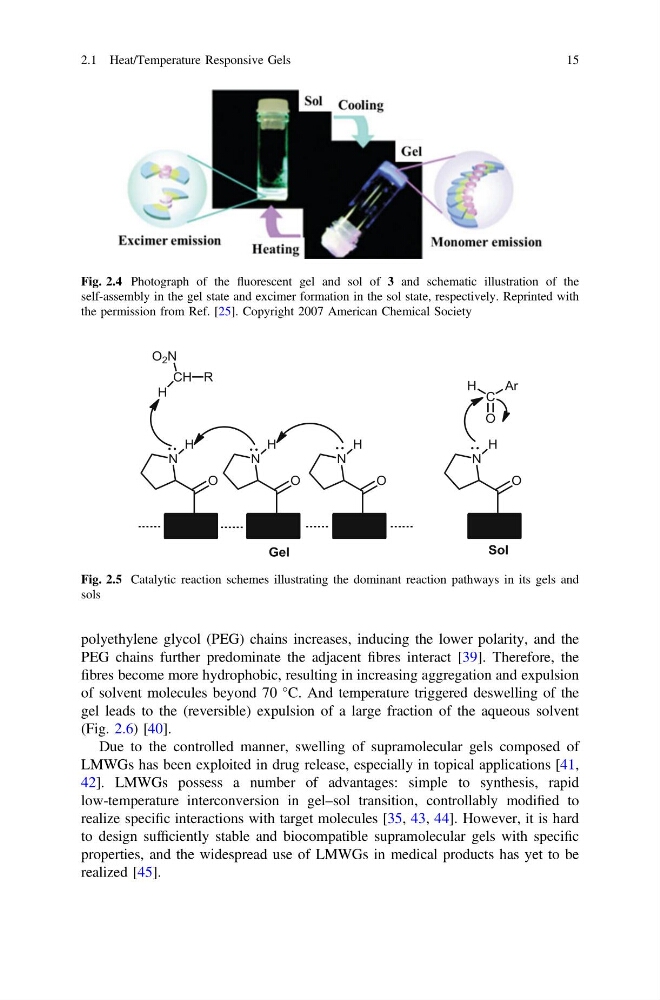
Fig. 2.4 Photograph of the fluorescent gel and sol of 3 and schematic illustration of the
self-assembly in the gel state and excimer formation in the sol state, respectively. Reprinted with
the permission from Ref. [25]. Copyright 2007 American Chemical Society
Fig. 2.5 Catalytic reaction schemes illustrating the dominant reaction pathways in its gels and
sols
2.1 Heat/Temperature Responsive Gels
15
PEG chains further predominate the adjacent fibres interact [39]. Therefore, the
fibres become more hydrophobic, resulting in increasing aggregation and expulsion
of solvent molecules beyond 70 °C. And temperature triggered deswelling of the
gel leads to the (reversible) expulsion of a large fraction of the aqueous solvent
(Fig. 2.6) [40].
Due to the controlled manner, swelling of supramolecular gels composed of
LMWGs has been exploited in drug release, especially in topical applications [41,
42]. LMWGs possess a number of advantages: simple to synthesis, rapid
low-temperature interconversion in gel–sol transition, controllably modified to
realize specific interactions with target molecules [35, 43, 44]. However, it is hard
to design sufficiently stable and biocompatible supramolecular gels with specific
properties, and the widespread use of LMWGs in medical products has yet to be
realized [45].
Fig. 2.4 Photograph of the fluorescent gel and sol of 3 and schematic illustration of the
self-assembly in the gel state and excimer formation in the sol state, respectively. Reprinted with
the permission from Ref. [25]. Copyright 2007 American Chemical Society
Fig. 2.5 Catalytic reaction schemes illustrating the dominant reaction pathways in its gels and
sols
2.1 Heat/Temperature Responsive Gels
15