

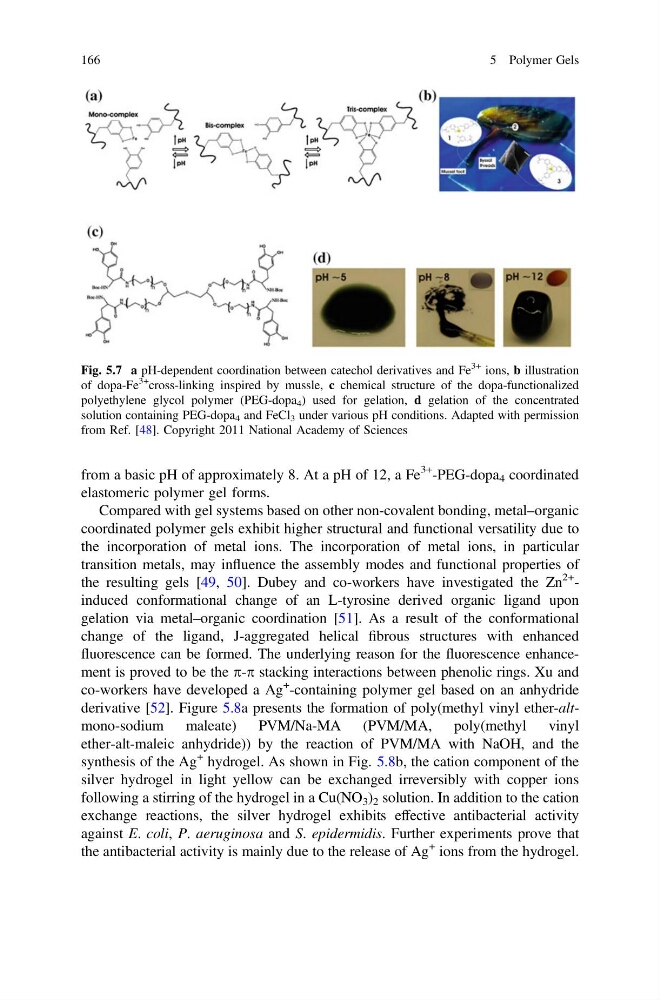
from a basic pH of approximately 8. At a pH of 12, a Fe
3+ -PEG-dopa 4 coordinated
elastomeric polymer gel forms.
Compared with gel systems based on other non-covalent bonding, metal–organic
coordinated polymer gels exhibit higher structural and functional versatility due to
the incorporation of metal ions. The incorporation of metal ions, in particular
transition metals, may influence the assembly modes and functional properties of
the resulting gels [49, 50]. Dubey and co-workers have investigated the Zn
2+ -
induced conformational change of an L-tyrosine derived organic ligand upon
gelation via metal–organic coordination [51]. As a result of the conformational
change of the ligand, J-aggregated helical fibrous structures with enhanced
fluorescence can be formed. The underlying reason for the fluorescence enhancement is proved to be the p-p stacking interactions between phenolic rings. Xu and
co-workers have developed a Ag
+
-containing polymer gel based on an anhydride
derivative [52]. Figure 5.8a presents the formation of poly(methyl vinyl ether-altmono-sodium maleate) PVM/Na-MA (PVM/MA, poly(methyl vinyl
ether-alt-maleic anhydride)) by the reaction of PVM/MA with NaOH, and the
synthesis of the Ag
+ hydrogel. As shown in Fig. 5.8b, the cation component of the
silver hydrogel in light yellow can be exchanged irreversibly with copper ions
following a stirring of the hydrogel in a Cu(NO 3 ) 2 solution. In addition to the cation
exchange reactions, the silver hydrogel exhibits effective antibacterial activity
against E. coli, P. aeruginosa and S. epidermidis. Further experiments prove that
the antibacterial activity is mainly due to the release of Ag
+ ions from the hydrogel.
Fig. 5.7 a pH-dependent coordination between catechol derivatives and Fe
3+ ions, b illustration
of dopa-Fe
3+ cross-linking inspired by mussle, c chemical structure of the dopa-functionalized
polyethylene glycol polymer (PEG-dopa 4 ) used for gelation, d gelation of the concentrated
solution containing PEG-dopa 4 and FeCl 3 under various pH conditions. Adapted with permission
from Ref. [48]. Copyright 2011 National Academy of Sciences
166
5 Polymer Gels
3+ -PEG-dopa 4 coordinated
elastomeric polymer gel forms.
Compared with gel systems based on other non-covalent bonding, metal–organic
coordinated polymer gels exhibit higher structural and functional versatility due to
the incorporation of metal ions. The incorporation of metal ions, in particular
transition metals, may influence the assembly modes and functional properties of
the resulting gels [49, 50]. Dubey and co-workers have investigated the Zn
2+ -
induced conformational change of an L-tyrosine derived organic ligand upon
gelation via metal–organic coordination [51]. As a result of the conformational
change of the ligand, J-aggregated helical fibrous structures with enhanced
fluorescence can be formed. The underlying reason for the fluorescence enhancement is proved to be the p-p stacking interactions between phenolic rings. Xu and
co-workers have developed a Ag
+
-containing polymer gel based on an anhydride
derivative [52]. Figure 5.8a presents the formation of poly(methyl vinyl ether-altmono-sodium maleate) PVM/Na-MA (PVM/MA, poly(methyl vinyl
ether-alt-maleic anhydride)) by the reaction of PVM/MA with NaOH, and the
synthesis of the Ag
+ hydrogel. As shown in Fig. 5.8b, the cation component of the
silver hydrogel in light yellow can be exchanged irreversibly with copper ions
following a stirring of the hydrogel in a Cu(NO 3 ) 2 solution. In addition to the cation
exchange reactions, the silver hydrogel exhibits effective antibacterial activity
against E. coli, P. aeruginosa and S. epidermidis. Further experiments prove that
the antibacterial activity is mainly due to the release of Ag
+ ions from the hydrogel.
Fig. 5.7 a pH-dependent coordination between catechol derivatives and Fe
3+ ions, b illustration
of dopa-Fe
3+ cross-linking inspired by mussle, c chemical structure of the dopa-functionalized
polyethylene glycol polymer (PEG-dopa 4 ) used for gelation, d gelation of the concentrated
solution containing PEG-dopa 4 and FeCl 3 under various pH conditions. Adapted with permission
from Ref. [48]. Copyright 2011 National Academy of Sciences
166
5 Polymer Gels