

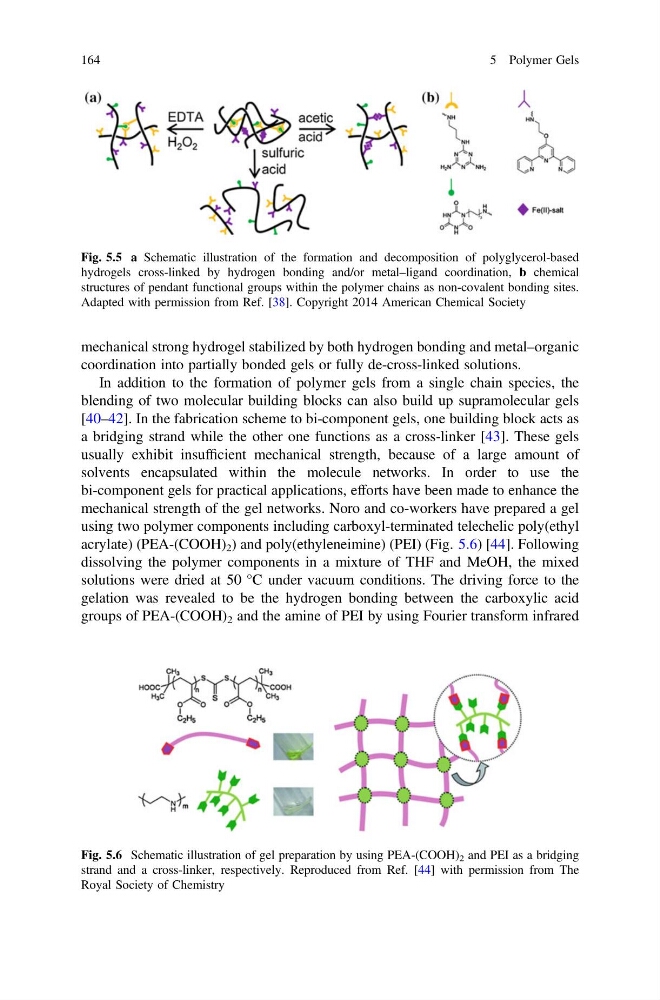
mechanical strong hydrogel stabilized by both hydrogen bonding and metal–organic
coordination into partially bonded gels or fully de-cross-linked solutions.
In addition to the formation of polymer gels from a single chain species, the
blending of two molecular building blocks can also build up supramolecular gels
[40–42]. In the fabrication scheme to bi-component gels, one building block acts as
a bridging strand while the other one functions as a cross-linker [43]. These gels
usually exhibit insufficient mechanical strength, because of a large amount of
solvents encapsulated within the molecule networks. In order to use the
bi-component gels for practical applications, efforts have been made to enhance the
mechanical strength of the gel networks. Noro and co-workers have prepared a gel
using two polymer components including carboxyl-terminated telechelic poly(ethyl
acrylate) (PEA-(COOH) 2 ) and poly(ethyleneimine) (PEI) (Fig. 5.6) [44]. Following
dissolving the polymer components in a mixture of THF and MeOH, the mixed
solutions were dried at 50 °C under vacuum conditions. The driving force to the
gelation was revealed to be the hydrogen bonding between the carboxylic acid
groups of PEA-(COOH) 2 and the amine of PEI by using Fourier transform infrared
Fig. 5.5 a Schematic illustration of the formation and decomposition of polyglycerol-based
hydrogels cross-linked by hydrogen bonding and/or metal–ligand coordination, b chemical
structures of pendant functional groups within the polymer chains as non-covalent bonding sites.
Adapted with permission from Ref. [38]. Copyright 2014 American Chemical Society
Fig. 5.6 Schematic illustration of gel preparation by using PEA-(COOH) 2 and PEI as a bridging
strand and a cross-linker, respectively. Reproduced from Ref. [44] with permission from The
Royal Society of Chemistry
164
5 Polymer Gels
coordination into partially bonded gels or fully de-cross-linked solutions.
In addition to the formation of polymer gels from a single chain species, the
blending of two molecular building blocks can also build up supramolecular gels
[40–42]. In the fabrication scheme to bi-component gels, one building block acts as
a bridging strand while the other one functions as a cross-linker [43]. These gels
usually exhibit insufficient mechanical strength, because of a large amount of
solvents encapsulated within the molecule networks. In order to use the
bi-component gels for practical applications, efforts have been made to enhance the
mechanical strength of the gel networks. Noro and co-workers have prepared a gel
using two polymer components including carboxyl-terminated telechelic poly(ethyl
acrylate) (PEA-(COOH) 2 ) and poly(ethyleneimine) (PEI) (Fig. 5.6) [44]. Following
dissolving the polymer components in a mixture of THF and MeOH, the mixed
solutions were dried at 50 °C under vacuum conditions. The driving force to the
gelation was revealed to be the hydrogen bonding between the carboxylic acid
groups of PEA-(COOH) 2 and the amine of PEI by using Fourier transform infrared
Fig. 5.5 a Schematic illustration of the formation and decomposition of polyglycerol-based
hydrogels cross-linked by hydrogen bonding and/or metal–ligand coordination, b chemical
structures of pendant functional groups within the polymer chains as non-covalent bonding sites.
Adapted with permission from Ref. [38]. Copyright 2014 American Chemical Society
Fig. 5.6 Schematic illustration of gel preparation by using PEA-(COOH) 2 and PEI as a bridging
strand and a cross-linker, respectively. Reproduced from Ref. [44] with permission from The
Royal Society of Chemistry
164
5 Polymer Gels