

deformation as large as 300%. The development of this UPy-PEG hybrid gel plays
a key step towards utilizing polymer gels in lithium-ion battery and biomedical
devices.
The toughness and stability of most polymer gels are often strengthened by
combining more than one supramolecular cross-linking modes within a single gel
system [37]. To date, a variety of synthetic polymers have been developed for the
formation of polymer gels linked by multiple non-covalent bonding [38, 39]. The
synthetic polymers (e.g. PEG, polyglycerol (PG) and poly(hydroxyethyl
methacrylate (PHEMA)) exhibit advantages over natural biopolymer gels, since
these synthetic ones show more structural uniformness from batch to batch. As
shown in Fig. 5.5, Hackelbusch and co-workers presented a polymer gel network
based on a polyglycerol backbone. The linear polyglycerol chains are biocompatible
and can be synthetically functionalized with cyanurate, diaminotriazine and terpyridine moieties. Hydrogels were formed under mild aqueous conditions through
the hydrogen bonding between cyanurate and diaminotriazine, and the coordination
interactions between terpyridine and iron(II) ions. Due to the stability of the
non-covalent bonds, the resulting hydrogels can remain stable in water for several
weeks. The mechanical performance of hydrogels can be tuned by manipulating the
interactions between polymer chains. This interaction manipulation is achieved
through adding de-cross-linking agents. The added acetic acid disrupts the hydrogen
bonds within a few hours while maintaining the terpyridine-iron(II) coordination
bonds. In contrast, the mixture of EDTA and H 2 O 2 disrupts the coordination bonds
instead of the hydrogen bonding. Compared to acetic acid and EDTA/H 2 O 2 , sulphuric acid is a stronger de-cross-linking agent leading to the degradation of the
entire gel networks. This agent-controlled approach enables the transition from the
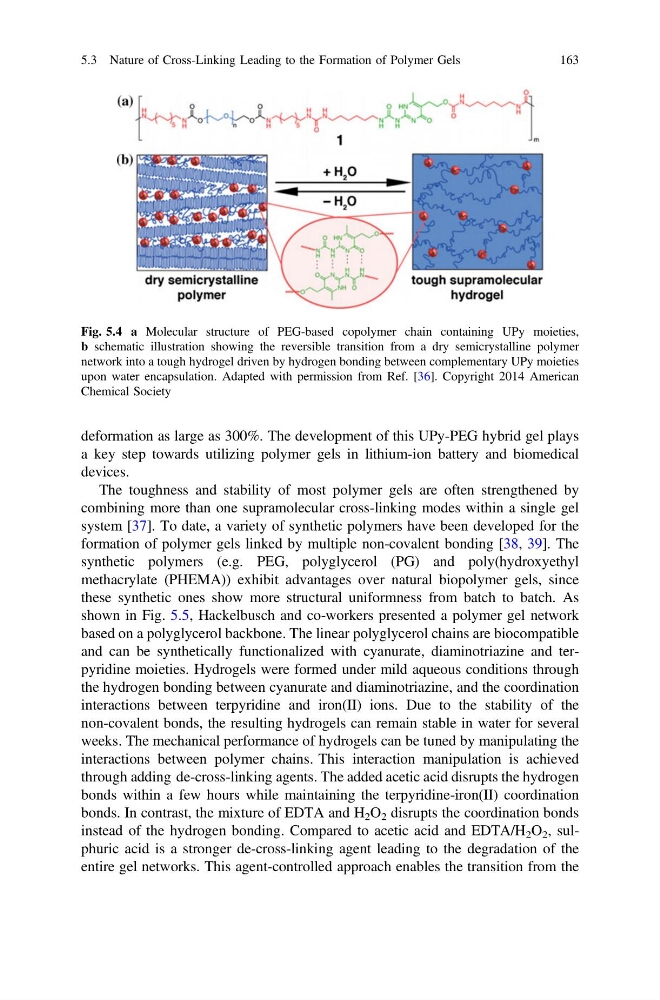
Fig. 5.4 a Molecular structure of PEG-based copolymer chain containing UPy moieties,
b schematic illustration showing the reversible transition from a dry semicrystalline polymer
network into a tough hydrogel driven by hydrogen bonding between complementary UPy moieties
upon water encapsulation. Adapted with permission from Ref. [36]. Copyright 2014 American
Chemical Society
5.3 Nature of Cross-Linking Leading to the Formation of Polymer Gels
163
a key step towards utilizing polymer gels in lithium-ion battery and biomedical
devices.
The toughness and stability of most polymer gels are often strengthened by
combining more than one supramolecular cross-linking modes within a single gel
system [37]. To date, a variety of synthetic polymers have been developed for the
formation of polymer gels linked by multiple non-covalent bonding [38, 39]. The
synthetic polymers (e.g. PEG, polyglycerol (PG) and poly(hydroxyethyl
methacrylate (PHEMA)) exhibit advantages over natural biopolymer gels, since
these synthetic ones show more structural uniformness from batch to batch. As
shown in Fig. 5.5, Hackelbusch and co-workers presented a polymer gel network
based on a polyglycerol backbone. The linear polyglycerol chains are biocompatible
and can be synthetically functionalized with cyanurate, diaminotriazine and terpyridine moieties. Hydrogels were formed under mild aqueous conditions through
the hydrogen bonding between cyanurate and diaminotriazine, and the coordination
interactions between terpyridine and iron(II) ions. Due to the stability of the
non-covalent bonds, the resulting hydrogels can remain stable in water for several
weeks. The mechanical performance of hydrogels can be tuned by manipulating the
interactions between polymer chains. This interaction manipulation is achieved
through adding de-cross-linking agents. The added acetic acid disrupts the hydrogen
bonds within a few hours while maintaining the terpyridine-iron(II) coordination
bonds. In contrast, the mixture of EDTA and H 2 O 2 disrupts the coordination bonds
instead of the hydrogen bonding. Compared to acetic acid and EDTA/H 2 O 2 , sulphuric acid is a stronger de-cross-linking agent leading to the degradation of the
entire gel networks. This agent-controlled approach enables the transition from the
Fig. 5.4 a Molecular structure of PEG-based copolymer chain containing UPy moieties,
b schematic illustration showing the reversible transition from a dry semicrystalline polymer
network into a tough hydrogel driven by hydrogen bonding between complementary UPy moieties
upon water encapsulation. Adapted with permission from Ref. [36]. Copyright 2014 American
Chemical Society
5.3 Nature of Cross-Linking Leading to the Formation of Polymer Gels
163