

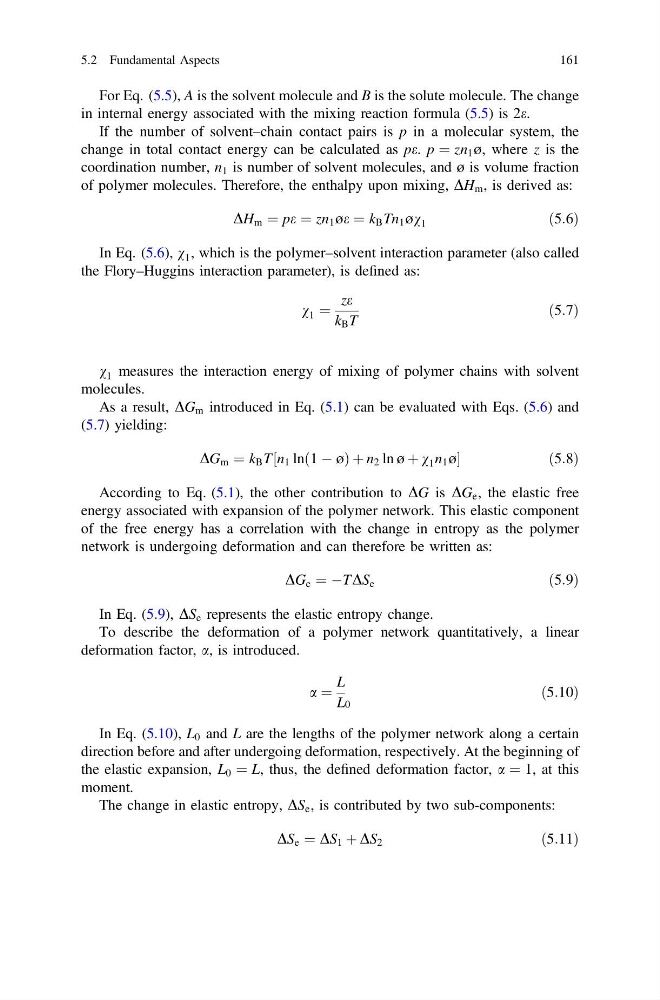
For Eq. (5.5), A is the solvent molecule and B is the solute molecule. The change
in internal energy associated with the mixing reaction formula (5.5) is 2e.
If the number of solvent–chain contact pairs is p in a molecular system, the
change in total contact energy can be calculated as pe. p ¼ zn 1 ø, where z is the
coordination number, n 1 is number of solvent molecules, and ø is volume fraction
of polymer molecules. Therefore, the enthalpy upon mixing, DH m , is derived as:
DH m ¼ pe ¼ zn 1 øe ¼ k B Tn 1 øv 1
ð5:6Þ
In Eq. (5.6), v 1 , which is the polymer–solvent interaction parameter (also called
the Flory–Huggins interaction parameter), is defined as:
v 1 ¼
ze
k B T
ð5:7Þ
v 1 measures the interaction energy of mixing of polymer chains with solvent
molecules.
As a result, DG m introduced in Eq. (5.1) can be evaluated with Eqs. (5.6) and
(5.7) yielding:
DG m ¼ k B T n 1 ln 1 À ø
ð
Þþn 2 ln ø þ v 1 n 1 ø
½
ð 5:8Þ
According to Eq. (5.1), the other contribution to DG is DG e , the elastic free
energy associated with expansion of the polymer network. This elastic component
of the free energy has a correlation with the change in entropy as the polymer
network is undergoing deformation and can therefore be written as:
DG e ¼ ÀTDS e
ð5:9Þ
In Eq. (5.9), DS e represents the elastic entropy change.
To describe the deformation of a polymer network quantitatively, a linear
deformation factor, a, is introduced.
a ¼
L
L0
ð5:10Þ
In Eq. (5.10), L 0 and L are the lengths of the polymer network along a certain
direction before and after undergoing deformation, respectively. At the beginning of
the elastic expansion, L 0 ¼ L, thus, the defined deformation factor, a ¼ 1, at this
moment.
The change in elastic entropy, DS e , is contributed by two sub-components:
DS e ¼ DS 1 þ DS 2
ð5:11Þ
5.2 Fundamental Aspects
161
in internal energy associated with the mixing reaction formula (5.5) is 2e.
If the number of solvent–chain contact pairs is p in a molecular system, the
change in total contact energy can be calculated as pe. p ¼ zn 1 ø, where z is the
coordination number, n 1 is number of solvent molecules, and ø is volume fraction
of polymer molecules. Therefore, the enthalpy upon mixing, DH m , is derived as:
DH m ¼ pe ¼ zn 1 øe ¼ k B Tn 1 øv 1
ð5:6Þ
In Eq. (5.6), v 1 , which is the polymer–solvent interaction parameter (also called
the Flory–Huggins interaction parameter), is defined as:
v 1 ¼
ze
k B T
ð5:7Þ
v 1 measures the interaction energy of mixing of polymer chains with solvent
molecules.
As a result, DG m introduced in Eq. (5.1) can be evaluated with Eqs. (5.6) and
(5.7) yielding:
DG m ¼ k B T n 1 ln 1 À ø
ð
Þþn 2 ln ø þ v 1 n 1 ø
½
ð 5:8Þ
According to Eq. (5.1), the other contribution to DG is DG e , the elastic free
energy associated with expansion of the polymer network. This elastic component
of the free energy has a correlation with the change in entropy as the polymer
network is undergoing deformation and can therefore be written as:
DG e ¼ ÀTDS e
ð5:9Þ
In Eq. (5.9), DS e represents the elastic entropy change.
To describe the deformation of a polymer network quantitatively, a linear
deformation factor, a, is introduced.
a ¼
L
L0
ð5:10Þ
In Eq. (5.10), L 0 and L are the lengths of the polymer network along a certain
direction before and after undergoing deformation, respectively. At the beginning of
the elastic expansion, L 0 ¼ L, thus, the defined deformation factor, a ¼ 1, at this
moment.
The change in elastic entropy, DS e , is contributed by two sub-components:
DS e ¼ DS 1 þ DS 2
ð5:11Þ
5.2 Fundamental Aspects
161