

bonding and p–p stacking as well as van der Waals force between alkyl chains are
responsive for the gelation. The organogel of 33 shows the ability to be coordinated by
Ca
2+ and formed metallogel CaG, accompanied by strong AIE (Fig. 4.9). The addition of Cu
2+ to CaG forms Ca
2+ /Cu
2+ -based metallogel (CaCuG) due to the
stronger coordination ability of Cu
2+ with 33 gel, resulting in quenching of the
fluorescence. The fluorescence may be restored after the addition of CN
− because
CN
− binds to Cu
2+ while Ca
2+ coordinates with 33 gel again. The result showed that
the “OFF–ON” fluorescent switch is controlled by Cu
2+ and CN
− .
After addition of 1 equiv. Mg
2+ to 33 gel, Mg
2+ was coordinated with the
nitrogen and oxygen atoms on acylhydrazone group, resulting in the formation of
MgG gel with blue fluorescence [23]. Then addition of 2 equiv. Co
2+ into MgG
forms Co
2+ /Mg
2+ -based metallogel MgCoG with quenched fluorescence because
Co
2+ replaces Mg
2+ due to the stronger coordination ability with G. Moreover, the
fluorescence could turn back after the addition of Cl
− because Cl
− bounds to Co
2+
and Mg
2+ coordinated with 33 again. The process is reversible so that the system
O
N
N
O
N
N
Cu
Weak coodination
O
N
N
O
N
N
Cu
Hg
Hg
Yellow gel (4-7 eqv. Hg)
Hg(OAc) 2
O
O
O
O
Cu
H
H
N
HN
H Hg
N
NH
H
Hg
Green gel ( 8 eqv. Hg)
Hg(OAc) 2
30
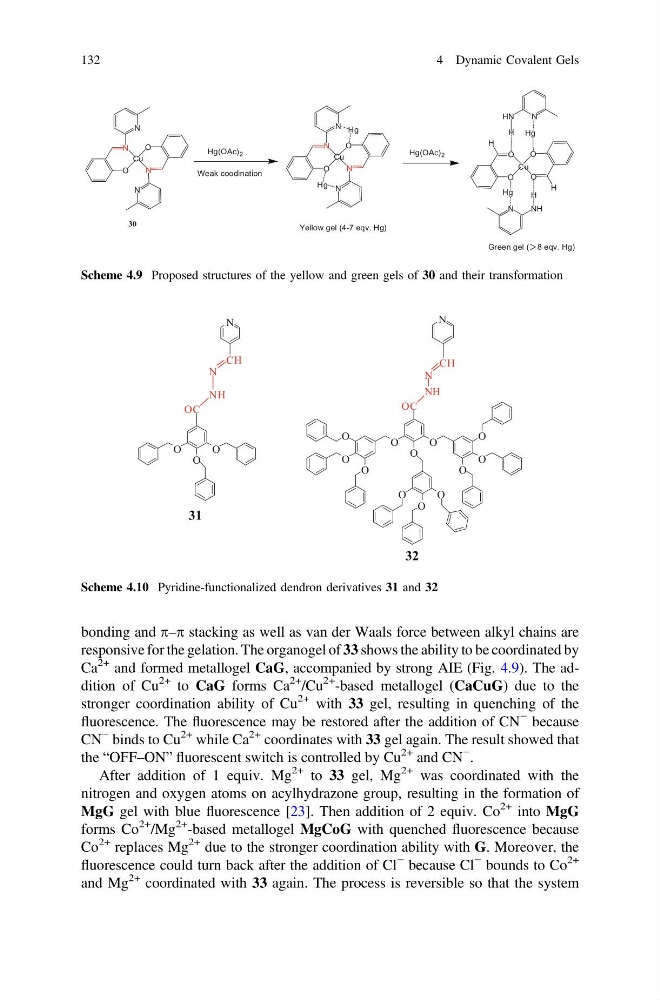
Scheme 4.9 Proposed structures of the yellow and green gels of 30 and their transformation
OC
O
O
O
OC
O
O
O
O
O
O
O
O
O
O
O
O
NH
N
CH
N
NH
N
CH
N
31
32
Scheme 4.10 Pyridine-functionalized dendron derivatives 31 and 32
132
4 Dynamic Covalent Gels
responsive for the gelation. The organogel of 33 shows the ability to be coordinated by
Ca
2+ and formed metallogel CaG, accompanied by strong AIE (Fig. 4.9). The addition of Cu
2+ to CaG forms Ca
2+ /Cu
2+ -based metallogel (CaCuG) due to the
stronger coordination ability of Cu
2+ with 33 gel, resulting in quenching of the
fluorescence. The fluorescence may be restored after the addition of CN
− because
CN
− binds to Cu
2+ while Ca
2+ coordinates with 33 gel again. The result showed that
the “OFF–ON” fluorescent switch is controlled by Cu
2+ and CN
− .
After addition of 1 equiv. Mg
2+ to 33 gel, Mg
2+ was coordinated with the
nitrogen and oxygen atoms on acylhydrazone group, resulting in the formation of
MgG gel with blue fluorescence [23]. Then addition of 2 equiv. Co
2+ into MgG
forms Co
2+ /Mg
2+ -based metallogel MgCoG with quenched fluorescence because
Co
2+ replaces Mg
2+ due to the stronger coordination ability with G. Moreover, the
fluorescence could turn back after the addition of Cl
− because Cl
− bounds to Co
2+
and Mg
2+ coordinated with 33 again. The process is reversible so that the system
O
N
N
O
N
N
Cu
Weak coodination
O
N
N
O
N
N
Cu
Hg
Hg
Yellow gel (4-7 eqv. Hg)
Hg(OAc) 2
O
O
O
O
Cu
H
H
N
HN
H Hg
N
NH
H
Hg
Green gel ( 8 eqv. Hg)
Hg(OAc) 2
30
Scheme 4.9 Proposed structures of the yellow and green gels of 30 and their transformation
OC
O
O
O
OC
O
O
O
O
O
O
O
O
O
O
O
O
NH
N
CH
N
NH
N
CH
N
31
32
Scheme 4.10 Pyridine-functionalized dendron derivatives 31 and 32
132
4 Dynamic Covalent Gels