

[13]. In order to avoid the collapse of the aggregate framework, the gels are handled
by a supercritical drying method that the solvent molecules are removed by using
liquid CO 2 , which can be converted to a gas via a supercritical fluid state with the
formation of destructive phase boundaries [14]. As an alternative method, cryoscopic TEM and SEM can be applied in which the sample is prepared by rapidly
freezing it to liquid N 2 temperatures to preserve the original structure and imaging
performed at low temperature. And at the nanoscale, X-ray diffraction (XRD),
small-angle neutron scattering (SANS) and small-angle X-ray scattering (SAXS)
are required to investigate the structures and packing model of gels. Specifically,
comparison of the XRD patterns given by a gelator in its crystalline form with that
from its gel can help identify the gel’s molecular packing [15]. Additionally, IR and
NMR spectroscopies can give information on the presence of the local environments and motions of functional groups, e.g. hydrogen bonding. Absorption and
emission spectroscopies can give information on the packing of gelator molecules,
e.g. stacking of aromatic groups.
Rheological study can give various parameters of gels. The stress and strain, for
instance, are usually measured to judge the viscoelastic behaviour of the gels. As a
kind of viscoelastic materials, rheological property [16] is often used to study the
response of the gels to an applied stress. In rheological experiment, the elastic
storage modulus (G′, the contribution of elastic, i.e. solid-like, behaviour to the
complex dynamic modulus) and elastic loss modulus (G″, the contribution of viscous, i.e. liquid-like, behaviour to the complex modulus) are two key parameters to
reflect the behaviours and structures of gel materials. Commonly, if the amount of
deformation of the material is proportional to applied force or stress, the material is
said to be elastic (like a rubber band). In purely elastic materials, the stress and
strain are in phase. On the contrary, for viscous materials, the strain lags behind the
stress by a 90° phase angle (also called the loss angle, d). The immediate stress
responds to the applied strain, and viscoelastic materials have a strain lag between
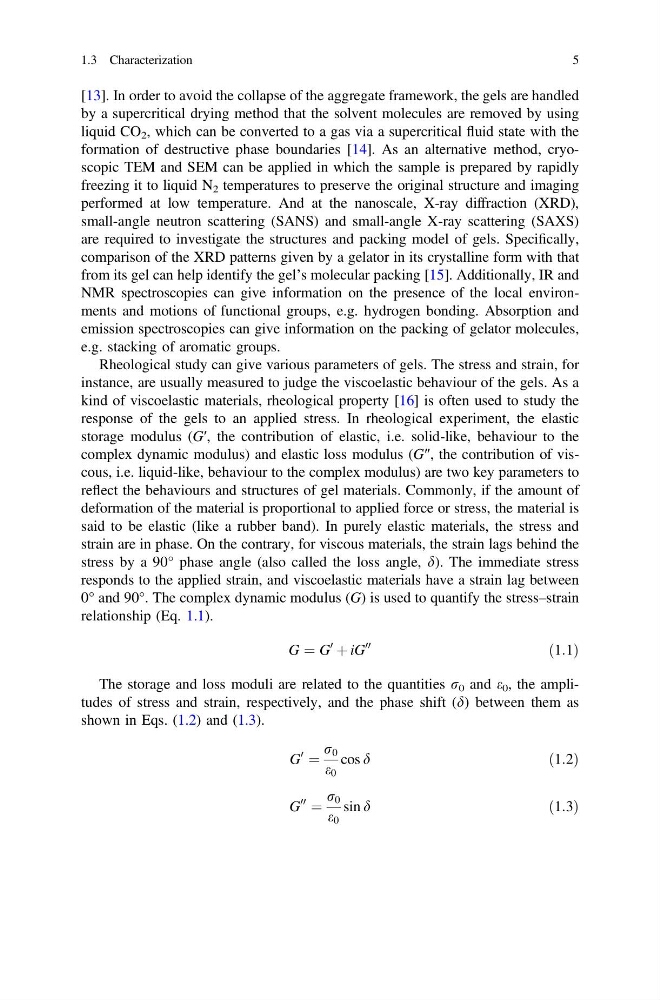
0° and 90°. The complex dynamic modulus (G) is used to quantify the stress–strain
relationship (Eq. 1.1).
G ¼ G
0
þ iG
00
ð1:1Þ
The storage and loss moduli are related to the quantities r 0 and e 0 , the amplitudes of stress and strain, respectively, and the phase shift (d) between them as
shown in Eqs. (1.2) and (1.3).
G
0
¼
r 0
e 0
cos d
ð1:2Þ
G
00
¼
r 0
e 0
sin d
ð1:3Þ
1.3 Characterization
5
by a supercritical drying method that the solvent molecules are removed by using
liquid CO 2 , which can be converted to a gas via a supercritical fluid state with the
formation of destructive phase boundaries [14]. As an alternative method, cryoscopic TEM and SEM can be applied in which the sample is prepared by rapidly
freezing it to liquid N 2 temperatures to preserve the original structure and imaging
performed at low temperature. And at the nanoscale, X-ray diffraction (XRD),
small-angle neutron scattering (SANS) and small-angle X-ray scattering (SAXS)
are required to investigate the structures and packing model of gels. Specifically,
comparison of the XRD patterns given by a gelator in its crystalline form with that
from its gel can help identify the gel’s molecular packing [15]. Additionally, IR and
NMR spectroscopies can give information on the presence of the local environments and motions of functional groups, e.g. hydrogen bonding. Absorption and
emission spectroscopies can give information on the packing of gelator molecules,
e.g. stacking of aromatic groups.
Rheological study can give various parameters of gels. The stress and strain, for
instance, are usually measured to judge the viscoelastic behaviour of the gels. As a
kind of viscoelastic materials, rheological property [16] is often used to study the
response of the gels to an applied stress. In rheological experiment, the elastic
storage modulus (G′, the contribution of elastic, i.e. solid-like, behaviour to the
complex dynamic modulus) and elastic loss modulus (G″, the contribution of viscous, i.e. liquid-like, behaviour to the complex modulus) are two key parameters to
reflect the behaviours and structures of gel materials. Commonly, if the amount of
deformation of the material is proportional to applied force or stress, the material is
said to be elastic (like a rubber band). In purely elastic materials, the stress and
strain are in phase. On the contrary, for viscous materials, the strain lags behind the
stress by a 90° phase angle (also called the loss angle, d). The immediate stress
responds to the applied strain, and viscoelastic materials have a strain lag between
0° and 90°. The complex dynamic modulus (G) is used to quantify the stress–strain
relationship (Eq. 1.1).
G ¼ G
0
þ iG
00
ð1:1Þ
The storage and loss moduli are related to the quantities r 0 and e 0 , the amplitudes of stress and strain, respectively, and the phase shift (d) between them as
shown in Eqs. (1.2) and (1.3).
G
0
¼
r 0
e 0
cos d
ð1:2Þ
G
00
¼
r 0
e 0
sin d
ð1:3Þ
1.3 Characterization
5