

4.2.2.3 Starting from Ti(III) Precursors
In order to introduce Ti
3+ to TiO 2 catalyst, Liu et al. mixed Ti 2 O 3 and TiO 2 powders
together and then heated them at high temperature (900
C) [77]. The ratio between
Ti 2 O 3 and TiO 2 , which is related to the degree of oxidation states of the TiO 2–x
samples, is the key for the successful doping of Ti
3+ . Liu et al. and Wang et al. also
chose Ti 2 O 3 as the raw material to provide high concentration of Ti
3+ into the bulk of
TiO 2–x . Ti 2 O 3 was firstly reacted with strong alkaline solution via hydrothermal
process, and then the obtained titanate was annealed under argon atmosphere to
avoid Ti
3+ oxidation.
Fang et al. obtained stable deep-blue-colored TiO 2–x nanocrystals (Fig. 4.8a, b)
using TiCl 3 as the starting material [78]. In order to avoid the oxidation of the
obtained Ti
3+ species, hydrofluoric acid was injected during the preparation process,
which also contributed to the formation of disordered layers outside the TiO 2–x
materials. Having Ti
3+ species located in the bulk of TiO 2–x materials avoided the
oxidation of Ti
3+ and contributed to the stabilization of these catalysts. As a result,
the obtained TiO 2–x photocatalysts showed enhanced photocatalytic CO 2 reduction
for selective CH 4 evolution under solar light irradiation, owning to the improved
solar light absorption and fast electron-hole separation induced by special dual
{001}-{101} facet exposure (Fig. 4.8c).
Zhu et al. fabricated TiO 2–x nanoparticles via solvothermal method on the
mixture of TiCl 3 and TiF 4 solutions [79]. The introduction of Ti
3+ species originated
from the injection of TiCl 3 , and the inhibition of Ti
3+ oxidation was achieved by Le
Chatelier’s principle [79]. Similarly, TiCl 3 and (NH 4 ) 2 TiF 6 were used as the source
of Ti
3+ and Ti
4+ , to synthesize TiO 2–x nanomaterials [80].
4.3 Properties of TiO 2–x Photocatalysts
The structure of TiO 2–x photocatalysts can be regarded as the incorporation of H
atoms or the removal of oxygen atoms on the surface and/or in the bulk of TiO 2
photocatalysts. According to the result of DFT calculations, Mo et al. reported that in
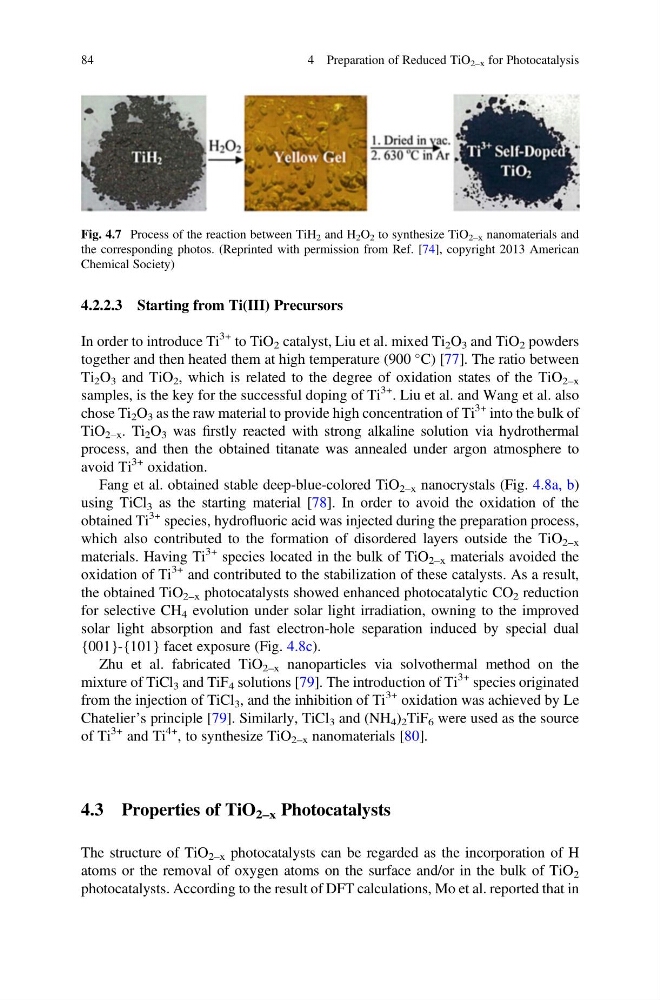
Fig. 4.7 Process of the reaction between TiH 2 and H 2 O 2 to synthesize TiO 2–x nanomaterials and
the corresponding photos. (Reprinted with permission from Ref. [74], copyright 2013 American
Chemical Society)
84
4 Preparation of Reduced TiO 2–x for Photocatalysis
In order to introduce Ti
3+ to TiO 2 catalyst, Liu et al. mixed Ti 2 O 3 and TiO 2 powders
together and then heated them at high temperature (900
C) [77]. The ratio between
Ti 2 O 3 and TiO 2 , which is related to the degree of oxidation states of the TiO 2–x
samples, is the key for the successful doping of Ti
3+ . Liu et al. and Wang et al. also
chose Ti 2 O 3 as the raw material to provide high concentration of Ti
3+ into the bulk of
TiO 2–x . Ti 2 O 3 was firstly reacted with strong alkaline solution via hydrothermal
process, and then the obtained titanate was annealed under argon atmosphere to
avoid Ti
3+ oxidation.
Fang et al. obtained stable deep-blue-colored TiO 2–x nanocrystals (Fig. 4.8a, b)
using TiCl 3 as the starting material [78]. In order to avoid the oxidation of the
obtained Ti
3+ species, hydrofluoric acid was injected during the preparation process,
which also contributed to the formation of disordered layers outside the TiO 2–x
materials. Having Ti
3+ species located in the bulk of TiO 2–x materials avoided the
oxidation of Ti
3+ and contributed to the stabilization of these catalysts. As a result,
the obtained TiO 2–x photocatalysts showed enhanced photocatalytic CO 2 reduction
for selective CH 4 evolution under solar light irradiation, owning to the improved
solar light absorption and fast electron-hole separation induced by special dual
{001}-{101} facet exposure (Fig. 4.8c).
Zhu et al. fabricated TiO 2–x nanoparticles via solvothermal method on the
mixture of TiCl 3 and TiF 4 solutions [79]. The introduction of Ti
3+ species originated
from the injection of TiCl 3 , and the inhibition of Ti
3+ oxidation was achieved by Le
Chatelier’s principle [79]. Similarly, TiCl 3 and (NH 4 ) 2 TiF 6 were used as the source
of Ti
3+ and Ti
4+ , to synthesize TiO 2–x nanomaterials [80].
4.3 Properties of TiO 2–x Photocatalysts
The structure of TiO 2–x photocatalysts can be regarded as the incorporation of H
atoms or the removal of oxygen atoms on the surface and/or in the bulk of TiO 2
photocatalysts. According to the result of DFT calculations, Mo et al. reported that in
Fig. 4.7 Process of the reaction between TiH 2 and H 2 O 2 to synthesize TiO 2–x nanomaterials and
the corresponding photos. (Reprinted with permission from Ref. [74], copyright 2013 American
Chemical Society)
84
4 Preparation of Reduced TiO 2–x for Photocatalysis