

for the loss of several hundred millivolts of photovoltage. A clear understanding of
the surface chemistry of hematite during PEC water oxidation is thus crucial as it
determines the extent of band bending and of Fermi-level pinning, which control the
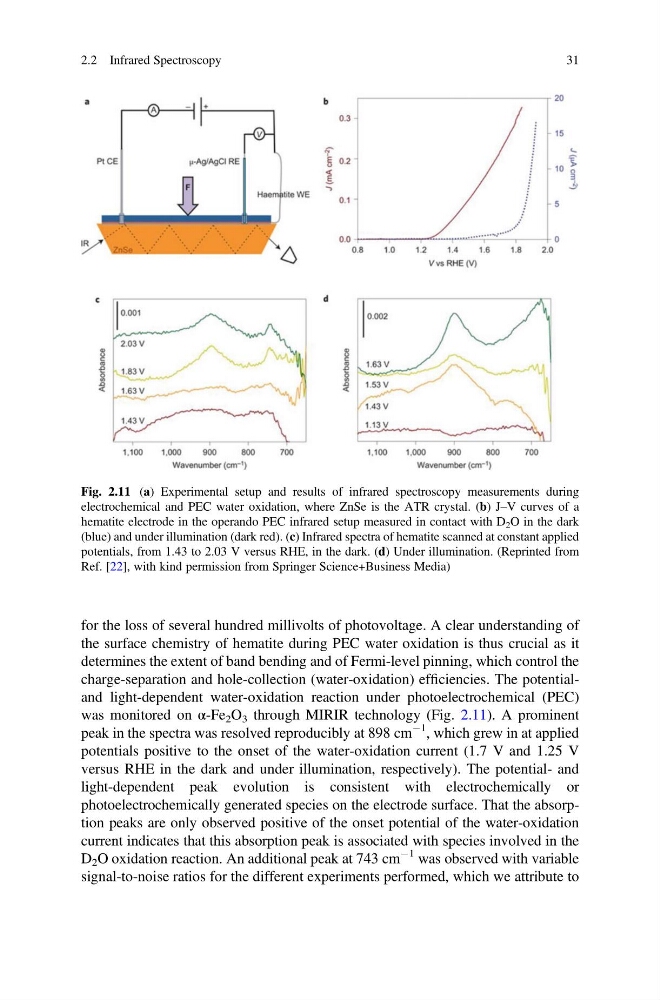
charge-separation and hole-collection (water-oxidation) efficiencies. The potentialand light-dependent water-oxidation reaction under photoelectrochemical (PEC)
was monitored on α-Fe 2 O 3 through MIRIR technology (Fig. 2.11). A prominent
peak in the spectra was resolved reproducibly at 898 cm
À1 , which grew in at applied
potentials positive to the onset of the water-oxidation current (1.7 V and 1.25 V
versus RHE in the dark and under illumination, respectively). The potential- and
light-dependent peak evolution is consistent with electrochemically or
photoelectrochemically generated species on the electrode surface. That the absorption peaks are only observed positive of the onset potential of the water-oxidation
current indicates that this absorption peak is associated with species involved in the
D 2 O oxidation reaction. An additional peak at 743 cm
À1 was observed with variable
signal-to-noise ratios for the different experiments performed, which we attribute to
Fig. 2.11 (a) Experimental setup and results of infrared spectroscopy measurements during
electrochemical and PEC water oxidation, where ZnSe is the ATR crystal. (b) J–V curves of a
hematite electrode in the operando PEC infrared setup measured in contact with D 2 O in the dark
(blue) and under illumination (dark red). (c) Infrared spectra of hematite scanned at constant applied
potentials, from 1.43 to 2.03 V versus RHE, in the dark. (d) Under illumination. (Reprinted from
Ref. [22], with kind permission from Springer Science+Business Media)
2.2 Infrared Spectroscopy
31
the surface chemistry of hematite during PEC water oxidation is thus crucial as it
determines the extent of band bending and of Fermi-level pinning, which control the
charge-separation and hole-collection (water-oxidation) efficiencies. The potentialand light-dependent water-oxidation reaction under photoelectrochemical (PEC)
was monitored on α-Fe 2 O 3 through MIRIR technology (Fig. 2.11). A prominent
peak in the spectra was resolved reproducibly at 898 cm
À1 , which grew in at applied
potentials positive to the onset of the water-oxidation current (1.7 V and 1.25 V
versus RHE in the dark and under illumination, respectively). The potential- and
light-dependent peak evolution is consistent with electrochemically or
photoelectrochemically generated species on the electrode surface. That the absorption peaks are only observed positive of the onset potential of the water-oxidation
current indicates that this absorption peak is associated with species involved in the
D 2 O oxidation reaction. An additional peak at 743 cm
À1 was observed with variable
signal-to-noise ratios for the different experiments performed, which we attribute to
Fig. 2.11 (a) Experimental setup and results of infrared spectroscopy measurements during
electrochemical and PEC water oxidation, where ZnSe is the ATR crystal. (b) J–V curves of a
hematite electrode in the operando PEC infrared setup measured in contact with D 2 O in the dark
(blue) and under illumination (dark red). (c) Infrared spectra of hematite scanned at constant applied
potentials, from 1.43 to 2.03 V versus RHE, in the dark. (d) Under illumination. (Reprinted from
Ref. [22], with kind permission from Springer Science+Business Media)
2.2 Infrared Spectroscopy
31