

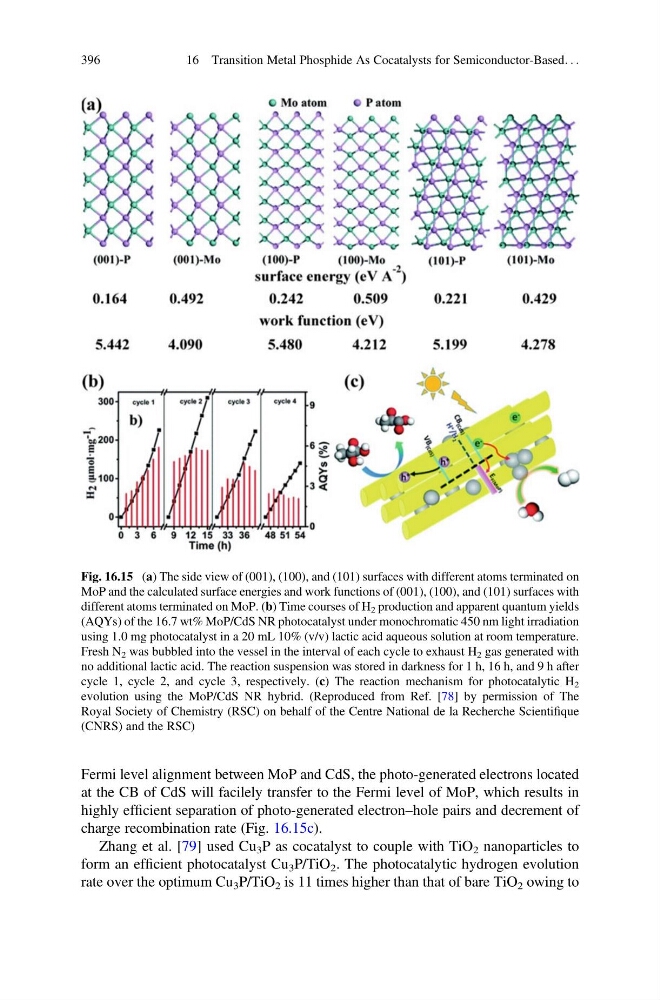
Fermi level alignment between MoP and CdS, the photo-generated electrons located
at the CB of CdS will facilely transfer to the Fermi level of MoP, which results in
highly efficient separation of photo-generated electron–hole pairs and decrement of
charge recombination rate (Fig. 16.15c).
Zhang et al. [79] used Cu 3 P as cocatalyst to couple with TiO 2 nanoparticles to
form an efficient photocatalyst Cu 3 P/TiO 2 . The photocatalytic hydrogen evolution
rate over the optimum Cu 3 P/TiO 2 is 11 times higher than that of bare TiO 2 owing to
Fig. 16.15 (a) The side view of (001), (100), and (101) surfaces with different atoms terminated on
MoP and the calculated surface energies and work functions of (001), (100), and (101) surfaces with
different atoms terminated on MoP. (b) Time courses of H 2 production and apparent quantum yields
(AQYs) of the 16.7 wt% MoP/CdS NR photocatalyst under monochromatic 450 nm light irradiation
using 1.0 mg photocatalyst in a 20 mL 10% (v/v) lactic acid aqueous solution at room temperature.
Fresh N 2 was bubbled into the vessel in the interval of each cycle to exhaust H 2 gas generated with
no additional lactic acid. The reaction suspension was stored in darkness for 1 h, 16 h, and 9 h after
cycle 1, cycle 2, and cycle 3, respectively. (c) The reaction mechanism for photocatalytic H 2
evolution using the MoP/CdS NR hybrid. (Reproduced from Ref. [78] by permission of The
Royal Society of Chemistry (RSC) on behalf of the Centre National de la Recherche Scientifique
(CNRS) and the RSC)
396
16 Transition Metal Phosphide As Cocatalysts for Semiconductor-Based. . .
at the CB of CdS will facilely transfer to the Fermi level of MoP, which results in
highly efficient separation of photo-generated electron–hole pairs and decrement of
charge recombination rate (Fig. 16.15c).
Zhang et al. [79] used Cu 3 P as cocatalyst to couple with TiO 2 nanoparticles to
form an efficient photocatalyst Cu 3 P/TiO 2 . The photocatalytic hydrogen evolution
rate over the optimum Cu 3 P/TiO 2 is 11 times higher than that of bare TiO 2 owing to
Fig. 16.15 (a) The side view of (001), (100), and (101) surfaces with different atoms terminated on
MoP and the calculated surface energies and work functions of (001), (100), and (101) surfaces with
different atoms terminated on MoP. (b) Time courses of H 2 production and apparent quantum yields
(AQYs) of the 16.7 wt% MoP/CdS NR photocatalyst under monochromatic 450 nm light irradiation
using 1.0 mg photocatalyst in a 20 mL 10% (v/v) lactic acid aqueous solution at room temperature.
Fresh N 2 was bubbled into the vessel in the interval of each cycle to exhaust H 2 gas generated with
no additional lactic acid. The reaction suspension was stored in darkness for 1 h, 16 h, and 9 h after
cycle 1, cycle 2, and cycle 3, respectively. (c) The reaction mechanism for photocatalytic H 2
evolution using the MoP/CdS NR hybrid. (Reproduced from Ref. [78] by permission of The
Royal Society of Chemistry (RSC) on behalf of the Centre National de la Recherche Scientifique
(CNRS) and the RSC)
396
16 Transition Metal Phosphide As Cocatalysts for Semiconductor-Based. . .