

caused by the unattached MoP nanoparticles that are collision with CdS nanorods
during the stirring process. The photocatalytic reaction in cycle 2 is very stable and
can keep an average AQY of 5.6%. However, the decrement of activity in cycle
3 and 4 is caused by the reduction of the content of sacrificial agent. Due to the good
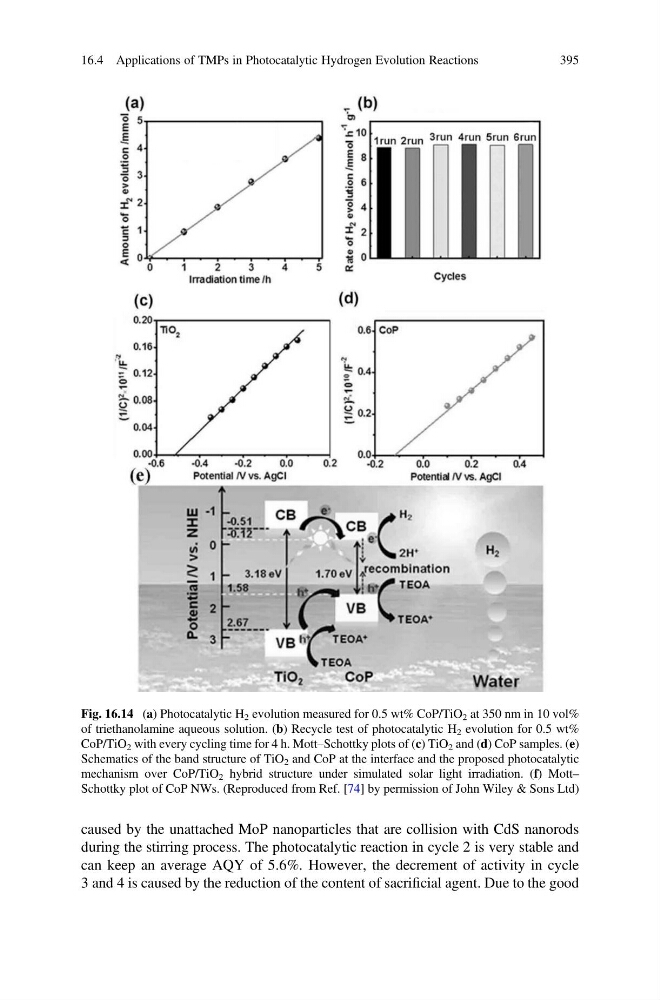
Fig. 16.14 (a) Photocatalytic H 2 evolution measured for 0.5 wt% CoP/TiO 2 at 350 nm in 10 vol%
of triethanolamine aqueous solution. (b) Recycle test of photocatalytic H 2 evolution for 0.5 wt%
CoP/TiO 2 with every cycling time for 4 h. Mott–Schottky plots of (c) TiO 2 and (d) CoP samples. (e)
Schematics of the band structure of TiO 2 and CoP at the interface and the proposed photocatalytic
mechanism over CoP/TiO 2 hybrid structure under simulated solar light irradiation. (f) Mott–
Schottky plot of CoP NWs. (Reproduced from Ref. [74] by permission of John Wiley & Sons Ltd)
16.4 Applications of TMPs in Photocatalytic Hydrogen Evolution Reactions
395
during the stirring process. The photocatalytic reaction in cycle 2 is very stable and
can keep an average AQY of 5.6%. However, the decrement of activity in cycle
3 and 4 is caused by the reduction of the content of sacrificial agent. Due to the good
Fig. 16.14 (a) Photocatalytic H 2 evolution measured for 0.5 wt% CoP/TiO 2 at 350 nm in 10 vol%
of triethanolamine aqueous solution. (b) Recycle test of photocatalytic H 2 evolution for 0.5 wt%
CoP/TiO 2 with every cycling time for 4 h. Mott–Schottky plots of (c) TiO 2 and (d) CoP samples. (e)
Schematics of the band structure of TiO 2 and CoP at the interface and the proposed photocatalytic
mechanism over CoP/TiO 2 hybrid structure under simulated solar light irradiation. (f) Mott–
Schottky plot of CoP NWs. (Reproduced from Ref. [74] by permission of John Wiley & Sons Ltd)
16.4 Applications of TMPs in Photocatalytic Hydrogen Evolution Reactions
395