

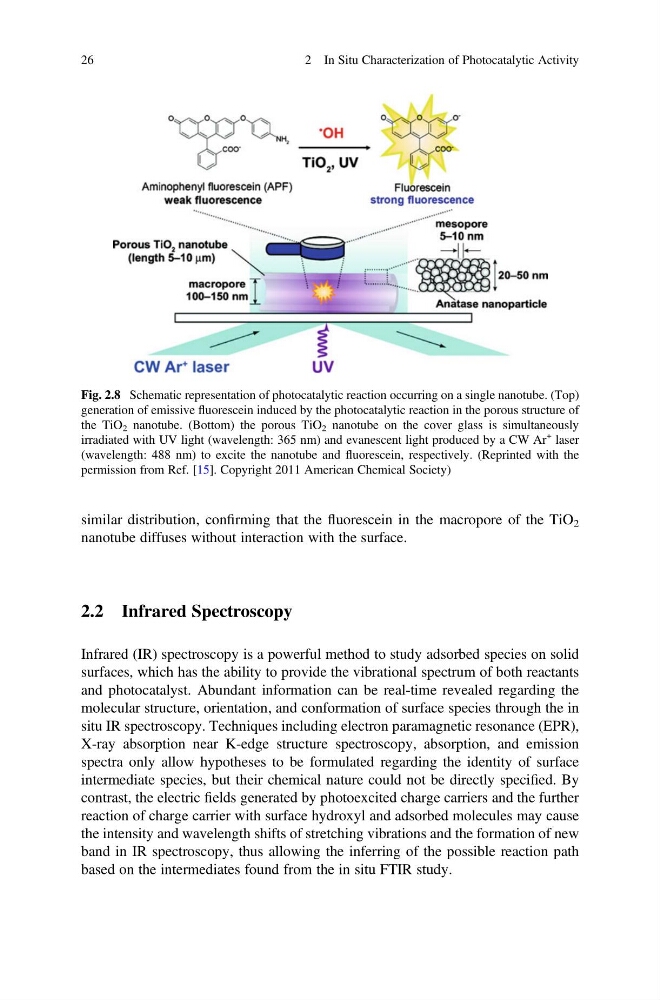
similar distribution, confirming that the fluorescein in the macropore of the TiO 2
nanotube diffuses without interaction with the surface.
2.2 Infrared Spectroscopy
Infrared (IR) spectroscopy is a powerful method to study adsorbed species on solid
surfaces, which has the ability to provide the vibrational spectrum of both reactants
and photocatalyst. Abundant information can be real-time revealed regarding the
molecular structure, orientation, and conformation of surface species through the in
situ IR spectroscopy. Techniques including electron paramagnetic resonance (EPR),
X-ray absorption near K-edge structure spectroscopy, absorption, and emission
spectra only allow hypotheses to be formulated regarding the identity of surface
intermediate species, but their chemical nature could not be directly specified. By
contrast, the electric fields generated by photoexcited charge carriers and the further
reaction of charge carrier with surface hydroxyl and adsorbed molecules may cause
the intensity and wavelength shifts of stretching vibrations and the formation of new
band in IR spectroscopy, thus allowing the inferring of the possible reaction path
based on the intermediates found from the in situ FTIR study.
Fig. 2.8 Schematic representation of photocatalytic reaction occurring on a single nanotube. (Top)
generation of emissive fluorescein induced by the photocatalytic reaction in the porous structure of
the TiO 2 nanotube. (Bottom) the porous TiO 2 nanotube on the cover glass is simultaneously
irradiated with UV light (wavelength: 365 nm) and evanescent light produced by a CW Ar
+ laser
(wavelength: 488 nm) to excite the nanotube and fluorescein, respectively. (Reprinted with the
permission from Ref. [15]. Copyright 2011 American Chemical Society)
26
2 In Situ Characterization of Photocatalytic Activity
nanotube diffuses without interaction with the surface.
2.2 Infrared Spectroscopy
Infrared (IR) spectroscopy is a powerful method to study adsorbed species on solid
surfaces, which has the ability to provide the vibrational spectrum of both reactants
and photocatalyst. Abundant information can be real-time revealed regarding the
molecular structure, orientation, and conformation of surface species through the in
situ IR spectroscopy. Techniques including electron paramagnetic resonance (EPR),
X-ray absorption near K-edge structure spectroscopy, absorption, and emission
spectra only allow hypotheses to be formulated regarding the identity of surface
intermediate species, but their chemical nature could not be directly specified. By
contrast, the electric fields generated by photoexcited charge carriers and the further
reaction of charge carrier with surface hydroxyl and adsorbed molecules may cause
the intensity and wavelength shifts of stretching vibrations and the formation of new
band in IR spectroscopy, thus allowing the inferring of the possible reaction path
based on the intermediates found from the in situ FTIR study.
Fig. 2.8 Schematic representation of photocatalytic reaction occurring on a single nanotube. (Top)
generation of emissive fluorescein induced by the photocatalytic reaction in the porous structure of
the TiO 2 nanotube. (Bottom) the porous TiO 2 nanotube on the cover glass is simultaneously
irradiated with UV light (wavelength: 365 nm) and evanescent light produced by a CW Ar
+ laser
(wavelength: 488 nm) to excite the nanotube and fluorescein, respectively. (Reprinted with the
permission from Ref. [15]. Copyright 2011 American Chemical Society)
26
2 In Situ Characterization of Photocatalytic Activity