

adsorption and activation of reactants. However, the performance is highly dependent on the accessibility of reactant molecules to the active sites inside the bulk
particles. The structural disorders or defects homogeneously distributed over the
framework often hinder the efficient molecular transport. One of the examples for the
single-molecule imaging of photocatalytic reactions in a porous TiO 2 nanotube was
achieved using fluorescein and TIRFM [15]. Single TiO 2 nanotube was placed in a
custom-made sample chamber, which is irradiated by UV light with a wavelength of
365 nm and laser light with a wavelength of 488 nm to excite the nanotube and
fluorescein, respectively (Fig. 2.8). It is expected that the photocatalytic reaction will
occur randomly on the entire nanotube. To examine the specific interaction between
the wall of the TiO 2 nanotube and the fluorescein diffusing in the macropore, SiO 2
nanotube without mesopores was used as a control. Fluorescein was generated by
auto-oxidation after intense UV irradiation. Both TiO 2 and SiO 2 nanotubes exhibit a
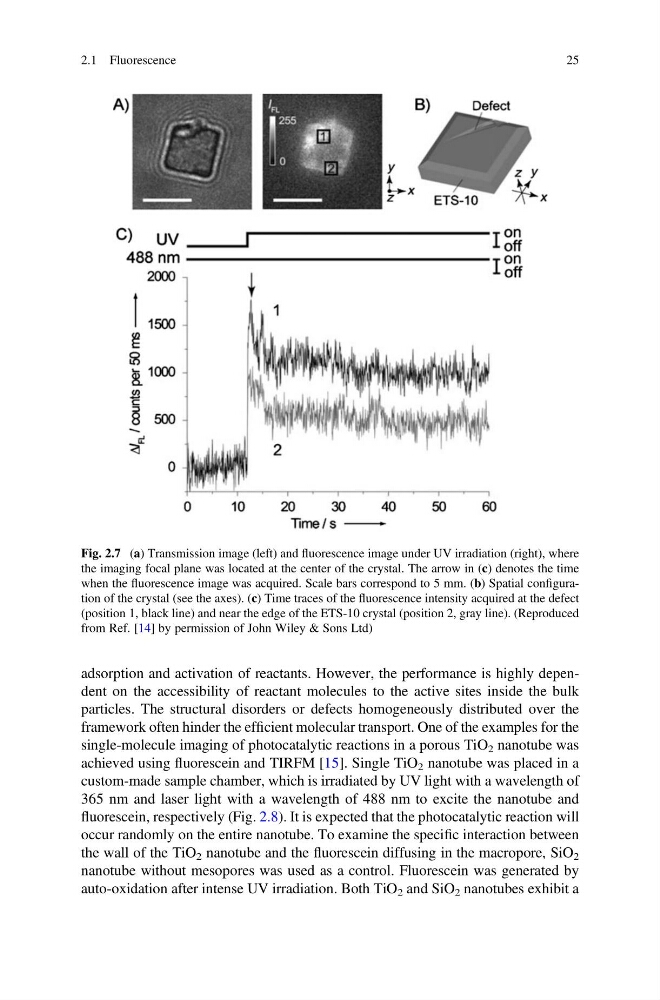
Fig. 2.7 (a) Transmission image (left) and fluorescence image under UV irradiation (right), where
the imaging focal plane was located at the center of the crystal. The arrow in (c) denotes the time
when the fluorescence image was acquired. Scale bars correspond to 5 mm. (b) Spatial configuration of the crystal (see the axes). (c) Time traces of the fluorescence intensity acquired at the defect
(position 1, black line) and near the edge of the ETS-10 crystal (position 2, gray line). (Reproduced
from Ref. [14] by permission of John Wiley & Sons Ltd)
2.1 Fluorescence
25
particles. The structural disorders or defects homogeneously distributed over the
framework often hinder the efficient molecular transport. One of the examples for the
single-molecule imaging of photocatalytic reactions in a porous TiO 2 nanotube was
achieved using fluorescein and TIRFM [15]. Single TiO 2 nanotube was placed in a
custom-made sample chamber, which is irradiated by UV light with a wavelength of
365 nm and laser light with a wavelength of 488 nm to excite the nanotube and
fluorescein, respectively (Fig. 2.8). It is expected that the photocatalytic reaction will
occur randomly on the entire nanotube. To examine the specific interaction between
the wall of the TiO 2 nanotube and the fluorescein diffusing in the macropore, SiO 2
nanotube without mesopores was used as a control. Fluorescein was generated by
auto-oxidation after intense UV irradiation. Both TiO 2 and SiO 2 nanotubes exhibit a
Fig. 2.7 (a) Transmission image (left) and fluorescence image under UV irradiation (right), where
the imaging focal plane was located at the center of the crystal. The arrow in (c) denotes the time
when the fluorescence image was acquired. Scale bars correspond to 5 mm. (b) Spatial configuration of the crystal (see the axes). (c) Time traces of the fluorescence intensity acquired at the defect
(position 1, black line) and near the edge of the ETS-10 crystal (position 2, gray line). (Reproduced
from Ref. [14] by permission of John Wiley & Sons Ltd)
2.1 Fluorescence
25