

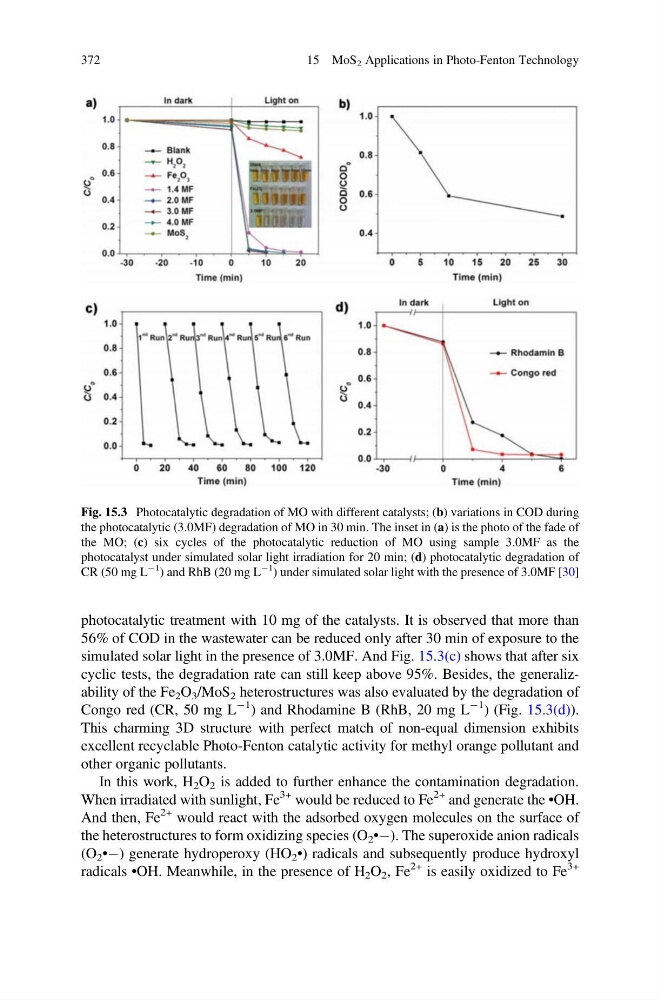
photocatalytic treatment with 10 mg of the catalysts. It is observed that more than
56% of COD in the wastewater can be reduced only after 30 min of exposure to the
simulated solar light in the presence of 3.0MF. And Fig. 15.3(c) shows that after six
cyclic tests, the degradation rate can still keep above 95%. Besides, the generalizability of the Fe 2 O 3 /MoS 2 heterostructures was also evaluated by the degradation of
Congo red (CR, 50 mg L
À1 ) and Rhodamine B (RhB, 20 mg L
À1 ) (Fig. 15.3(d)).
This charming 3D structure with perfect match of non-equal dimension exhibits
excellent recyclable Photo-Fenton catalytic activity for methyl orange pollutant and
other organic pollutants.
In this work, H 2 O 2 is added to further enhance the contamination degradation.
When irradiated with sunlight, Fe
3+ would be reduced to Fe
2+ and generate the •OH.
And then, Fe
2+ would react with the adsorbed oxygen molecules on the surface of
the heterostructures to form oxidizing species (O 2 •À). The superoxide anion radicals
(O 2 •À) generate hydroperoxy (HO 2 •) radicals and subsequently produce hydroxyl
radicals •OH. Meanwhile, in the presence of H 2 O 2 , Fe
2+ is easily oxidized to Fe
3+
Fig. 15.3 Photocatalytic degradation of MO with different catalysts; (b) variations in COD during
the photocatalytic (3.0MF) degradation of MO in 30 min. The inset in (a) is the photo of the fade of
the MO; (c) six cycles of the photocatalytic reduction of MO using sample 3.0MF as the
photocatalyst under simulated solar light irradiation for 20 min; (d) photocatalytic degradation of
CR (50 mg L
À1
) and RhB (20 mg L
À1
) under simulated solar light with the presence of 3.0MF [30]
372
15 MoS 2 Applications in Photo-Fenton Technology
56% of COD in the wastewater can be reduced only after 30 min of exposure to the
simulated solar light in the presence of 3.0MF. And Fig. 15.3(c) shows that after six
cyclic tests, the degradation rate can still keep above 95%. Besides, the generalizability of the Fe 2 O 3 /MoS 2 heterostructures was also evaluated by the degradation of
Congo red (CR, 50 mg L
À1 ) and Rhodamine B (RhB, 20 mg L
À1 ) (Fig. 15.3(d)).
This charming 3D structure with perfect match of non-equal dimension exhibits
excellent recyclable Photo-Fenton catalytic activity for methyl orange pollutant and
other organic pollutants.
In this work, H 2 O 2 is added to further enhance the contamination degradation.
When irradiated with sunlight, Fe
3+ would be reduced to Fe
2+ and generate the •OH.
And then, Fe
2+ would react with the adsorbed oxygen molecules on the surface of
the heterostructures to form oxidizing species (O 2 •À). The superoxide anion radicals
(O 2 •À) generate hydroperoxy (HO 2 •) radicals and subsequently produce hydroxyl
radicals •OH. Meanwhile, in the presence of H 2 O 2 , Fe
2+ is easily oxidized to Fe
3+
Fig. 15.3 Photocatalytic degradation of MO with different catalysts; (b) variations in COD during
the photocatalytic (3.0MF) degradation of MO in 30 min. The inset in (a) is the photo of the fade of
the MO; (c) six cycles of the photocatalytic reduction of MO using sample 3.0MF as the
photocatalyst under simulated solar light irradiation for 20 min; (d) photocatalytic degradation of
CR (50 mg L
À1
) and RhB (20 mg L
À1
) under simulated solar light with the presence of 3.0MF [30]
372
15 MoS 2 Applications in Photo-Fenton Technology