

hard template and a cyclic aromatic compound 3-amino-1,2,4-triazine as the precursor, MCN material with 3D porous structure and high nitrogen content was prepared
by Toshiyuki Mori et al. Their work showed that the cyclic aromatic precursor
benefited to preserve the nitrogen in the carbon matrix of the final product even after
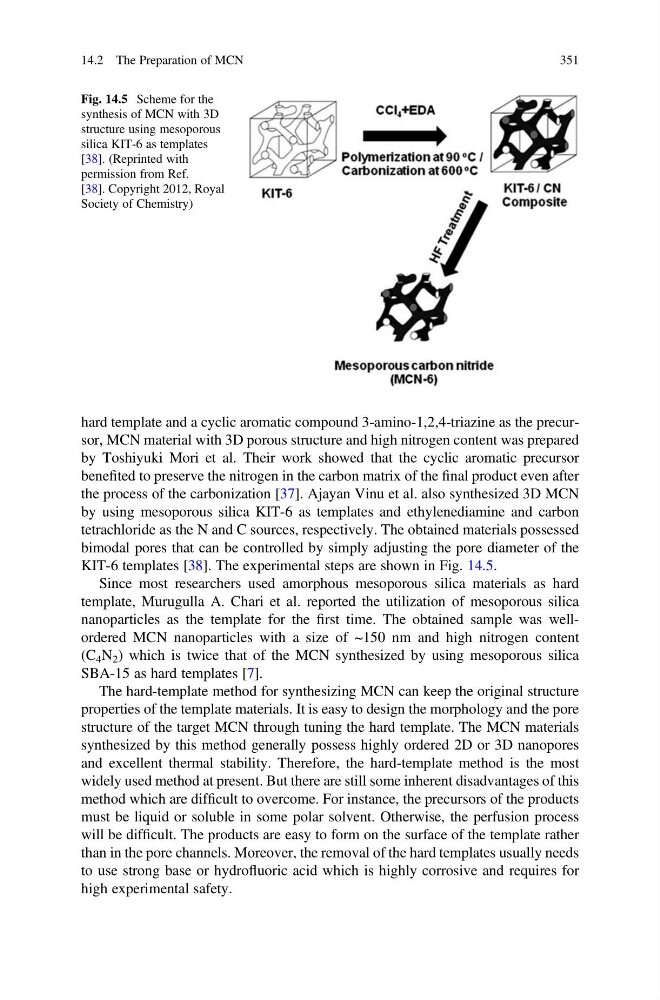
the process of the carbonization [37]. Ajayan Vinu et al. also synthesized 3D MCN
by using mesoporous silica KIT-6 as templates and ethylenediamine and carbon
tetrachloride as the N and C sources, respectively. The obtained materials possessed
bimodal pores that can be controlled by simply adjusting the pore diameter of the
KIT-6 templates [38]. The experimental steps are shown in Fig. 14.5.
Since most researchers used amorphous mesoporous silica materials as hard
template, Murugulla A. Chari et al. reported the utilization of mesoporous silica
nanoparticles as the template for the first time. The obtained sample was wellordered MCN nanoparticles with a size of ~150 nm and high nitrogen content
(C 4 N 2 ) which is twice that of the MCN synthesized by using mesoporous silica
SBA-15 as hard templates [7].
The hard-template method for synthesizing MCN can keep the original structure
properties of the template materials. It is easy to design the morphology and the pore
structure of the target MCN through tuning the hard template. The MCN materials
synthesized by this method generally possess highly ordered 2D or 3D nanopores
and excellent thermal stability. Therefore, the hard-template method is the most
widely used method at present. But there are still some inherent disadvantages of this
method which are difficult to overcome. For instance, the precursors of the products
must be liquid or soluble in some polar solvent. Otherwise, the perfusion process
will be difficult. The products are easy to form on the surface of the template rather
than in the pore channels. Moreover, the removal of the hard templates usually needs
to use strong base or hydrofluoric acid which is highly corrosive and requires for
high experimental safety.
Fig. 14.5 Scheme for the
synthesis of MCN with 3D
structure using mesoporous
silica KIT-6 as templates
[38]. (Reprinted with
permission from Ref.
[38]. Copyright 2012, Royal
Society of Chemistry)
14.2 The Preparation of MCN
351
by Toshiyuki Mori et al. Their work showed that the cyclic aromatic precursor
benefited to preserve the nitrogen in the carbon matrix of the final product even after
the process of the carbonization [37]. Ajayan Vinu et al. also synthesized 3D MCN
by using mesoporous silica KIT-6 as templates and ethylenediamine and carbon
tetrachloride as the N and C sources, respectively. The obtained materials possessed
bimodal pores that can be controlled by simply adjusting the pore diameter of the
KIT-6 templates [38]. The experimental steps are shown in Fig. 14.5.
Since most researchers used amorphous mesoporous silica materials as hard
template, Murugulla A. Chari et al. reported the utilization of mesoporous silica
nanoparticles as the template for the first time. The obtained sample was wellordered MCN nanoparticles with a size of ~150 nm and high nitrogen content
(C 4 N 2 ) which is twice that of the MCN synthesized by using mesoporous silica
SBA-15 as hard templates [7].
The hard-template method for synthesizing MCN can keep the original structure
properties of the template materials. It is easy to design the morphology and the pore
structure of the target MCN through tuning the hard template. The MCN materials
synthesized by this method generally possess highly ordered 2D or 3D nanopores
and excellent thermal stability. Therefore, the hard-template method is the most
widely used method at present. But there are still some inherent disadvantages of this
method which are difficult to overcome. For instance, the precursors of the products
must be liquid or soluble in some polar solvent. Otherwise, the perfusion process
will be difficult. The products are easy to form on the surface of the template rather
than in the pore channels. Moreover, the removal of the hard templates usually needs
to use strong base or hydrofluoric acid which is highly corrosive and requires for
high experimental safety.
Fig. 14.5 Scheme for the
synthesis of MCN with 3D
structure using mesoporous
silica KIT-6 as templates
[38]. (Reprinted with
permission from Ref.
[38]. Copyright 2012, Royal
Society of Chemistry)
14.2 The Preparation of MCN
351