

will be impaired [23]. Therefore, the all-solid-state Z-scheme system was developed
to solve this problem. Generally, the all-solid-state Z-scheme photocatalytic system
(PS) was divided into two components: PS-PS and three-component PS-conductor
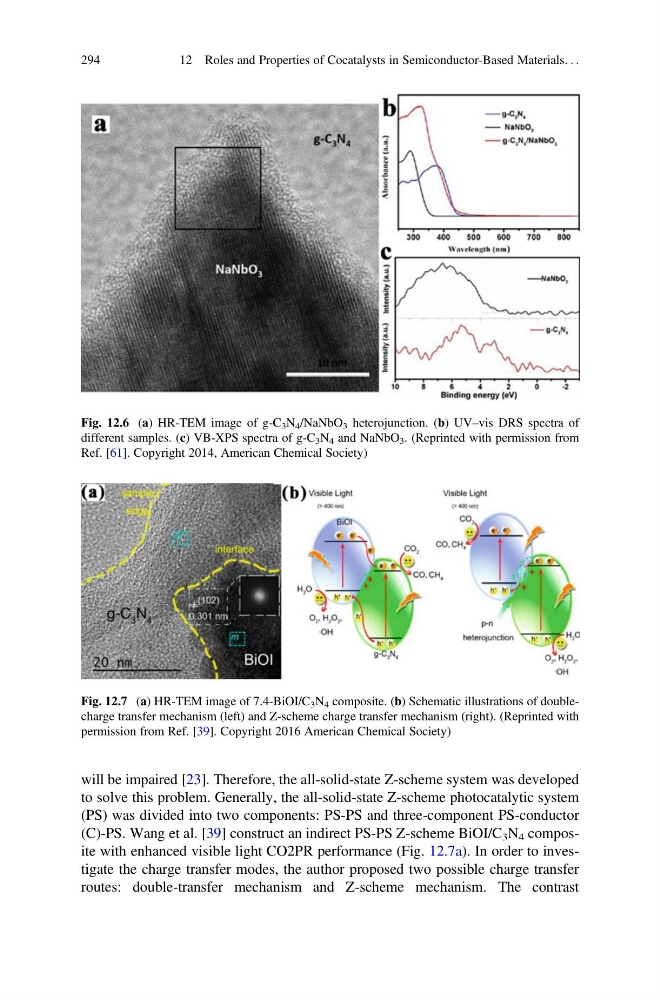
(C)-PS. Wang et al. [39] construct an indirect PS-PS Z-scheme BiOI/C 3 N 4 composite with enhanced visible light CO2PR performance (Fig. 12.7a). In order to investigate the charge transfer modes, the author proposed two possible charge transfer
routes: double-transfer mechanism and Z-scheme mechanism. The contrast
Fig. 12.6 (a) HR-TEM image of g-C 3 N 4 /NaNbO 3 heterojunction. (b) UV–vis DRS spectra of
different samples. (c) VB-XPS spectra of g-C 3 N 4 and NaNbO 3 . (Reprinted with permission from
Ref. [61]. Copyright 2014, American Chemical Society)
Fig. 12.7 (a) HR-TEM image of 7.4-BiOI/C 3 N 4 composite. (b) Schematic illustrations of doublecharge transfer mechanism (left) and Z-scheme charge transfer mechanism (right). (Reprinted with
permission from Ref. [39]. Copyright 2016 American Chemical Society)
294
12 Roles and Properties of Cocatalysts in Semiconductor-Based Materials. . .
to solve this problem. Generally, the all-solid-state Z-scheme photocatalytic system
(PS) was divided into two components: PS-PS and three-component PS-conductor
(C)-PS. Wang et al. [39] construct an indirect PS-PS Z-scheme BiOI/C 3 N 4 composite with enhanced visible light CO2PR performance (Fig. 12.7a). In order to investigate the charge transfer modes, the author proposed two possible charge transfer
routes: double-transfer mechanism and Z-scheme mechanism. The contrast
Fig. 12.6 (a) HR-TEM image of g-C 3 N 4 /NaNbO 3 heterojunction. (b) UV–vis DRS spectra of
different samples. (c) VB-XPS spectra of g-C 3 N 4 and NaNbO 3 . (Reprinted with permission from
Ref. [61]. Copyright 2014, American Chemical Society)
Fig. 12.7 (a) HR-TEM image of 7.4-BiOI/C 3 N 4 composite. (b) Schematic illustrations of doublecharge transfer mechanism (left) and Z-scheme charge transfer mechanism (right). (Reprinted with
permission from Ref. [39]. Copyright 2016 American Chemical Society)
294
12 Roles and Properties of Cocatalysts in Semiconductor-Based Materials. . .