

When graphene was introduced as the cocatalyst, Yu et al. [54] developed a
metal-free CdS/rGO composite with enhanced CH 4 generation rate (2.51 μmol/gÁh)
which is ten times higher than pure CdS rods and overperforms the Pt/CdS. The
enhanced performance was attributed to the π–π conjugate interaction between CO 2
and graphene and thus improves the CO 2 adsorption amount and destabilizes CO 2 ;
besides, the rGO promotes the electron transfer, and storage was confirmed by
conducting transient photocurrent and impedance analysis (Fig. 12.5b). Recently,
Xu et al. [52] reported a CsPbBr 3 perovskite graphene composite which could
efficiently convert CO 2 into CH 4 with 99.3% selectivity. The author also adopted
steady-state PL and time-resolved PL decay to probe the electron transfer dynamic.
Distinct PL intensity quenching of CsPbBr 3 QD and the PL decay time of CsPbBr 3
QD/GO composite are shorter compared with CsPbBr 3 QDs, which both reflect the
introduction of GO benefits to the electron transfer and suppress the electron-hole
recombination (Fig. 12.5d).
Construction of the semiconductors’ heterojunction is another strategy to improving the charge separation efficiency in CO2PR. Shi et al. [61] reported a visible light
responsive g-C 3 N 4 /NaNbO 3 nanowire with higher CO2PR activity than either
g-C 3 N 4 or NaNbO 3 . From Fig. 12.6 (a), the HR-TEM image shows the obvious
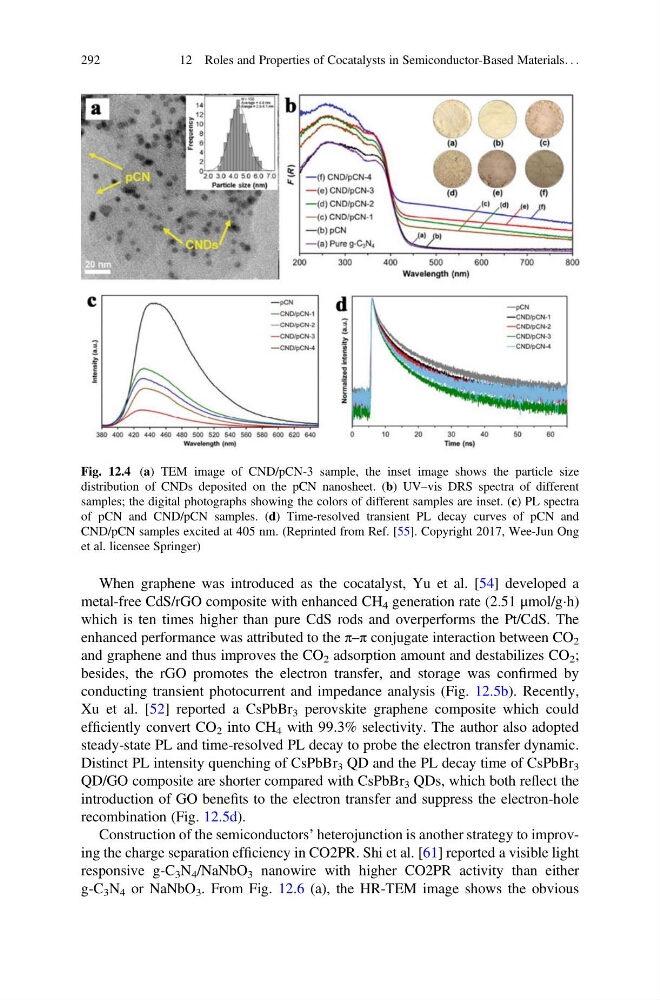
Fig. 12.4 (a) TEM image of CND/pCN-3 sample, the inset image shows the particle size
distribution of CNDs deposited on the pCN nanosheet. (b) UV–vis DRS spectra of different
samples; the digital photographs showing the colors of different samples are inset. (c) PL spectra
of pCN and CND/pCN samples. (d) Time-resolved transient PL decay curves of pCN and
CND/pCN samples excited at 405 nm. (Reprinted from Ref. [55]. Copyright 2017, Wee-Jun Ong
et al. licensee Springer)
292
12 Roles and Properties of Cocatalysts in Semiconductor-Based Materials. . .
metal-free CdS/rGO composite with enhanced CH 4 generation rate (2.51 μmol/gÁh)
which is ten times higher than pure CdS rods and overperforms the Pt/CdS. The
enhanced performance was attributed to the π–π conjugate interaction between CO 2
and graphene and thus improves the CO 2 adsorption amount and destabilizes CO 2 ;
besides, the rGO promotes the electron transfer, and storage was confirmed by
conducting transient photocurrent and impedance analysis (Fig. 12.5b). Recently,
Xu et al. [52] reported a CsPbBr 3 perovskite graphene composite which could
efficiently convert CO 2 into CH 4 with 99.3% selectivity. The author also adopted
steady-state PL and time-resolved PL decay to probe the electron transfer dynamic.
Distinct PL intensity quenching of CsPbBr 3 QD and the PL decay time of CsPbBr 3
QD/GO composite are shorter compared with CsPbBr 3 QDs, which both reflect the
introduction of GO benefits to the electron transfer and suppress the electron-hole
recombination (Fig. 12.5d).
Construction of the semiconductors’ heterojunction is another strategy to improving the charge separation efficiency in CO2PR. Shi et al. [61] reported a visible light
responsive g-C 3 N 4 /NaNbO 3 nanowire with higher CO2PR activity than either
g-C 3 N 4 or NaNbO 3 . From Fig. 12.6 (a), the HR-TEM image shows the obvious
Fig. 12.4 (a) TEM image of CND/pCN-3 sample, the inset image shows the particle size
distribution of CNDs deposited on the pCN nanosheet. (b) UV–vis DRS spectra of different
samples; the digital photographs showing the colors of different samples are inset. (c) PL spectra
of pCN and CND/pCN samples. (d) Time-resolved transient PL decay curves of pCN and
CND/pCN samples excited at 405 nm. (Reprinted from Ref. [55]. Copyright 2017, Wee-Jun Ong
et al. licensee Springer)
292
12 Roles and Properties of Cocatalysts in Semiconductor-Based Materials. . .