

and transfer, and (iii) surface catalytic reactions. Based on these principles, semiconductors modified with suitable cocatalysts can greatly boost the CO2PR activity
and selectivity [4, 8]. In Table 12.1 we summarized the semiconductor-based
photocatalysts with various cocatalysts loaded in CO2PR based on the researches
in recent years. The content of Table 12.1 including the optimal products (such as
CH 4 , CO, CH 3 OH, HCOOH, and H 2 ) yields brief introduction of photocatalysts’
preparation, CO2PR evaluation details, etc. Among these cocatalysts, for example,
noble metal NPs like Pt [8–13], Au [14], Pd [15–18], Ag [19–21], etc., lower Fermi
level is often considered as efficient cocatalysts for electron trapping and active site
with suitable binding energy to some intermediates [5]; combined semiconductors
with suitable band structures together can form p–n junction or Z-scheme and thus
favored the light adsorption and charge separation [22–25]; the semiconductor–
MOF or semiconductor–graphene composites often show enhanced CO 2 adsorption
performance and effective CO 2 activation properties, etc.
In this chapter, we plan to present a short review to discuss about the cocatalysts
including metal NPs, metal alloy NPs, graphene, carbon nanodots, MOFs, semiconductors, etc., synthesis methods, and basic roles in CO 2 photoreduction based on
recent research progress. The advanced techniques such as time-resolved DRIFTS,
time-resolved PL decay, EPR, and DFT calculations applied to clarify the charge
transfer mechanism and surface catalytic reaction pathways are also discussed in
detail.
12.2 Basic Principles of CO 2 Photoreduction
Generally, semiconductors can be excited by photon carriers with energy higher than
its bandgap energy; after the excitation, the photo-generated electron-hole pairs
would migrate to the surface for certain reduction/oxidation reactions or recombine
together and release energy by means of heat. In order to catalyze the CO2PR
reaction with H 2 O, the photo-generated electron-hole pairs must possess suitable
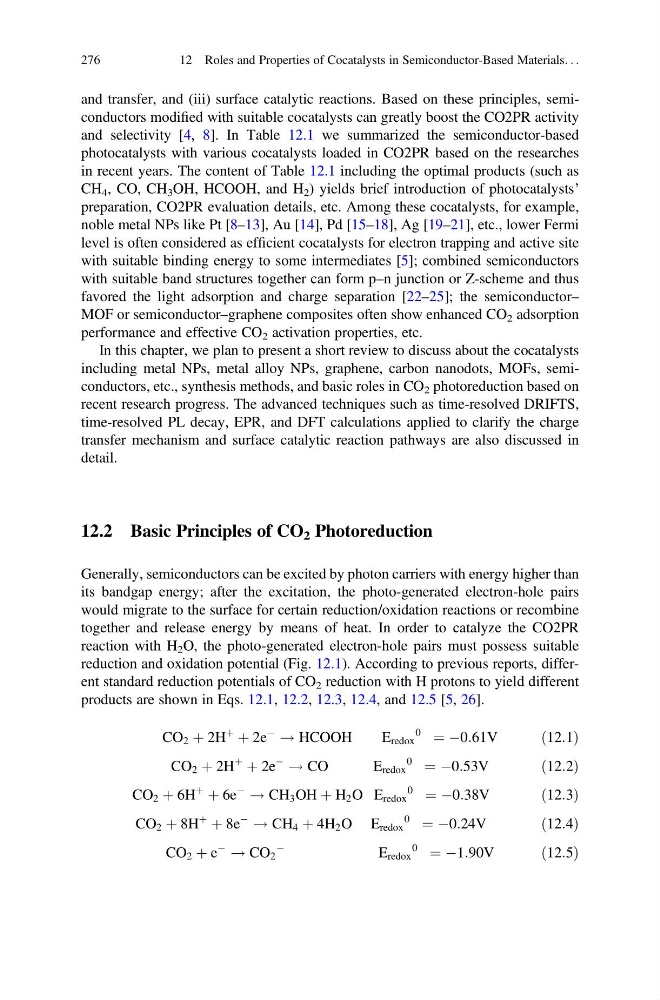
reduction and oxidation potential (Fig. 12.1). According to previous reports, different standard reduction potentials of CO 2 reduction with H protons to yield different
products are shown in Eqs. 12.1, 12.2, 12.3, 12.4, and 12.5 [5, 26].
CO 2 þ 2H
þ
þ 2e
À
! HCOOH
E redox
0
¼ À0:61V
ð12:1Þ
CO 2 þ 2H
þ
þ 2e
À
! CO
E redox
0
¼ À0:53V
ð12:2Þ
CO 2 þ 6H
þ
þ 6e
À
! CH 3 OH þ H 2 O E redox
0
¼ À0:38V
ð12:3Þ
CO 2 þ 8H
þ
þ 8e
À
! CH 4 þ 4H 2 O E redox
0
¼ À0:24V
ð12:4Þ
CO 2 þ e
À
! CO 2
À
E redox
0
¼ À1:90V
ð12:5Þ
276
12 Roles and Properties of Cocatalysts in Semiconductor-Based Materials. . .
and selectivity [4, 8]. In Table 12.1 we summarized the semiconductor-based
photocatalysts with various cocatalysts loaded in CO2PR based on the researches
in recent years. The content of Table 12.1 including the optimal products (such as
CH 4 , CO, CH 3 OH, HCOOH, and H 2 ) yields brief introduction of photocatalysts’
preparation, CO2PR evaluation details, etc. Among these cocatalysts, for example,
noble metal NPs like Pt [8–13], Au [14], Pd [15–18], Ag [19–21], etc., lower Fermi
level is often considered as efficient cocatalysts for electron trapping and active site
with suitable binding energy to some intermediates [5]; combined semiconductors
with suitable band structures together can form p–n junction or Z-scheme and thus
favored the light adsorption and charge separation [22–25]; the semiconductor–
MOF or semiconductor–graphene composites often show enhanced CO 2 adsorption
performance and effective CO 2 activation properties, etc.
In this chapter, we plan to present a short review to discuss about the cocatalysts
including metal NPs, metal alloy NPs, graphene, carbon nanodots, MOFs, semiconductors, etc., synthesis methods, and basic roles in CO 2 photoreduction based on
recent research progress. The advanced techniques such as time-resolved DRIFTS,
time-resolved PL decay, EPR, and DFT calculations applied to clarify the charge
transfer mechanism and surface catalytic reaction pathways are also discussed in
detail.
12.2 Basic Principles of CO 2 Photoreduction
Generally, semiconductors can be excited by photon carriers with energy higher than
its bandgap energy; after the excitation, the photo-generated electron-hole pairs
would migrate to the surface for certain reduction/oxidation reactions or recombine
together and release energy by means of heat. In order to catalyze the CO2PR
reaction with H 2 O, the photo-generated electron-hole pairs must possess suitable
reduction and oxidation potential (Fig. 12.1). According to previous reports, different standard reduction potentials of CO 2 reduction with H protons to yield different
products are shown in Eqs. 12.1, 12.2, 12.3, 12.4, and 12.5 [5, 26].
CO 2 þ 2H
þ
þ 2e
À
! HCOOH
E redox
0
¼ À0:61V
ð12:1Þ
CO 2 þ 2H
þ
þ 2e
À
! CO
E redox
0
¼ À0:53V
ð12:2Þ
CO 2 þ 6H
þ
þ 6e
À
! CH 3 OH þ H 2 O E redox
0
¼ À0:38V
ð12:3Þ
CO 2 þ 8H
þ
þ 8e
À
! CH 4 þ 4H 2 O E redox
0
¼ À0:24V
ð12:4Þ
CO 2 þ e
À
! CO 2
À
E redox
0
¼ À1:90V
ð12:5Þ
276
12 Roles and Properties of Cocatalysts in Semiconductor-Based Materials. . .