

phenylhydrazine-4-sulfonic acid to synthesize HG/Fe 3 O 4 composite. The result
showed that Fe 3 O 4 nanoparticles were uniformly and tightly clinched onto the HG
sheets, and the composites demonstrated paramagnetic characteristic, better stability
in water, and higher Photo-Fenton activity.
After years of research, a variety of preparation methods of Fe 3 O 4 and graphenebased catalyst have been invented in order to improve the photocatalytic efficiency
in Fenton reaction, cost saving, and environmental friendly. Santhosh et al. [67]
prepared G–Fe 3 O 4 composite through a one-step solvothermal route, which was
more convenient and less contaminative compared to two (or more)-step routes.
Fe 3 O 4 was proved to anchor firmly and well dispersedly on the graphene sheets in
the resulting G–Fe 3 O 4 composite which showed excellent performance on adsorbing
heavy metal like lead ion and degrading methylene blue due to the inhibition of
electron–hole recombination and more active sites for degradation. Jiang et al. [68]
studied the fabrication of rGO–Fe 3 O 4 nanocomposite through a creative procedure
that utilized a brown alga (Sargassum thunbergii) as the solely reducing agent,
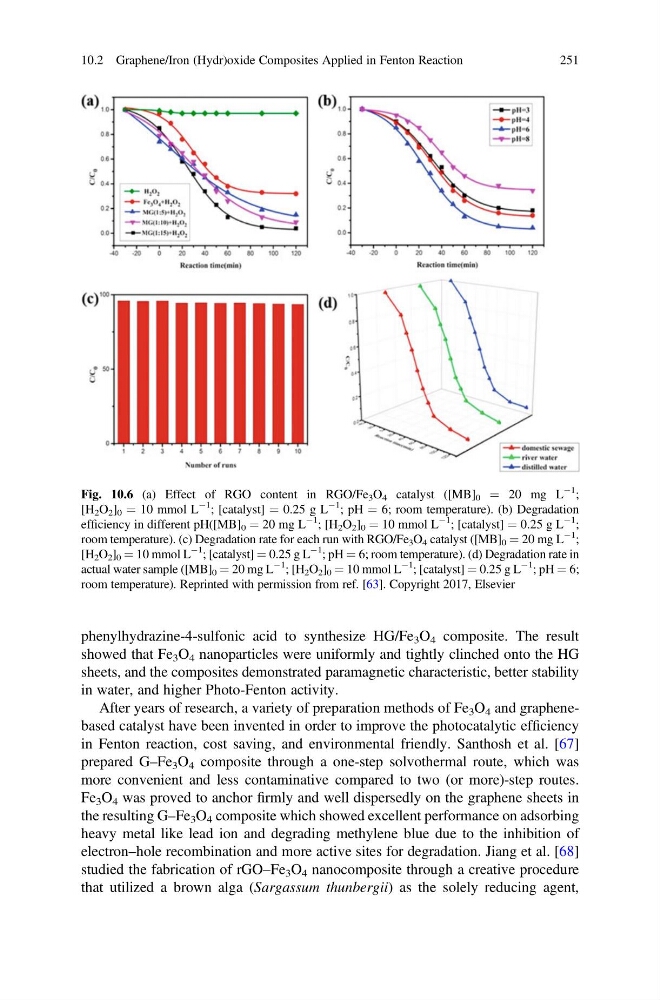
Fig. 10.6 (a) Effect of RGO content in RGO/Fe 3 O 4 catalyst ([MB] 0 ¼ 20 mg L
À1
;
[H 2 O 2 ] 0 ¼ 10 mmol L
À1
; [catalyst] ¼ 0.25 g L
À1
; pH ¼ 6; room temperature). (b) Degradation
efficiency in different pH([MB] 0 ¼ 20 mg L
À1
; [H 2 O 2 ] 0 ¼ 10 mmol L
À1
; [catalyst] ¼ 0.25 g L
À1
;
room temperature). (c) Degradation rate for each run with RGO/Fe 3 O 4 catalyst ([MB] 0 ¼ 20 mg L
À1
;
[H 2 O 2 ] 0 ¼ 10 mmol L
À1
; [catalyst] ¼ 0.25 g L
À1
; pH ¼ 6; room temperature). (d) Degradation rate in
actual water sample ([MB] 0 ¼ 20 mg L
À1
; [H 2 O 2 ] 0 ¼ 10 mmol L
À1
; [catalyst] ¼ 0.25 g L
À1
; pH ¼ 6;
room temperature). Reprinted with permission from ref. [63]. Copyright 2017, Elsevier
10.2 Graphene/Iron (Hydr)oxide Composites Applied in Fenton Reaction
251
showed that Fe 3 O 4 nanoparticles were uniformly and tightly clinched onto the HG
sheets, and the composites demonstrated paramagnetic characteristic, better stability
in water, and higher Photo-Fenton activity.
After years of research, a variety of preparation methods of Fe 3 O 4 and graphenebased catalyst have been invented in order to improve the photocatalytic efficiency
in Fenton reaction, cost saving, and environmental friendly. Santhosh et al. [67]
prepared G–Fe 3 O 4 composite through a one-step solvothermal route, which was
more convenient and less contaminative compared to two (or more)-step routes.
Fe 3 O 4 was proved to anchor firmly and well dispersedly on the graphene sheets in
the resulting G–Fe 3 O 4 composite which showed excellent performance on adsorbing
heavy metal like lead ion and degrading methylene blue due to the inhibition of
electron–hole recombination and more active sites for degradation. Jiang et al. [68]
studied the fabrication of rGO–Fe 3 O 4 nanocomposite through a creative procedure
that utilized a brown alga (Sargassum thunbergii) as the solely reducing agent,
Fig. 10.6 (a) Effect of RGO content in RGO/Fe 3 O 4 catalyst ([MB] 0 ¼ 20 mg L
À1
;
[H 2 O 2 ] 0 ¼ 10 mmol L
À1
; [catalyst] ¼ 0.25 g L
À1
; pH ¼ 6; room temperature). (b) Degradation
efficiency in different pH([MB] 0 ¼ 20 mg L
À1
; [H 2 O 2 ] 0 ¼ 10 mmol L
À1
; [catalyst] ¼ 0.25 g L
À1
;
room temperature). (c) Degradation rate for each run with RGO/Fe 3 O 4 catalyst ([MB] 0 ¼ 20 mg L
À1
;
[H 2 O 2 ] 0 ¼ 10 mmol L
À1
; [catalyst] ¼ 0.25 g L
À1
; pH ¼ 6; room temperature). (d) Degradation rate in
actual water sample ([MB] 0 ¼ 20 mg L
À1
; [H 2 O 2 ] 0 ¼ 10 mmol L
À1
; [catalyst] ¼ 0.25 g L
À1
; pH ¼ 6;
room temperature). Reprinted with permission from ref. [63]. Copyright 2017, Elsevier
10.2 Graphene/Iron (Hydr)oxide Composites Applied in Fenton Reaction
251