

comparatively studied the influence of the weight ratio of GO in Fe 3 O 4 -based
composite ranging from 0 to 15 wt% on the photocatalytic activity. The result
showed that the degradation rate reached the highest value when the GO content is
5 wt% in Fe 3 O 4 /GO composite regardless of increasing or decreasing GO content
because the active sites may be covered and the contact with H 2 O 2 may be hindered
by superfluous GO.
In several reports, the composite of Fe 3 O 4 nanoparticles combining with modified
graphene shows the more efficient photocatalysis than ordinary Fe 3 O 4 /GO catalyst.
The introduction of other functional groups or elements into graphene may facilitate
the higher catalytic activity and conductivity of graphene and subsequently reinforce
the capability of prohibiting the electron–hole recombination rate and adsorbing
organic contaminants onto the sheets with compositing with Fe 3 O 4 nanoparticles.
Boruah et al. [65] synthesized AG/Fe 3 O 4 composite that graphene was decorated
with ammonia. The new catalyst exhibited efficient photocatalytic activity degradation of phenol, 2-nitrophenol (2-NP), and 2-chlorophenol (2-CP) and further high
removal of three organic compounds under sunlight irradiation, which was attributed
to the synergistic effect between AG and Fe 3 O 4 NPs by preventing the recombination of electron–hole pair to enhance the catalytic performance. The synthetic route
and the mechanism of degradation were presented in Fig. 10.7. Graphene could not
form a good composite with Fe 3 O 4 due to its hydrophobicity, so Wang et al. [66]
prepared a type of hydrophilic graphene (HG) by GO reacting with
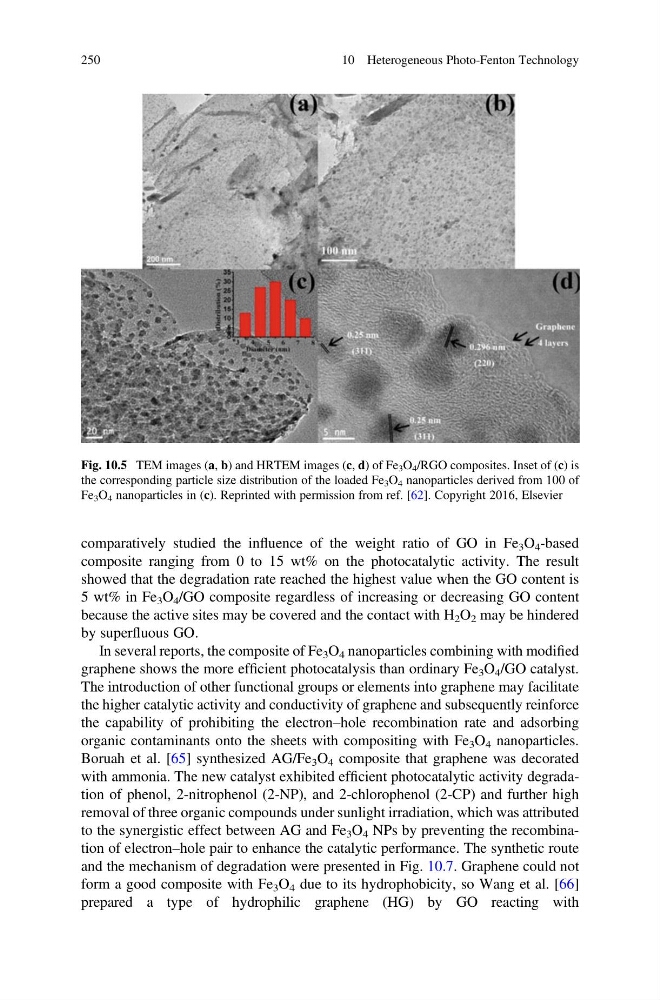
Fig. 10.5 TEM images (a, b) and HRTEM images (c, d) of Fe 3 O 4 /RGO composites. Inset of (c) is
the corresponding particle size distribution of the loaded Fe 3 O 4 nanoparticles derived from 100 of
Fe 3 O 4 nanoparticles in (c). Reprinted with permission from ref. [62]. Copyright 2016, Elsevier
250
10 Heterogeneous Photo-Fenton Technology
composite ranging from 0 to 15 wt% on the photocatalytic activity. The result
showed that the degradation rate reached the highest value when the GO content is
5 wt% in Fe 3 O 4 /GO composite regardless of increasing or decreasing GO content
because the active sites may be covered and the contact with H 2 O 2 may be hindered
by superfluous GO.
In several reports, the composite of Fe 3 O 4 nanoparticles combining with modified
graphene shows the more efficient photocatalysis than ordinary Fe 3 O 4 /GO catalyst.
The introduction of other functional groups or elements into graphene may facilitate
the higher catalytic activity and conductivity of graphene and subsequently reinforce
the capability of prohibiting the electron–hole recombination rate and adsorbing
organic contaminants onto the sheets with compositing with Fe 3 O 4 nanoparticles.
Boruah et al. [65] synthesized AG/Fe 3 O 4 composite that graphene was decorated
with ammonia. The new catalyst exhibited efficient photocatalytic activity degradation of phenol, 2-nitrophenol (2-NP), and 2-chlorophenol (2-CP) and further high
removal of three organic compounds under sunlight irradiation, which was attributed
to the synergistic effect between AG and Fe 3 O 4 NPs by preventing the recombination of electron–hole pair to enhance the catalytic performance. The synthetic route
and the mechanism of degradation were presented in Fig. 10.7. Graphene could not
form a good composite with Fe 3 O 4 due to its hydrophobicity, so Wang et al. [66]
prepared a type of hydrophilic graphene (HG) by GO reacting with
Fig. 10.5 TEM images (a, b) and HRTEM images (c, d) of Fe 3 O 4 /RGO composites. Inset of (c) is
the corresponding particle size distribution of the loaded Fe 3 O 4 nanoparticles derived from 100 of
Fe 3 O 4 nanoparticles in (c). Reprinted with permission from ref. [62]. Copyright 2016, Elsevier
250
10 Heterogeneous Photo-Fenton Technology