

particle size and concentration, Fe 2 O 3 /GAs exhibited higher Photo-Fenton reaction
activity after the several cycles.
10.2.2 Graphene/Fe 3 O 4 Composite as Photocatalyst
in Fenton Reaction
Fe 3 O 4 , a magnetic material with a structure of inverse spinal, is regarded as the most
promising catalyst in Fenton-like reaction due to its decent magnetic, electric, and
catalytic properties, biocompatibility, and low toxicity [55, 56] The octahedral
structure contains both Fe
2+ and Fe
3+ and the electrons can move fast between
them, allowing the Fe species to be selectively reduced or oxidized and keeping
the structure invariant at the same time. In addition, the narrow bandgap (0.1 eV) of
Fe 3 O 4 is of great importance to electron carrier and magnetic properties of Fe 3 O 4
cause it to be easily dispersed by an external magnetic field, both of which can
enhance photocatalytic activity. However, the nanoscaled Fe 3 O 4 particles are prone
to aggregate to become larger particles that will lose its initial huge surface area and
dispersibility in the aqueous solution and finally diminish the photocatalytic activity
toward organic pollutants. Meanwhile, the slow conversion rate of Fe(II) and Fe(III)
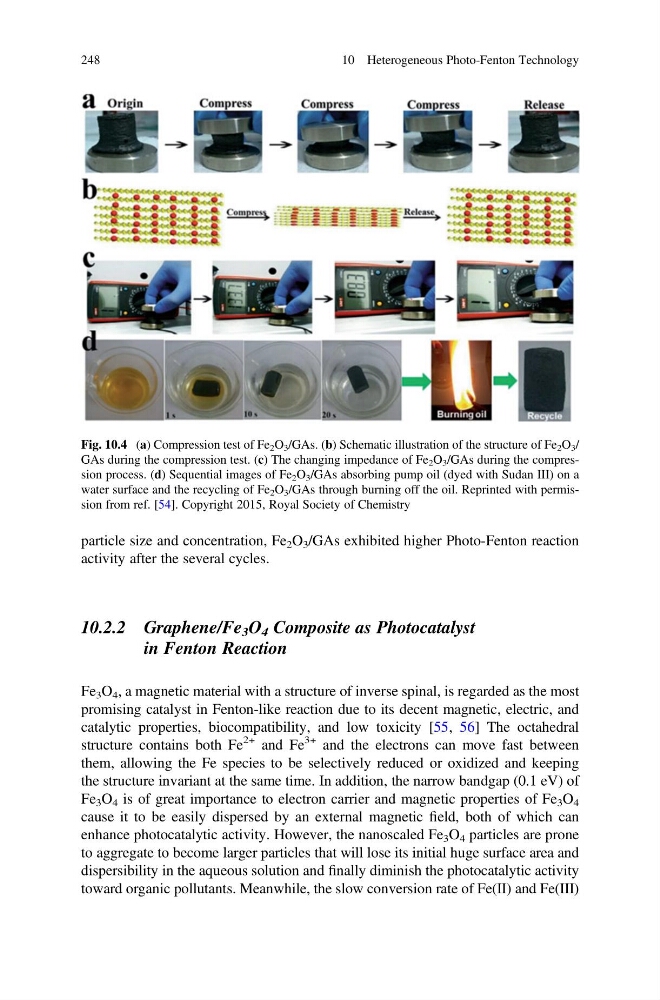
Fig. 10.4 (a) Compression test of Fe 2 O 3 /GAs. (b) Schematic illustration of the structure of Fe 2 O 3 /
GAs during the compression test. (c) The changing impedance of Fe 2 O 3 /GAs during the compression process. (d) Sequential images of Fe 2 O 3 /GAs absorbing pump oil (dyed with Sudan III) on a
water surface and the recycling of Fe 2 O 3 /GAs through burning off the oil. Reprinted with permission from ref. [54]. Copyright 2015, Royal Society of Chemistry
248
10 Heterogeneous Photo-Fenton Technology
activity after the several cycles.
10.2.2 Graphene/Fe 3 O 4 Composite as Photocatalyst
in Fenton Reaction
Fe 3 O 4 , a magnetic material with a structure of inverse spinal, is regarded as the most
promising catalyst in Fenton-like reaction due to its decent magnetic, electric, and
catalytic properties, biocompatibility, and low toxicity [55, 56] The octahedral
structure contains both Fe
2+ and Fe
3+ and the electrons can move fast between
them, allowing the Fe species to be selectively reduced or oxidized and keeping
the structure invariant at the same time. In addition, the narrow bandgap (0.1 eV) of
Fe 3 O 4 is of great importance to electron carrier and magnetic properties of Fe 3 O 4
cause it to be easily dispersed by an external magnetic field, both of which can
enhance photocatalytic activity. However, the nanoscaled Fe 3 O 4 particles are prone
to aggregate to become larger particles that will lose its initial huge surface area and
dispersibility in the aqueous solution and finally diminish the photocatalytic activity
toward organic pollutants. Meanwhile, the slow conversion rate of Fe(II) and Fe(III)
Fig. 10.4 (a) Compression test of Fe 2 O 3 /GAs. (b) Schematic illustration of the structure of Fe 2 O 3 /
GAs during the compression test. (c) The changing impedance of Fe 2 O 3 /GAs during the compression process. (d) Sequential images of Fe 2 O 3 /GAs absorbing pump oil (dyed with Sudan III) on a
water surface and the recycling of Fe 2 O 3 /GAs through burning off the oil. Reprinted with permission from ref. [54]. Copyright 2015, Royal Society of Chemistry
248
10 Heterogeneous Photo-Fenton Technology