

nanocomposite which showed 1.5 times higher on degrading methyl blue and 2.3
times higher on converting glyphosate. There are two reasons to explain: (1) the
content of the oxygen-containing groups on GO had been adjusted and the morphology of NG-Fe 2 O 3 has been changed a larger BET surface area compared to that
of bare Fe 2 O 3 and (2) the intimating contact between Fe 2 O 3 and NG accelerated the
electron transfer from Fe 2 O 3 to NG so that the holes in Fe 2 O 3 were increased to
accept electrons from H 2 O 2 to generate hydroxyl radicals in Photo-Fenton reaction.
Thus, the photocatalytic efficiency was improved as observed.
Recently, Fe 2 O 3 /3D graphene aerogels (GAs) have been widely studied, but most
of researches have been done on lithium ion batteries due to the difficulty in
dispersing Fe 2 O 3 particles on 3D-graphene, which limits its application in PhotoFenton reaction. Qiu et al. [54] have solved the problem of dispersion of Fe 2 O 3
particles on GAs by a modified Stöber-like method. Such 3D network structure
inhibited Fe(II) loss and stabilized the conversion of Fe(III)/Fe(II) in Photo-Fenton
reaction. Besides, the composite was full of elasticity and easy to be recycled shown
in Fig. 10.4, and the loss of Fe(II) of Fe 2 O 3 /GR ordinary composite remained high in
acidic solution, which led to the deactivation of the catalyst and degradation rate of
organic contaminants. Thus, compared to pure Fe 2 O 3 and Fe 2 O 3 /GR with the similar
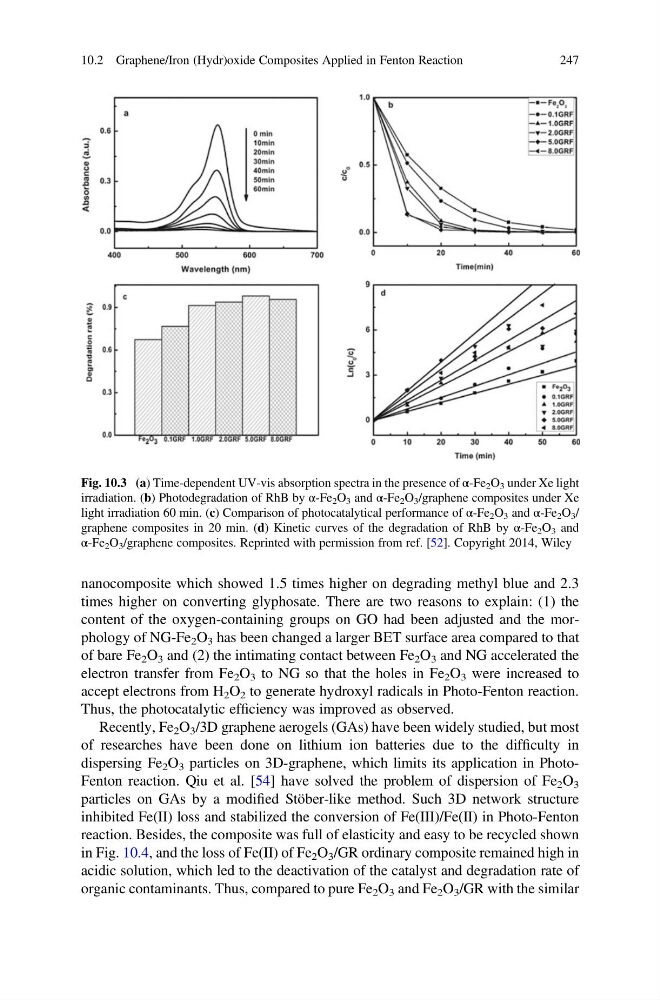
Fig. 10.3 (a) Time-dependent UV-vis absorption spectra in the presence of α-Fe 2 O 3 under Xe light
irradiation. (b) Photodegradation of RhB by α-Fe 2 O 3 and α-Fe 2 O 3 /graphene composites under Xe
light irradiation 60 min. (c) Comparison of photocatalytical performance of α-Fe 2 O 3 and α-Fe 2 O 3 /
graphene composites in 20 min. (d) Kinetic curves of the degradation of RhB by α-Fe 2 O 3 and
α-Fe 2 O 3 /graphene composites. Reprinted with permission from ref. [52]. Copyright 2014, Wiley
10.2 Graphene/Iron (Hydr)oxide Composites Applied in Fenton Reaction
247
times higher on converting glyphosate. There are two reasons to explain: (1) the
content of the oxygen-containing groups on GO had been adjusted and the morphology of NG-Fe 2 O 3 has been changed a larger BET surface area compared to that
of bare Fe 2 O 3 and (2) the intimating contact between Fe 2 O 3 and NG accelerated the
electron transfer from Fe 2 O 3 to NG so that the holes in Fe 2 O 3 were increased to
accept electrons from H 2 O 2 to generate hydroxyl radicals in Photo-Fenton reaction.
Thus, the photocatalytic efficiency was improved as observed.
Recently, Fe 2 O 3 /3D graphene aerogels (GAs) have been widely studied, but most
of researches have been done on lithium ion batteries due to the difficulty in
dispersing Fe 2 O 3 particles on 3D-graphene, which limits its application in PhotoFenton reaction. Qiu et al. [54] have solved the problem of dispersion of Fe 2 O 3
particles on GAs by a modified Stöber-like method. Such 3D network structure
inhibited Fe(II) loss and stabilized the conversion of Fe(III)/Fe(II) in Photo-Fenton
reaction. Besides, the composite was full of elasticity and easy to be recycled shown
in Fig. 10.4, and the loss of Fe(II) of Fe 2 O 3 /GR ordinary composite remained high in
acidic solution, which led to the deactivation of the catalyst and degradation rate of
organic contaminants. Thus, compared to pure Fe 2 O 3 and Fe 2 O 3 /GR with the similar
Fig. 10.3 (a) Time-dependent UV-vis absorption spectra in the presence of α-Fe 2 O 3 under Xe light
irradiation. (b) Photodegradation of RhB by α-Fe 2 O 3 and α-Fe 2 O 3 /graphene composites under Xe
light irradiation 60 min. (c) Comparison of photocatalytical performance of α-Fe 2 O 3 and α-Fe 2 O 3 /
graphene composites in 20 min. (d) Kinetic curves of the degradation of RhB by α-Fe 2 O 3 and
α-Fe 2 O 3 /graphene composites. Reprinted with permission from ref. [52]. Copyright 2014, Wiley
10.2 Graphene/Iron (Hydr)oxide Composites Applied in Fenton Reaction
247