

10.2 Graphene/Iron (Hydr)oxide Composites Applied
in Fenton Reaction
To date, a series of studies has been reported on the application of graphene/iron
(hydr)oxide composites as photocatalysts to degrade organic pollutants in wastewater, especially dye pollution, which is attributed to their excellent conductivity,
adsorptivity, stability, reusability, etc. Graphene has been used as an ideal support
material to combine with various iron (hydr)oxides such as Fe 2 O 3 , Fe 3 O 4 , FeOOH,
ZnFe 2 O 4 , and so on [45–48]. The synergistic effects of restricting electron–hole
recombination and preventing the leaching of iron oxides strongly enhance the
photocatalytic activity of the composite. Besides, the large plane structure of
graphene makes aromatic pollution easier to be adsorbed and accelerates the process
of catalysis. Thus, graphene/Fe 2 O 3 , graphene/Fe 3 O 4 , and other graphene/iron (hydr)
oxides have been discussed and their photocatalytic activity has been evaluated in
the following parts and tabulated in Table 10.1.
10.2.1 Graphene/Fe 2 O 3 Composite as Photocatalyst
in Fenton Reaction
α-Fe 2 O 3 is the most widely used crystalline structure of iron oxide as it is abundant,
inexpensive, and environmentally benign. α-Fe 2 O 3 is an n-type semiconductor and
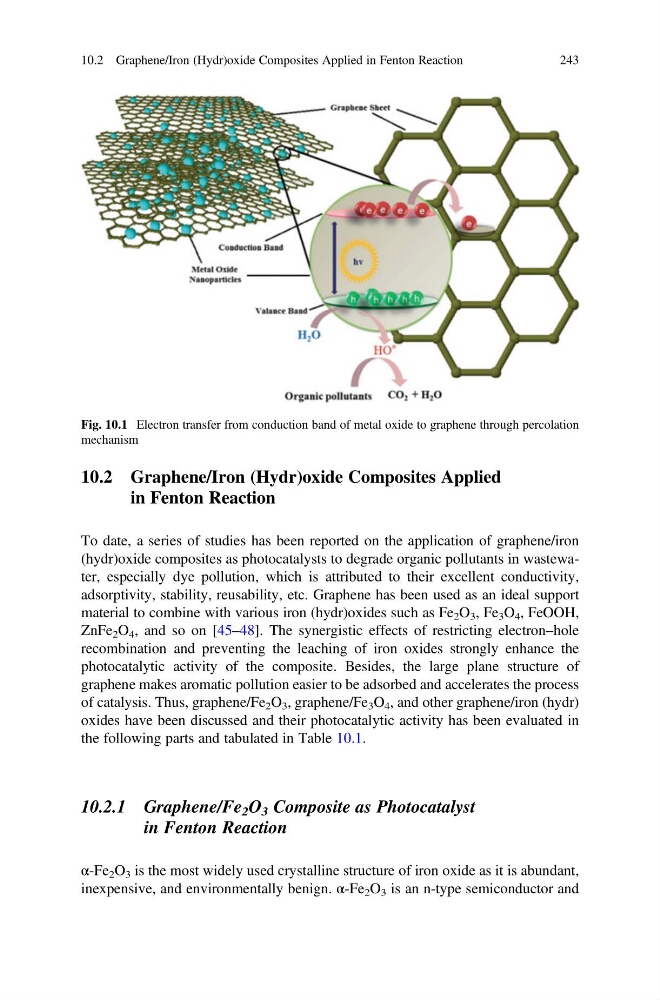
Fig. 10.1 Electron transfer from conduction band of metal oxide to graphene through percolation
mechanism
10.2 Graphene/Iron (Hydr)oxide Composites Applied in Fenton Reaction
243
in Fenton Reaction
To date, a series of studies has been reported on the application of graphene/iron
(hydr)oxide composites as photocatalysts to degrade organic pollutants in wastewater, especially dye pollution, which is attributed to their excellent conductivity,
adsorptivity, stability, reusability, etc. Graphene has been used as an ideal support
material to combine with various iron (hydr)oxides such as Fe 2 O 3 , Fe 3 O 4 , FeOOH,
ZnFe 2 O 4 , and so on [45–48]. The synergistic effects of restricting electron–hole
recombination and preventing the leaching of iron oxides strongly enhance the
photocatalytic activity of the composite. Besides, the large plane structure of
graphene makes aromatic pollution easier to be adsorbed and accelerates the process
of catalysis. Thus, graphene/Fe 2 O 3 , graphene/Fe 3 O 4 , and other graphene/iron (hydr)
oxides have been discussed and their photocatalytic activity has been evaluated in
the following parts and tabulated in Table 10.1.
10.2.1 Graphene/Fe 2 O 3 Composite as Photocatalyst
in Fenton Reaction
α-Fe 2 O 3 is the most widely used crystalline structure of iron oxide as it is abundant,
inexpensive, and environmentally benign. α-Fe 2 O 3 is an n-type semiconductor and
Fig. 10.1 Electron transfer from conduction band of metal oxide to graphene through percolation
mechanism
10.2 Graphene/Iron (Hydr)oxide Composites Applied in Fenton Reaction
243