

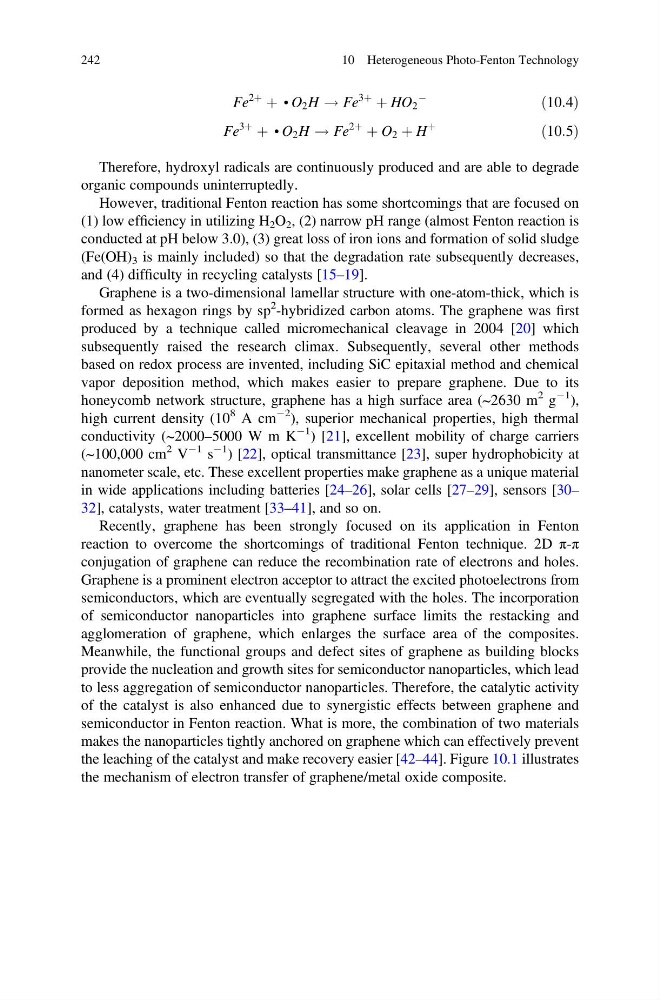
Fe
2þ
þ • O 2 H ! Fe
3þ
þ HO 2
À
ð10:4Þ
Fe
3þ
þ • O 2 H ! Fe
2þ
þ O 2 þ H
þ
ð10:5Þ
Therefore, hydroxyl radicals are continuously produced and are able to degrade
organic compounds uninterruptedly.
However, traditional Fenton reaction has some shortcomings that are focused on
(1) low efficiency in utilizing H 2 O 2 , (2) narrow pH range (almost Fenton reaction is
conducted at pH below 3.0), (3) great loss of iron ions and formation of solid sludge
(Fe(OH) 3 is mainly included) so that the degradation rate subsequently decreases,
and (4) difficulty in recycling catalysts [15–19].
Graphene is a two-dimensional lamellar structure with one-atom-thick, which is
formed as hexagon rings by sp
2 -hybridized carbon atoms. The graphene was first
produced by a technique called micromechanical cleavage in 2004 [20] which
subsequently raised the research climax. Subsequently, several other methods
based on redox process are invented, including SiC epitaxial method and chemical
vapor deposition method, which makes easier to prepare graphene. Due to its
honeycomb network structure, graphene has a high surface area (~2630 m
2 g
À1 ),
high current density (10
8 A cm
À2
), superior mechanical properties, high thermal
conductivity (~2000–5000 W m K
À1 ) [21], excellent mobility of charge carriers
(~100,000 cm
2 V
À1 s
À1 ) [22], optical transmittance [23], super hydrophobicity at
nanometer scale, etc. These excellent properties make graphene as a unique material
in wide applications including batteries [24–26], solar cells [27–29], sensors [30–
32], catalysts, water treatment [33–41], and so on.
Recently, graphene has been strongly focused on its application in Fenton
reaction to overcome the shortcomings of traditional Fenton technique. 2D π-π
conjugation of graphene can reduce the recombination rate of electrons and holes.
Graphene is a prominent electron acceptor to attract the excited photoelectrons from
semiconductors, which are eventually segregated with the holes. The incorporation
of semiconductor nanoparticles into graphene surface limits the restacking and
agglomeration of graphene, which enlarges the surface area of the composites.
Meanwhile, the functional groups and defect sites of graphene as building blocks
provide the nucleation and growth sites for semiconductor nanoparticles, which lead
to less aggregation of semiconductor nanoparticles. Therefore, the catalytic activity
of the catalyst is also enhanced due to synergistic effects between graphene and
semiconductor in Fenton reaction. What is more, the combination of two materials
makes the nanoparticles tightly anchored on graphene which can effectively prevent
the leaching of the catalyst and make recovery easier [42–44]. Figure 10.1 illustrates
the mechanism of electron transfer of graphene/metal oxide composite.
242
10 Heterogeneous Photo-Fenton Technology
2þ
þ • O 2 H ! Fe
3þ
þ HO 2
À
ð10:4Þ
Fe
3þ
þ • O 2 H ! Fe
2þ
þ O 2 þ H
þ
ð10:5Þ
Therefore, hydroxyl radicals are continuously produced and are able to degrade
organic compounds uninterruptedly.
However, traditional Fenton reaction has some shortcomings that are focused on
(1) low efficiency in utilizing H 2 O 2 , (2) narrow pH range (almost Fenton reaction is
conducted at pH below 3.0), (3) great loss of iron ions and formation of solid sludge
(Fe(OH) 3 is mainly included) so that the degradation rate subsequently decreases,
and (4) difficulty in recycling catalysts [15–19].
Graphene is a two-dimensional lamellar structure with one-atom-thick, which is
formed as hexagon rings by sp
2 -hybridized carbon atoms. The graphene was first
produced by a technique called micromechanical cleavage in 2004 [20] which
subsequently raised the research climax. Subsequently, several other methods
based on redox process are invented, including SiC epitaxial method and chemical
vapor deposition method, which makes easier to prepare graphene. Due to its
honeycomb network structure, graphene has a high surface area (~2630 m
2 g
À1 ),
high current density (10
8 A cm
À2
), superior mechanical properties, high thermal
conductivity (~2000–5000 W m K
À1 ) [21], excellent mobility of charge carriers
(~100,000 cm
2 V
À1 s
À1 ) [22], optical transmittance [23], super hydrophobicity at
nanometer scale, etc. These excellent properties make graphene as a unique material
in wide applications including batteries [24–26], solar cells [27–29], sensors [30–
32], catalysts, water treatment [33–41], and so on.
Recently, graphene has been strongly focused on its application in Fenton
reaction to overcome the shortcomings of traditional Fenton technique. 2D π-π
conjugation of graphene can reduce the recombination rate of electrons and holes.
Graphene is a prominent electron acceptor to attract the excited photoelectrons from
semiconductors, which are eventually segregated with the holes. The incorporation
of semiconductor nanoparticles into graphene surface limits the restacking and
agglomeration of graphene, which enlarges the surface area of the composites.
Meanwhile, the functional groups and defect sites of graphene as building blocks
provide the nucleation and growth sites for semiconductor nanoparticles, which lead
to less aggregation of semiconductor nanoparticles. Therefore, the catalytic activity
of the catalyst is also enhanced due to synergistic effects between graphene and
semiconductor in Fenton reaction. What is more, the combination of two materials
makes the nanoparticles tightly anchored on graphene which can effectively prevent
the leaching of the catalyst and make recovery easier [42–44]. Figure 10.1 illustrates
the mechanism of electron transfer of graphene/metal oxide composite.
242
10 Heterogeneous Photo-Fenton Technology