

excellent photocatalyst of both water oxidation and selective benzyl alcohol
oxidation.
A new strategy for design and synthesis of Co 9 S 8 hollow cubes decorated by CdS
QDs was developed by Zhang et al. [15]. The hybrid Z-scheme system is obtained by
a simple hydrothermal method containing dimethyl sulfoxide (DMSO) as a solvent
and hollow Co(OH) 2 cubes as a template. DMSO solvent served as a sulfur source to
react with Cd
2+ , producing CdS QDs, and was also used as the anion exchange
reagent to react with easily prepared Co(OH) 2 cubes. The hollow CdS–Co 9 S 8 cubes
exhibit efficient solar light harvesting, as well as impressively enhanced hydrogen
evolution reaction (HER) activity and stability under solar light irradiation compared
to that of the pure Co 9 S 8 and CdS catalysts. An efficient Z-scheme building block
and the multiple reflections of solar light within the cavity of hollow cubes are
responsible for substantially enhanced HER activity and stability (Fig. 9.9).
MnO x @CdS/CoP hollow spheres with spatially separated surfaces were fabricated by loading the dual cocatalysts (inside MnO x and outside CoP) for enhanced
photocatalytic H 2 evolution activities [16]. CdS shells (hollow spheres) can be
realized by using SiO 2 spheres as sacrificial templates, where the MnO x and CoP
NPs are selectively anchored on the inner and outer surface of CdS shells, respectively. That is, the photo-generated electrons and holes can directionally migrate to
the locations of dual cocatalysts for reduction and oxidation reaction, respectively.
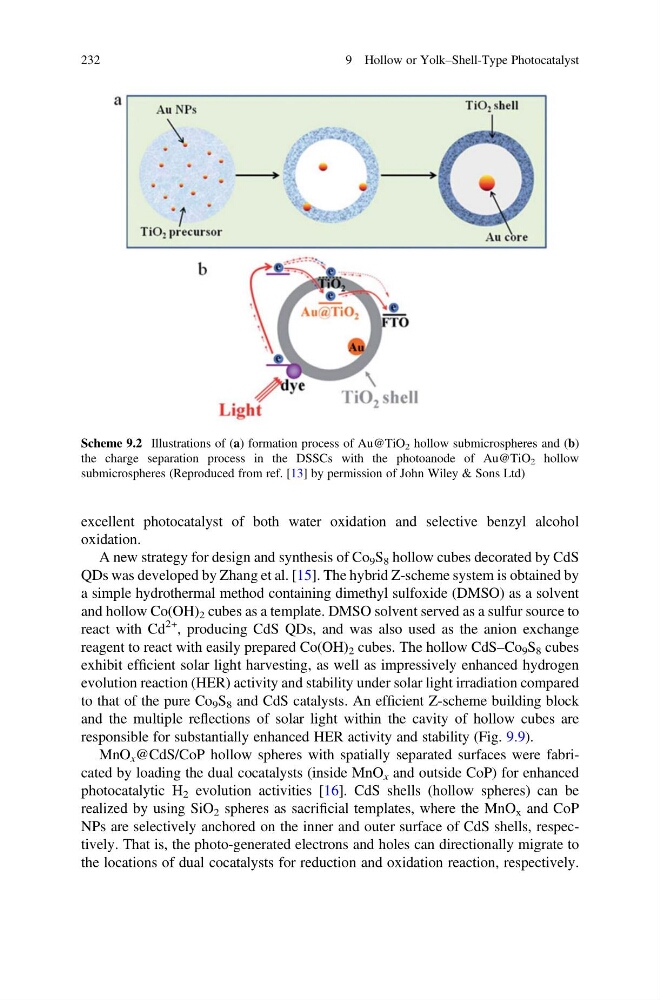
Scheme 9.2 Illustrations of (a) formation process of Au@TiO 2 hollow submicrospheres and (b)
the charge separation process in the DSSCs with the photoanode of Au@TiO 2 hollow
submicrospheres (Reproduced from ref. [13] by permission of John Wiley & Sons Ltd)
232
9 Hollow or Yolk–Shell-Type Photocatalyst
oxidation.
A new strategy for design and synthesis of Co 9 S 8 hollow cubes decorated by CdS
QDs was developed by Zhang et al. [15]. The hybrid Z-scheme system is obtained by
a simple hydrothermal method containing dimethyl sulfoxide (DMSO) as a solvent
and hollow Co(OH) 2 cubes as a template. DMSO solvent served as a sulfur source to
react with Cd
2+ , producing CdS QDs, and was also used as the anion exchange
reagent to react with easily prepared Co(OH) 2 cubes. The hollow CdS–Co 9 S 8 cubes
exhibit efficient solar light harvesting, as well as impressively enhanced hydrogen
evolution reaction (HER) activity and stability under solar light irradiation compared
to that of the pure Co 9 S 8 and CdS catalysts. An efficient Z-scheme building block
and the multiple reflections of solar light within the cavity of hollow cubes are
responsible for substantially enhanced HER activity and stability (Fig. 9.9).
MnO x @CdS/CoP hollow spheres with spatially separated surfaces were fabricated by loading the dual cocatalysts (inside MnO x and outside CoP) for enhanced
photocatalytic H 2 evolution activities [16]. CdS shells (hollow spheres) can be
realized by using SiO 2 spheres as sacrificial templates, where the MnO x and CoP
NPs are selectively anchored on the inner and outer surface of CdS shells, respectively. That is, the photo-generated electrons and holes can directionally migrate to
the locations of dual cocatalysts for reduction and oxidation reaction, respectively.
Scheme 9.2 Illustrations of (a) formation process of Au@TiO 2 hollow submicrospheres and (b)
the charge separation process in the DSSCs with the photoanode of Au@TiO 2 hollow
submicrospheres (Reproduced from ref. [13] by permission of John Wiley & Sons Ltd)
232
9 Hollow or Yolk–Shell-Type Photocatalyst