

method. Different new bonds were determined to form on the surface of TiO 2 when
the order of boron and nitrogen addition was changed, and they could significantly
affect the photoactivities of the materials. The abovementioned experimental results
are further illustrated by the DFT calculation. Gombac et al. [148] found that the
surface N doping did not appreciably modify the TiO 2 structures and texture, and
boron incorporation in TiO 2 indeed inhibited the TiO 2 crystallite growth and
increased the surface area of TiO 2 . Only when B was present in excess with respect
to N, a remarkable photoactivity improvement could be obtained. DFT calculation
method was used to interpret the observed behavior. And the B in molar excess with
respect to N led to the generation of Ti
3+ sites, which might further induce the
generation of reactive superoxide species. Different from the surface bond structures
and the reactive Ti
3+ sites induced by B and N co-doping, Czoska et al. [70]
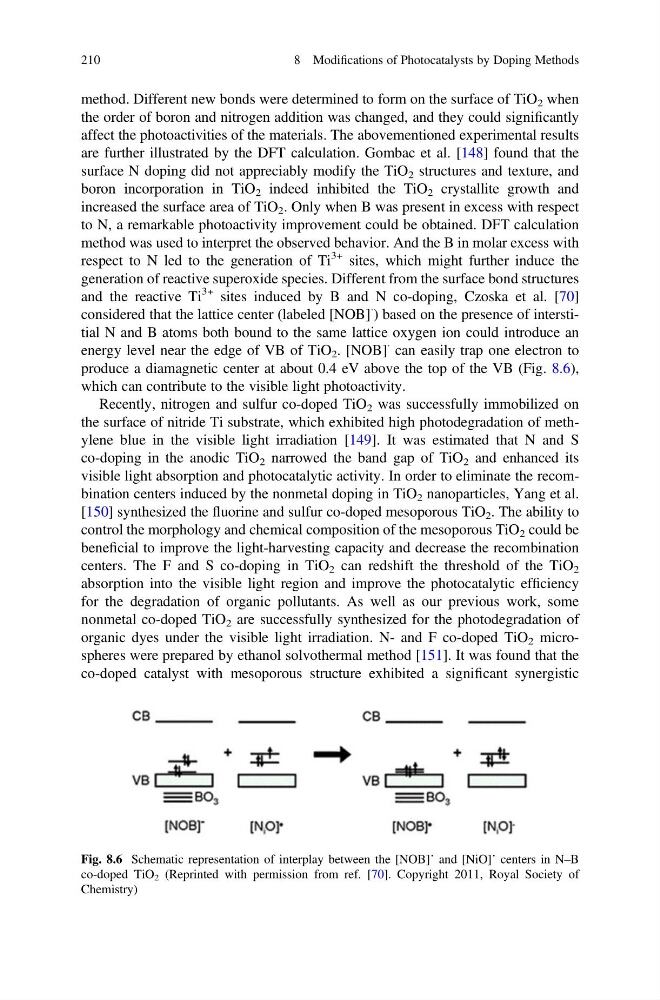
considered that the lattice center (labeled [NOB]
Á
) based on the presence of interstitial N and B atoms both bound to the same lattice oxygen ion could introduce an
energy level near the edge of VB of TiO 2 . [NOB]
Á can easily trap one electron to
produce a diamagnetic center at about 0.4 eV above the top of the VB (Fig. 8.6),
which can contribute to the visible light photoactivity.
Recently, nitrogen and sulfur co-doped TiO 2 was successfully immobilized on
the surface of nitride Ti substrate, which exhibited high photodegradation of methylene blue in the visible light irradiation [149]. It was estimated that N and S
co-doping in the anodic TiO 2 narrowed the band gap of TiO 2 and enhanced its
visible light absorption and photocatalytic activity. In order to eliminate the recombination centers induced by the nonmetal doping in TiO 2 nanoparticles, Yang et al.
[150] synthesized the fluorine and sulfur co-doped mesoporous TiO 2 . The ability to
control the morphology and chemical composition of the mesoporous TiO 2 could be
beneficial to improve the light-harvesting capacity and decrease the recombination
centers. The F and S co-doping in TiO 2 can redshift the threshold of the TiO 2
absorption into the visible light region and improve the photocatalytic efficiency
for the degradation of organic pollutants. As well as our previous work, some
nonmetal co-doped TiO 2 are successfully synthesized for the photodegradation of
organic dyes under the visible light irradiation. N- and F co-doped TiO 2 microspheres were prepared by ethanol solvothermal method [151]. It was found that the
co-doped catalyst with mesoporous structure exhibited a significant synergistic
Fig. 8.6 Schematic representation of interplay between the [NOB]˙ and [NiO]˙ centers in N–B
co-doped TiO 2 (Reprinted with permission from ref. [70]. Copyright 2011, Royal Society of
Chemistry)
210
8 Modifications of Photocatalysts by Doping Methods
the order of boron and nitrogen addition was changed, and they could significantly
affect the photoactivities of the materials. The abovementioned experimental results
are further illustrated by the DFT calculation. Gombac et al. [148] found that the
surface N doping did not appreciably modify the TiO 2 structures and texture, and
boron incorporation in TiO 2 indeed inhibited the TiO 2 crystallite growth and
increased the surface area of TiO 2 . Only when B was present in excess with respect
to N, a remarkable photoactivity improvement could be obtained. DFT calculation
method was used to interpret the observed behavior. And the B in molar excess with
respect to N led to the generation of Ti
3+ sites, which might further induce the
generation of reactive superoxide species. Different from the surface bond structures
and the reactive Ti
3+ sites induced by B and N co-doping, Czoska et al. [70]
considered that the lattice center (labeled [NOB]
Á
) based on the presence of interstitial N and B atoms both bound to the same lattice oxygen ion could introduce an
energy level near the edge of VB of TiO 2 . [NOB]
Á can easily trap one electron to
produce a diamagnetic center at about 0.4 eV above the top of the VB (Fig. 8.6),
which can contribute to the visible light photoactivity.
Recently, nitrogen and sulfur co-doped TiO 2 was successfully immobilized on
the surface of nitride Ti substrate, which exhibited high photodegradation of methylene blue in the visible light irradiation [149]. It was estimated that N and S
co-doping in the anodic TiO 2 narrowed the band gap of TiO 2 and enhanced its
visible light absorption and photocatalytic activity. In order to eliminate the recombination centers induced by the nonmetal doping in TiO 2 nanoparticles, Yang et al.
[150] synthesized the fluorine and sulfur co-doped mesoporous TiO 2 . The ability to
control the morphology and chemical composition of the mesoporous TiO 2 could be
beneficial to improve the light-harvesting capacity and decrease the recombination
centers. The F and S co-doping in TiO 2 can redshift the threshold of the TiO 2
absorption into the visible light region and improve the photocatalytic efficiency
for the degradation of organic pollutants. As well as our previous work, some
nonmetal co-doped TiO 2 are successfully synthesized for the photodegradation of
organic dyes under the visible light irradiation. N- and F co-doped TiO 2 microspheres were prepared by ethanol solvothermal method [151]. It was found that the
co-doped catalyst with mesoporous structure exhibited a significant synergistic
Fig. 8.6 Schematic representation of interplay between the [NOB]˙ and [NiO]˙ centers in N–B
co-doped TiO 2 (Reprinted with permission from ref. [70]. Copyright 2011, Royal Society of
Chemistry)
210
8 Modifications of Photocatalysts by Doping Methods