

photocatalyst in recent years, the modification mechanism of co-doping, and the
synergistic effect existing in the co-doped TiO 2 .
According to the band theory of semiconductors, the conduction band of TiO 2
semiconductors is mainly determined by the Ti3d orbital energy level, and the
valence band mainly depends on the energy level of O2p orbital. Compared with
the O2p orbital, nonmetal elements such as N, C, S, and P have the 2p orbital with
relatively high energy levels; hence, it is possible to enhance the visible light
photocatalytic activity of TiO 2 by the doping N, C, S, P, and other nonmetal
elements, due to the increase of electric potential of valence band by the partial
substitution of impurity dopants for lattice oxygen.
Compared with other nonmetallic element co-doping modification, nitrogen
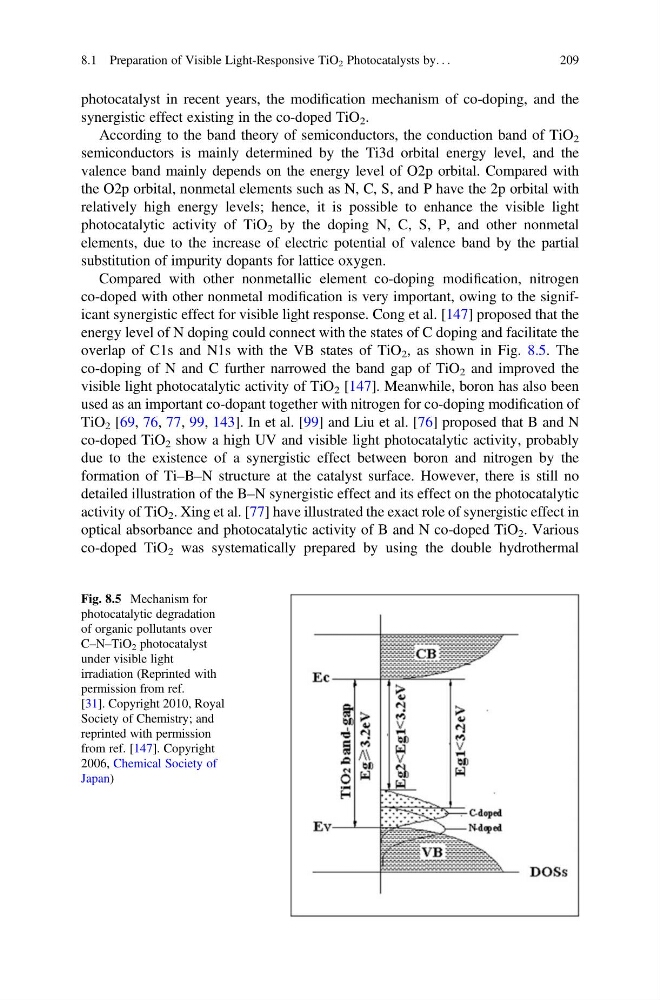
co-doped with other nonmetal modification is very important, owing to the significant synergistic effect for visible light response. Cong et al. [147] proposed that the
energy level of N doping could connect with the states of C doping and facilitate the
overlap of C1s and N1s with the VB states of TiO 2 , as shown in Fig. 8.5. The
co-doping of N and C further narrowed the band gap of TiO 2 and improved the
visible light photocatalytic activity of TiO 2 [147]. Meanwhile, boron has also been
used as an important co-dopant together with nitrogen for co-doping modification of
TiO 2 [69, 76, 77, 99, 143]. In et al. [99] and Liu et al. [76] proposed that B and N
co-doped TiO 2 show a high UV and visible light photocatalytic activity, probably
due to the existence of a synergistic effect between boron and nitrogen by the
formation of Ti–B–N structure at the catalyst surface. However, there is still no
detailed illustration of the B–N synergistic effect and its effect on the photocatalytic
activity of TiO 2 . Xing et al. [77] have illustrated the exact role of synergistic effect in
optical absorbance and photocatalytic activity of B and N co-doped TiO 2 . Various
co-doped TiO 2 was systematically prepared by using the double hydrothermal
Fig. 8.5 Mechanism for
photocatalytic degradation
of organic pollutants over
C–N–TiO 2 photocatalyst
under visible light
irradiation (Reprinted with
permission from ref.
[31]. Copyright 2010, Royal
Society of Chemistry; and
reprinted with permission
from ref. [147]. Copyright
2006, Chemical Society of
Japan)
8.1 Preparation of Visible Light-Responsive TiO 2 Photocatalysts by. . .
209
synergistic effect existing in the co-doped TiO 2 .
According to the band theory of semiconductors, the conduction band of TiO 2
semiconductors is mainly determined by the Ti3d orbital energy level, and the
valence band mainly depends on the energy level of O2p orbital. Compared with
the O2p orbital, nonmetal elements such as N, C, S, and P have the 2p orbital with
relatively high energy levels; hence, it is possible to enhance the visible light
photocatalytic activity of TiO 2 by the doping N, C, S, P, and other nonmetal
elements, due to the increase of electric potential of valence band by the partial
substitution of impurity dopants for lattice oxygen.
Compared with other nonmetallic element co-doping modification, nitrogen
co-doped with other nonmetal modification is very important, owing to the significant synergistic effect for visible light response. Cong et al. [147] proposed that the
energy level of N doping could connect with the states of C doping and facilitate the
overlap of C1s and N1s with the VB states of TiO 2 , as shown in Fig. 8.5. The
co-doping of N and C further narrowed the band gap of TiO 2 and improved the
visible light photocatalytic activity of TiO 2 [147]. Meanwhile, boron has also been
used as an important co-dopant together with nitrogen for co-doping modification of
TiO 2 [69, 76, 77, 99, 143]. In et al. [99] and Liu et al. [76] proposed that B and N
co-doped TiO 2 show a high UV and visible light photocatalytic activity, probably
due to the existence of a synergistic effect between boron and nitrogen by the
formation of Ti–B–N structure at the catalyst surface. However, there is still no
detailed illustration of the B–N synergistic effect and its effect on the photocatalytic
activity of TiO 2 . Xing et al. [77] have illustrated the exact role of synergistic effect in
optical absorbance and photocatalytic activity of B and N co-doped TiO 2 . Various
co-doped TiO 2 was systematically prepared by using the double hydrothermal
Fig. 8.5 Mechanism for
photocatalytic degradation
of organic pollutants over
C–N–TiO 2 photocatalyst
under visible light
irradiation (Reprinted with
permission from ref.
[31]. Copyright 2010, Royal
Society of Chemistry; and
reprinted with permission
from ref. [147]. Copyright
2006, Chemical Society of
Japan)
8.1 Preparation of Visible Light-Responsive TiO 2 Photocatalysts by. . .
209