

widely studied. In some of recent work [51, 52], a new approach to synthesize the
N-doped TiO 2 nanocrystals was developed, and the relationship of doped nitrogen
species to visible light photoactivity was investigated. It was found that the nitrogen
introduced into TiO 2 is beneficial to the visible light photodegradation of
2,4-dichlorophen and the nitrogen species chemically adsorbed on catalyst surface
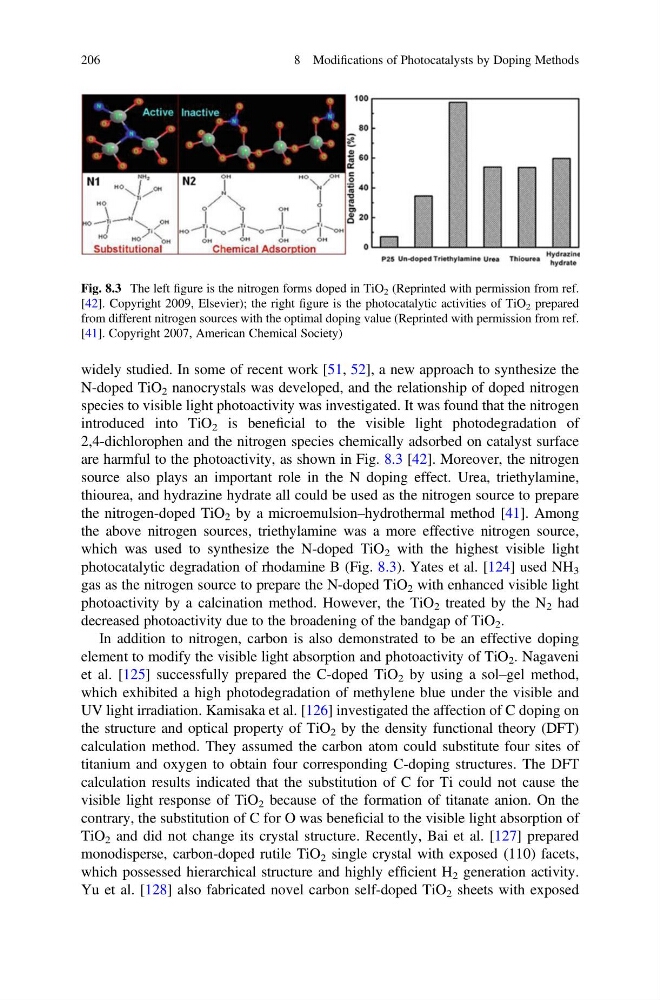
are harmful to the photoactivity, as shown in Fig. 8.3 [42]. Moreover, the nitrogen
source also plays an important role in the N doping effect. Urea, triethylamine,
thiourea, and hydrazine hydrate all could be used as the nitrogen source to prepare
the nitrogen-doped TiO 2 by a microemulsion–hydrothermal method [41]. Among
the above nitrogen sources, triethylamine was a more effective nitrogen source,
which was used to synthesize the N-doped TiO 2 with the highest visible light
photocatalytic degradation of rhodamine B (Fig. 8.3). Yates et al. [124] used NH 3
gas as the nitrogen source to prepare the N-doped TiO 2 with enhanced visible light
photoactivity by a calcination method. However, the TiO 2 treated by the N 2 had
decreased photoactivity due to the broadening of the bandgap of TiO 2 .
In addition to nitrogen, carbon is also demonstrated to be an effective doping
element to modify the visible light absorption and photoactivity of TiO 2 . Nagaveni
et al. [125] successfully prepared the C-doped TiO 2 by using a sol–gel method,
which exhibited a high photodegradation of methylene blue under the visible and
UV light irradiation. Kamisaka et al. [126] investigated the affection of C doping on
the structure and optical property of TiO 2 by the density functional theory (DFT)
calculation method. They assumed the carbon atom could substitute four sites of
titanium and oxygen to obtain four corresponding C-doping structures. The DFT
calculation results indicated that the substitution of C for Ti could not cause the
visible light response of TiO 2 because of the formation of titanate anion. On the
contrary, the substitution of C for O was beneficial to the visible light absorption of
TiO 2 and did not change its crystal structure. Recently, Bai et al. [127] prepared
monodisperse, carbon-doped rutile TiO 2 single crystal with exposed (110) facets,
which possessed hierarchical structure and highly efficient H 2 generation activity.
Yu et al. [128] also fabricated novel carbon self-doped TiO 2 sheets with exposed
Fig. 8.3 The left figure is the nitrogen forms doped in TiO 2 (Reprinted with permission from ref.
[42]. Copyright 2009, Elsevier); the right figure is the photocatalytic activities of TiO 2 prepared
from different nitrogen sources with the optimal doping value (Reprinted with permission from ref.
[41]. Copyright 2007, American Chemical Society)
206
8 Modifications of Photocatalysts by Doping Methods
N-doped TiO 2 nanocrystals was developed, and the relationship of doped nitrogen
species to visible light photoactivity was investigated. It was found that the nitrogen
introduced into TiO 2 is beneficial to the visible light photodegradation of
2,4-dichlorophen and the nitrogen species chemically adsorbed on catalyst surface
are harmful to the photoactivity, as shown in Fig. 8.3 [42]. Moreover, the nitrogen
source also plays an important role in the N doping effect. Urea, triethylamine,
thiourea, and hydrazine hydrate all could be used as the nitrogen source to prepare
the nitrogen-doped TiO 2 by a microemulsion–hydrothermal method [41]. Among
the above nitrogen sources, triethylamine was a more effective nitrogen source,
which was used to synthesize the N-doped TiO 2 with the highest visible light
photocatalytic degradation of rhodamine B (Fig. 8.3). Yates et al. [124] used NH 3
gas as the nitrogen source to prepare the N-doped TiO 2 with enhanced visible light
photoactivity by a calcination method. However, the TiO 2 treated by the N 2 had
decreased photoactivity due to the broadening of the bandgap of TiO 2 .
In addition to nitrogen, carbon is also demonstrated to be an effective doping
element to modify the visible light absorption and photoactivity of TiO 2 . Nagaveni
et al. [125] successfully prepared the C-doped TiO 2 by using a sol–gel method,
which exhibited a high photodegradation of methylene blue under the visible and
UV light irradiation. Kamisaka et al. [126] investigated the affection of C doping on
the structure and optical property of TiO 2 by the density functional theory (DFT)
calculation method. They assumed the carbon atom could substitute four sites of
titanium and oxygen to obtain four corresponding C-doping structures. The DFT
calculation results indicated that the substitution of C for Ti could not cause the
visible light response of TiO 2 because of the formation of titanate anion. On the
contrary, the substitution of C for O was beneficial to the visible light absorption of
TiO 2 and did not change its crystal structure. Recently, Bai et al. [127] prepared
monodisperse, carbon-doped rutile TiO 2 single crystal with exposed (110) facets,
which possessed hierarchical structure and highly efficient H 2 generation activity.
Yu et al. [128] also fabricated novel carbon self-doped TiO 2 sheets with exposed
Fig. 8.3 The left figure is the nitrogen forms doped in TiO 2 (Reprinted with permission from ref.
[42]. Copyright 2009, Elsevier); the right figure is the photocatalytic activities of TiO 2 prepared
from different nitrogen sources with the optimal doping value (Reprinted with permission from ref.
[41]. Copyright 2007, American Chemical Society)
206
8 Modifications of Photocatalysts by Doping Methods