

8.1.2 Nonmetal Doping Modification
Although the metal doping modification could promote the absorption of TiO 2 for
the visible light, the metallic ions also would induce the poor thermostability of TiO 2
and introduce some recombination centers with an excess doping concentration.
Since in 2001 Asahi et al. [50] found that the nitrogen-doped TiO 2 exhibited the
visible light absorption and photocatalytic activity, the study on nonmetal doping
modification in TiO 2 has been a research hotspot.
Taking into consideration of the poor thermostability caused by the metal doping
and the high cost in modification, the increasing number of nonmetal elements is
used as the dopant to modify the bandgap of TiO 2 in recent years. Nonmetal doping
mainly consists of the N, C, F, B, and other elements having the similar atomic
radius with O atom. Among them, nitrogen has attracted much attention and been
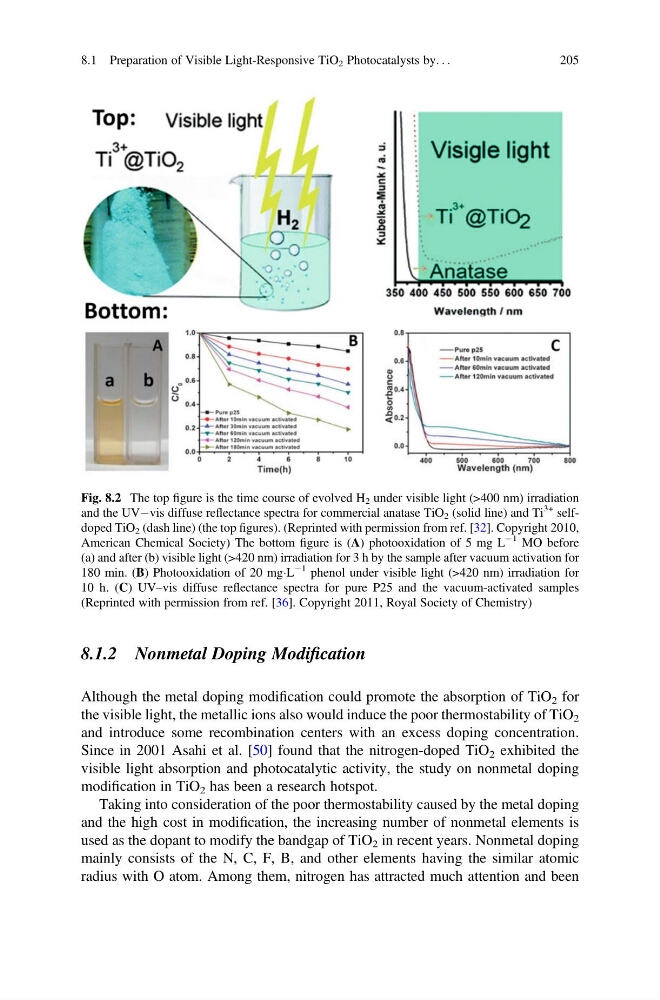
Fig. 8.2 The top figure is the time course of evolved H 2 under visible light (>400 nm) irradiation
and the UVÀvis diffuse reflectance spectra for commercial anatase TiO 2 (solid line) and Ti
3+ selfdoped TiO 2 (dash line) (the top figures). (Reprinted with permission from ref. [32]. Copyright 2010,
American Chemical Society) The bottom figure is (A) photooxidation of 5 mg L
À1 MO before
(a) and after (b) visible light (>420 nm) irradiation for 3 h by the sample after vacuum activation for
180 min. (B) Photooxidation of 20 mgÁL
À1 phenol under visible light (>420 nm) irradiation for
10 h. (C) UV–vis diffuse reflectance spectra for pure P25 and the vacuum-activated samples
(Reprinted with permission from ref. [36]. Copyright 2011, Royal Society of Chemistry)
8.1 Preparation of Visible Light-Responsive TiO 2 Photocatalysts by. . .
205
Although the metal doping modification could promote the absorption of TiO 2 for
the visible light, the metallic ions also would induce the poor thermostability of TiO 2
and introduce some recombination centers with an excess doping concentration.
Since in 2001 Asahi et al. [50] found that the nitrogen-doped TiO 2 exhibited the
visible light absorption and photocatalytic activity, the study on nonmetal doping
modification in TiO 2 has been a research hotspot.
Taking into consideration of the poor thermostability caused by the metal doping
and the high cost in modification, the increasing number of nonmetal elements is
used as the dopant to modify the bandgap of TiO 2 in recent years. Nonmetal doping
mainly consists of the N, C, F, B, and other elements having the similar atomic
radius with O atom. Among them, nitrogen has attracted much attention and been
Fig. 8.2 The top figure is the time course of evolved H 2 under visible light (>400 nm) irradiation
and the UVÀvis diffuse reflectance spectra for commercial anatase TiO 2 (solid line) and Ti
3+ selfdoped TiO 2 (dash line) (the top figures). (Reprinted with permission from ref. [32]. Copyright 2010,
American Chemical Society) The bottom figure is (A) photooxidation of 5 mg L
À1 MO before
(a) and after (b) visible light (>420 nm) irradiation for 3 h by the sample after vacuum activation for
180 min. (B) Photooxidation of 20 mgÁL
À1 phenol under visible light (>420 nm) irradiation for
10 h. (C) UV–vis diffuse reflectance spectra for pure P25 and the vacuum-activated samples
(Reprinted with permission from ref. [36]. Copyright 2011, Royal Society of Chemistry)
8.1 Preparation of Visible Light-Responsive TiO 2 Photocatalysts by. . .
205